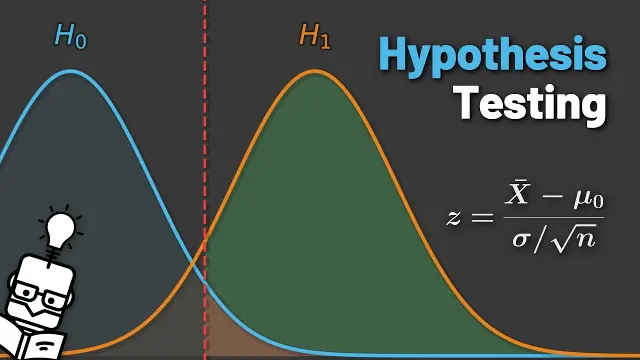
Understanding the Core Logic Behind Hypothesis Testing
This video breaks down hypothesis testing by comparing it to a courtroom trial using the null hypothesis and p-values.
YouTube · DataMListic · 17 April 2026 Watch on YouTube
Tried this idea? Show how yours turned out.
I made this#hypothesistesting #statistics #pvalue
How to do it
Step by step
- Start by assuming nothing is going on — state the null hypothesis, the "innocent until proven guilty" baseline.
- Set the alternative hypothesis, the world where something real is happening.
- Compute a test statistic and treat it as a ruler for surprise.
- Turn that statistic into a p-value, the probability of being fooled by noise.
- Compare the p-value against your threshold and make the decision.
- Check which error you risk — Type I or Type II — given how much the two distributions overlap.
Tips
- Read the p-value as the chance of being fooled, not as the chance the null is true.
- The overlap between the null and alternative distributions is exactly why a decision can go wrong either way.
- Keep the courtroom framing in mind: the evidence either fails to overturn the presumption of innocence or it does — it never proves innocence.
Written by Tagrazzi from the original's description and photo.
The title and summary are written by Tagrazzi; the video belongs to its creator and plays from YouTube.




Comments (0)
No comments yet. Be the first to comment.
Sign in to write a comment.