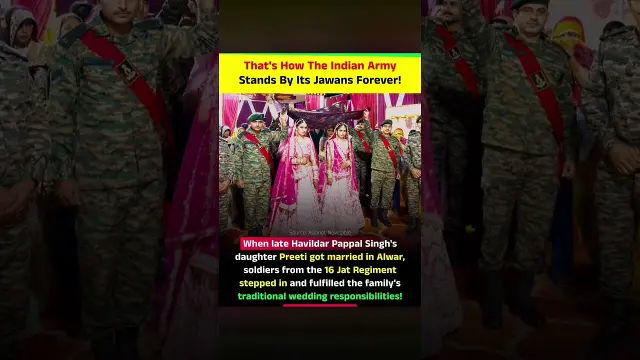
 16 Jat Regiment Soldiers Stand In as Family at Late Comrade's Wedding
#16 Jat Regiment
1 ideas
16 Jat Regiment Soldiers Stand In as Family at Late Comrade's Wedding
Get new #16 Jat Regiment ideas by email
Every Thursday: the week's best ideas, with the newest from #16 Jat Regiment.
Related tags
The 16 Jat Regiment: Identity, Service and Brotherhood
The name reads almost like a code, and in a sense it is. In the Indian Army, infantry is organised into regiments, and each regiment is made up of numbered battalions. "16 Jat" identifies a battalion of the Jat Regiment — a small, self-contained world of soldiers who train, eat, deploy and grow older together.
Where the name comes from
The Jat Regiment takes its name from the Jat community of northern India, whose heartland stretches across Haryana, Rajasthan, western Uttar Pradesh and parts of Punjab. Farming communities there carried long traditions of local self-defence, and under British rule several of these groups were drawn into regional infantry units. When India reorganised its army after independence, those lineages were consolidated into the regiments that serve today. The Jat Regiment is one of them, and each of its battalions carries its own history, honours and nickname.
The battalion as a family
Read more
Ask a soldier what a battalion is and the answer rarely stays organisational. A battalion has its own officers, its own colours, its own way of doing things, and a reputation to keep. Men join young, learn the trade from those ahead of them, and become the ones teaching a few years later. The result is a closeness that civilian life rarely reproduces — a unit that knows who is married, whose mother is ill, whose child starts school this year.
That closeness explains a lot of what you see in photographs of regimental life: soldiers travelling long distances for a comrade's wedding, standing in for a family that could not be there, carrying a coffin, or turning up at a hospital door. It is not ceremony for its own sake. It is how a unit holds itself together.
Peacetime is not idle time
Battalions rotate between field postings, peace stations, training establishments and ceremonial duties. Between those, there is an unglamorous amount of work: maintenance, physical training, sports, welfare funds, liaising with the families of serving and retired soldiers. Much of it never makes a headline, and most of the people doing it would rather it stayed that way.
What a reader should keep in mind
If you are here out of curiosity about a relative's service, or because you came across a photograph and wanted to understand it, a few simple courtesies go a long way. Treat images of soldiers with respect and avoid guessing at identities, locations or units beyond what is publicly stated. Details about deployment, equipment and movement are not small talk, and they are not something to repost. Ask the family before sharing anything that shows a face.
Regiments are old institutions, and this one is older than most of the people who serve in it. What sustains it is not the number in the name but the ordinary habit of showing up for one another — the same habit, at bottom, that a good neighbour or a good family relies on.
Videos come from YouTube and posts from Instagram; titles and summaries are our own. All rights belong to their creators.