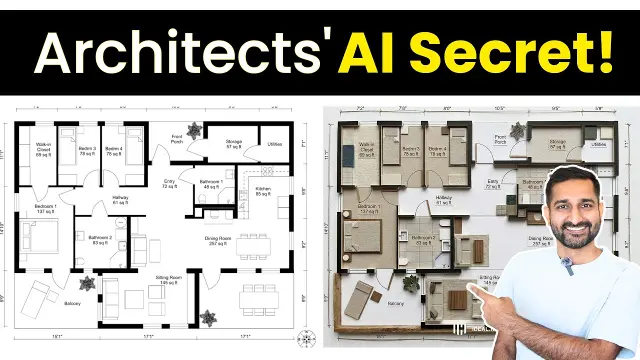
 Ideal House AI Interior Design Tool with 3D Floor Plans
#3D Modeling
1 ideas
Ideal House AI Interior Design Tool with 3D Floor Plans
Get new #3D Modeling ideas by email
Every Thursday: the week's best ideas, with the newest from #3D Modeling.
Related tags
3D Modeling: A Beginner’s Guide
3D modeling is the process of creating a digital object with height, width, and depth. Instead of drawing only a flat image, you build a form that can be rotated, viewed from any angle, and used in many different kinds of visual work. It is a core part of animation, product design, games, architecture, interior visualization, and special effects.
At its simplest, 3D modeling is about shaping geometry. You start with basic forms and gradually refine them into something more detailed and realistic, or more stylized and artistic. Some models are meant to look true to life, while others are simplified, exaggerated, or geometric depending on the purpose.
There are several common ways to create 3D models. Polygon modeling is one of the most widely used methods, where a shape is built from flat surfaces connected together. Sculpting is more like working with digital clay, making it useful for organic forms such as faces, animals, or fantasy creatures. NURBS or curve-based modeling is often used for smooth, precise shapes like vehicles or industrial objects. Many projects combine more than one approach.
3D modeling is used in many fields. In design and architecture, it helps visualize spaces before they are built. In entertainment, it brings characters, props, and environments to life. In product work, it can help test form, proportion, and presentation. It is also useful for 3D printing, where a digital model becomes a physical object.
Read more
If you are just starting, it helps to think in simple shapes first. Most complex models are built from basic forms, so learning to see structure is more important than rushing into details. Good proportions, clean lines, and a clear purpose matter more than adding lots of small features too soon.
A few habits make the process easier:
- Begin with a reference image or a clear idea of the object you want to make.
- Work from large shapes to small details.
- Keep your model organized so it is easier to edit later.
- Check the silhouette often, since the outline often reveals proportion problems.
- Learn to use light and camera views, because a model only feels real when it reads well from different angles.
Shading and materials are also part of the final result. A plain model can look very different once it has surfaces, texture, and lighting. That is why 3D modeling often works together with texturing, rendering, and animation. Even a simple model can look polished when these parts are handled carefully.
For beginners, patience matters. 3D modeling can feel technical at first, but the basic ideas are visual and practical. If you focus on form, scale, and structure, you will build a strong foundation and find it easier to move into more detailed work later.
Videos come from YouTube and posts from Instagram; titles and summaries are our own. All rights belong to their creators.