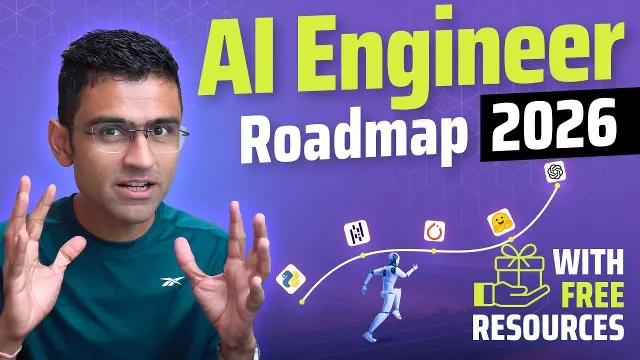
 AI Engineer Roadmap: Learning AI Week by Week With Free Resources
#AI Engineering
4 ideas
AI Engineer Roadmap: Learning AI Week by Week With Free Resources
 A Short Overview of the AI Engineering Learning Path
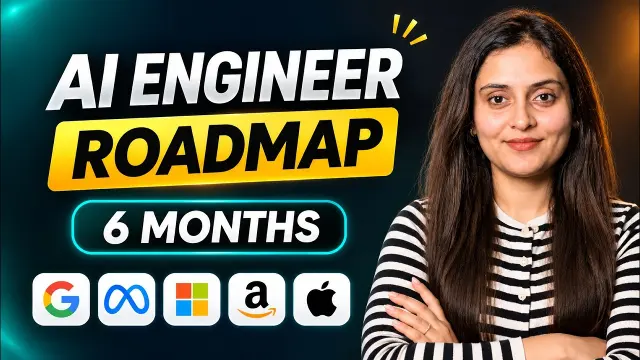 A Six-Month AI Engineer Learning Roadmap From Python to Agents
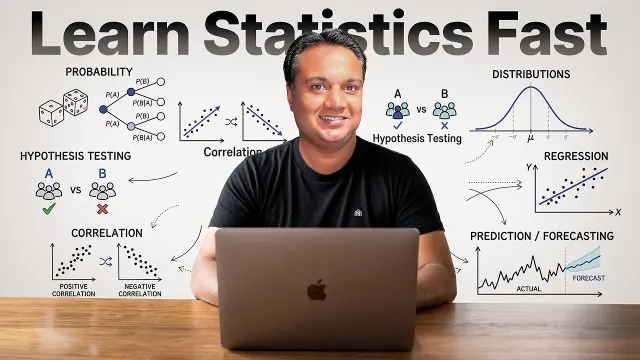 Statistics for AI Engineering: A Four-Hour Course Walkthrough
Get new #AI Engineering ideas by email
Every Thursday: the week's best ideas, with the newest from #AI Engineering.
Related tags
AI Engineering: A Practical Guide for Beginners
AI engineering is the craft of turning machine learning models into working products. Where a researcher asks whether a model can do something, and a data scientist asks what the data says, an AI engineer asks how to make a model behave reliably inside a real application, for real users, under real constraints of cost, latency and failure.
Where it comes from
The role grew out of applied machine learning and the older discipline of getting models into production, often called MLOps. As capable pre-trained models became available through APIs and open weights, the balance of the work shifted. Fewer teams train a model from scratch; more teams build systems around models they did not train themselves. That shift is what the title now mostly describes: engineering with models rather than only engineering models.
The main kinds of work
Read more
Application engineering is the most common entry point. You connect a model to prompts, context and tools, then wrap the result in ordinary software: an interface, a database, error handling, permissions.
Retrieval and knowledge systems sit alongside it. Rather than expecting a model to remember facts, you store documents, search them, and pass the relevant passages into the request. Getting the retrieval right usually matters more than tweaking the wording of the prompt.
Evaluation is the discipline that holds the rest together. Without a way to measure whether outputs are correct, grounded and consistent, you cannot tell improvement from luck.
Deployment and monitoring close the loop: serving requests at acceptable speed, watching cost, and noticing when quality drifts because inputs have changed.
What beginners should learn first
Start with programming rather than models. Solid Python, version control, an understanding of APIs and a little comfort with the command line will carry you further than any single framework. Learn to read a stack trace without panic.
Then build fluency with data: loading it, cleaning it, splitting it honestly, and understanding why a good score on your own test set can still disappoint in use.
Only after that should you go deep on modelling. Learn what a model is optimising, what the common failure modes are, and how prompting, fine-tuning and retrieval differ in cost and effect. Statistics helps throughout: sampling, distributions and uncertainty will save you from confident nonsense.
Practical habits
Work in small complete projects rather than collecting tutorials. A modest tool that does one useful thing end to end teaches more than a fragment of something ambitious.
Write down what "good" means before you build. A handful of example inputs with correct outputs, assembled by hand, becomes your compass.
Treat prompts as code: keep them in files, version them, and change one thing at a time.
Assume failure. Models produce confident errors, so design your system to check, cite, refuse or ask, rather than to trust.
Keep the human in view. Ask what the person using the tool needs to decide, and build for that decision, not for the demonstration.
Finally, be honest about limits. Learn to say what your system cannot do; that habit is what separates engineering from enthusiasm.
#AI Engineering: frequently asked questions
How do I start learning AI engineering from scratch?
Begin with programming basics, especially Python, plus version control, APIs, and comfort with the command line. Once that feels natural, practice with small projects that turn a model into a working tool, rather than jumping straight into advanced model training.
What skills do I need to become an AI engineer?
You need a mix of software engineering and data skills: writing reliable code, handling data carefully, and understanding how applications use models. It also helps to know how prompts, retrieval, evaluation, and deployment fit together so you can build systems that work in practice.
Should I focus on building prompts, retrieval, or fine-tuning first?
For many real products, retrieval and application wiring matter more than prompt wording or fine-tuning. Start by learning how to connect a model to the right context and tools, then compare approaches based on cost, reliability, and how much control you need.
How do I make an AI system more reliable in real use?
Design for failure instead of assuming the model will always be right. Add checks, clear error handling, and a way to measure output quality so you can catch problems like inconsistent answers, weak grounding, or changing input patterns.
What are common mistakes beginners make in AI engineering?
A common mistake is chasing demos instead of building something complete and useful end to end. Other mistakes include trusting model outputs too much, ignoring evaluation, and changing too many things at once without tracking what actually improved the system.
Videos come from YouTube and posts from Instagram; titles and summaries are our own. All rights belong to their creators.