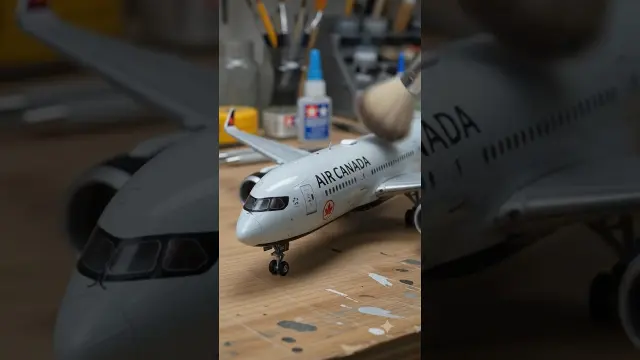
 Satisfying Assembly and Detailing of an Air Canada Model Airplane
#Airliner
1 ideas
Satisfying Assembly and Detailing of an Air Canada Model Airplane
Get new #Airliner ideas by email
Every Thursday: the week's best ideas, with the newest from #Airliner.
Related tags
Airliners: A Guide to Passenger Aircraft
Airliners are aircraft designed to carry passengers from one place to another safely, efficiently, and comfortably. They are the familiar passenger planes used for short domestic flights as well as long journeys across continents. Unlike private or military aircraft, airliners are built around the needs of scheduled travel: repeated takeoffs and landings, quick boarding, reliable operation, and enough cabin space for many travelers.
What makes an airliner
An airliner is usually designed with a pressurized cabin, a fuselage large enough for seats and aisles, and wings shaped for stable flight at cruising altitude. Most are powered by jet engines, though some smaller aircraft use propellers. The main purpose is to move groups of people economically while keeping the flight smooth and practical for both passengers and crew.
Airliners vary widely in size. Smaller regional aircraft may serve shorter routes and smaller airports, while larger wide-body jets are used for long-distance travel and high passenger numbers. Some are meant for efficiency on busy routes, while others are built for longer range and greater comfort on extended journeys.
Read more
Main types and styles
You will often hear airliners grouped by size and cabin layout:
- Regional airliners: smaller aircraft used for shorter routes and fewer passengers.
- Narrow-body airliners: planes with one aisle, common on domestic and short-to-medium routes.
- Wide-body airliners: larger aircraft with two aisles, often used for long-haul flights.
They can also be described by their wing and engine layout, but for most people the size of the cabin and the length of the route are the easiest ways to understand them.
How they are used
Airliners are part of the everyday infrastructure of travel. They connect cities, countries, and continents, and they are designed to make frequent travel possible. Inside, the cabin is arranged to balance seating capacity, safety, and passenger movement. The cockpit, flight controls, and systems are built for careful management by trained crews, while the cabin crew looks after passenger safety and service.
What to know if you are interested in airliners
If you are new to the topic, start by noticing a few basic features:
- The number of aisles tells you a lot about the aircraft’s size.
- The engine position and wing shape affect how the plane looks and functions.
- Cabin layout influences comfort, boarding, and space.
- Range and capacity help determine what kind of routes the aircraft can serve.
Airliners are often admired not only for their engineering but also for the way they combine form and function. Their design has to support aerodynamics, safety, maintenance, and passenger comfort all at once.
A few practical observations
When you watch or study airliners, it helps to pay attention to how they are used rather than only how they look. A small aircraft may be ideal for shorter hops between nearby cities, while a larger one may be chosen for busy international routes. In model form, airliners are also popular because their shapes are distinctive and their liveries are easy to recognize.
If you want to understand airliners well, think of them as purpose-built machines: made to carry people efficiently, adapted to many route lengths, and refined around the practical demands of modern air travel.
#Airliner: frequently asked questions
How do I get started if I know nothing about airliners?
Start by learning to read the outside of a plane rather than memorising model names. The number of aisles in the cabin, where the engines sit, and the shape of the wings tell you most of what you need to sort aircraft into broad groups. From there, pay attention to what each plane is used for, since purpose explains design far better than appearance alone.
What is the real difference between a narrow-body and a wide-body airliner?
A narrow-body plane has a single aisle running through the cabin, while a wide-body has a pair of aisles that let more passengers move around at once. That single structural difference is why narrow-bodies handle shorter, busier routes and wide-bodies are picked for long journeys with many travellers. Once you know which one you are looking at, the rest of the aircraft's design choices start to make sense.
Which kind of airliner is right for a given route?
Match the aircraft to the distance and the number of people travelling rather than to how impressive it looks. Smaller regional planes suit short hops between nearby cities and quieter airports, while larger long-range aircraft make sense on busy intercontinental services. Efficiency on the route matters more than size, which is why operators mix types across their networks.
What should a beginner look for when choosing a model airliner to build?
Pick a livery and aircraft shape you actually like looking at, since that keeps you motivated through the fiddly stages. Check the kit's scale and part count against your experience, and look at whether the decals are the kind you can apply patiently without rushing. A simpler kit finished cleanly usually looks better than an ambitious one left half done.
How should a finished model airliner be cared for?
Keep it out of direct sunlight and away from heat, because fading and warping are the usual culprits behind a model that ages badly. Dust it gently with a soft brush instead of a damp cloth, which can lift decals or dull the finish. A stand or a closed display case protects the landing gear and the small protruding parts.
What do people commonly get wrong when they first study airliners?
The most frequent mistake is judging an aircraft by how striking it looks instead of asking what it was built to do. Another is assuming bigger always means better, when range, capacity and route length are what actually decide which plane gets used. Treating an airliner as a purpose-built machine rather than a shape to admire clears up most of the confusion.
Videos come from YouTube and posts from Instagram; titles and summaries are our own. All rights belong to their creators.