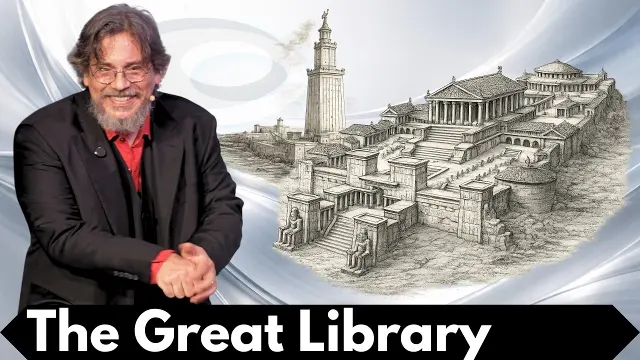
 The Great Library of Alexandria: A History Lecture by Roy Casagranda
#Alexandria
1 ideas
The Great Library of Alexandria: A History Lecture by Roy Casagranda
Get new #Alexandria ideas by email
Every Thursday: the week's best ideas, with the newest from #Alexandria.
Related tags
Alexandria: City of the Great Library
Alexandria is a Mediterranean port city on Egypt's northern coast, founded in antiquity by Alexander the Great and shaped ever since by the sea. It was the capital of the Ptolemaic kingdom and later a major centre of the Roman world. For centuries it stood at the meeting point of Greek, Egyptian, Jewish, Roman and later Coptic and Islamic cultures, and that layering is what makes the city so distinctive. Its climate is mild and its winters soft, so much of life happens outdoors, along the waterfront and in the cafés.
The ancient reputation
The city is best known for two things that have entirely disappeared: the Great Library and the Pharos lighthouse. The library was part of a larger scholarly institution, the Mouseion, where poets, geographers, astronomers and mathematicians were supported by royal patrons. Its ambition was to gather copies of everything written in the known world, and its scholars are remembered for measuring the size of the earth and for organising the texts of Homer. The lighthouse, a tower on the island of Pharos, was counted among the wonders of the ancient world and guided ships for centuries before earthquakes brought it down. Neither survived, but they defined how the city has imagined itself ever since: as a place of learning and of arrivals.
Below the surface
Much of ancient Alexandria is now underwater. Diving sites off the harbour reveal columns, statues and blocks from sunken buildings. On land, the Kom el-Dikka district preserves a Roman theatre and bath complex, the catacombs of Kom el-Shoqafa show how Egyptian funerary art absorbed Greek style, and Pompey's Pillar stands as the most visible relic of the classical city. The fort at Qaitbay sits close to where the lighthouse once stood, and is said to include some of its stone.
Reading the modern city
Modern Alexandria is a long promenade of fishing boats and cafés, with tramlines, crumbling colonial-era buildings and a seafront that curves for miles. The city has a strong literary identity: the poet C. P. Cavafy, who wrote in Greek while living there, is its most celebrated writer, and the city's cosmopolitan character has drawn novelists and travellers for generations. The Bibliotheca Alexandrina, a modern library built as a tribute to the ancient one, stands right on the corniche at the edge of the eastern harbour, its tilted glass roof facing out over the water.
Read more
Practical notes for a first visit
- The corniche is the spine of the city: walk it in the evening, when the whole population seems to be out.
- Seafood is the local speciality; choose a place with the day's catch on display.
- An Arabic-speaking visitor's world opens up with a few basic words. Egyptian Arabic is the everyday language, and English is common in tourist areas.
- Dress modestly away from the beach, especially in residential neighbourhoods and places of worship.
- Plan around the midday hours in summer, and carry water; sightseeing is better early or late.
- Ask permission before photographing people, and accept that some conversations will turn into tea.
Alexandria rewards a slow visit. It is not a city of preserved monuments so much as one of memory and atmosphere, where the past sits just under the surface of the everyday.
#Alexandria: frequently asked questions
What should a first-time visitor actually see in Alexandria?
Start with the waterfront: the long corniche is where the city shows itself, and an evening walk along it tells you more than any single sight. Inland you can find a small open-air Roman theatre with a bath complex, rock-cut catacombs where Egyptian funerary art takes on Greek forms, a lone surviving column from the classical city, and a harbour fort built near the spot where the famous lighthouse once stood. The sunken ruins in the bay are only for divers, so don't plan on seeing them from land.
Is the city still worth visiting if its famous ancient wonders are gone?
Yes, but go expecting atmosphere rather than monuments. Both of the city's ancient celebrities vanished long ago, and what remains is a layering of cultures you read in the streets, the crumbling old buildings and the cafés rather than in a preserved ruin. The modern library on the corniche, with its tilted glass roof facing the water, captures that same instinct to look back while building something new.
When is the best time to visit, and how should I plan my days?
The climate is mild and winters are soft, so outdoor life continues through most of the year. In summer, sightseeing is far more pleasant early in the morning or late in the afternoon, with the hottest middle hours left for shade, a long lunch or a siesta. Carry water and let the waterfront set your rhythm rather than a checklist.
What and where should I eat?
Seafood is the local speciality, and the safest way to choose is to pick a place with the day's catch laid out on display. Eating near the harbour or along the corniche keeps things simple and fresh. Expect conversation to be part of the meal — some encounters will turn into tea whether you planned for it or not.
What mistakes do first-timers make?
The most common one is treating the city as a tick-list of sights and rushing through it, when it rewards a slow visit. Dress modestly away from the beach, particularly in residential areas and places of worship, and always ask before photographing people. Assuming English will carry you everywhere is another easy slip: Egyptian Arabic is the everyday language, and even a few basic words change how people receive you.
Videos come from YouTube and posts from Instagram; titles and summaries are our own. All rights belong to their creators.