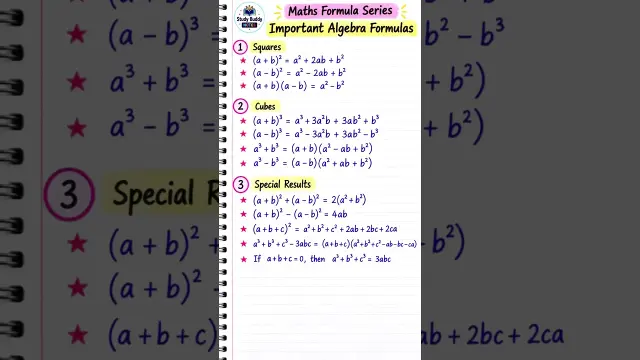
 Quick revision of algebra formulas and identities
#Algebraic Expressions
1 ideas
Quick revision of algebra formulas and identities
Get new #Algebraic Expressions ideas by email
Every Thursday: the week's best ideas, with the newest from #Algebraic Expressions.
Related tags
Algebraic Expressions: A Beginner's Guide
An algebraic expression is a short piece of mathematical language: a combination of numbers, letters and operation signs that names a quantity without claiming it equals anything. The expression 3x + 5 describes "three times some number, plus five." It is not a statement to be solved; it is a value that changes depending on what the letter stands for. Understanding that difference is the first step, because equations ask for an answer while expressions ask to be tidied up.
The parts of an expression
Every expression is built from a few recognisable pieces. A variable is a letter standing in for a number you do not yet know or that is allowed to vary. A coefficient is the number multiplied by that variable, so in 7y the coefficient is 7. A constant is a plain number with no letter attached. Terms are the chunks separated by plus and minus signs, and factors are the pieces multiplied together inside a single term.
- In 4a² − 2a + 9, the terms are 4a², −2a and 9
- The coefficient of a² is 4, and 9 is the constant
- The factor a appears in both lettered terms
Read more
Where it comes from
Expressions grew out of practical arithmetic — measuring land, sharing goods, tracking debts — and out of an older tradition of solving puzzles about unknown quantities that developed across the ancient Mediterranean and the medieval Islamic world. Over centuries, mathematicians replaced long written-out sentences with the compact symbols used today, which made it possible to manipulate whole relationships at once instead of one case at a time. School algebra inherits that shorthand.
Main kinds
Expressions are usually named by how many terms they contain: a monomial has one term, a binomial two, a trinomial three, and a polynomial any number. A rational expression is a fraction with expressions in the numerator, denominator or both. They are also described by degree, which is the highest power of a variable present.
What beginners should know
Most early difficulty comes from small conventions rather than deep ideas.
- Collect only like terms: 3x and 5x combine, 3x and 5x² do not
- Remember that x + x is 2x, not x²
- Watch signs when subtracting a bracket: the minus flips every term inside
- Substitute a test number to check a simplification — a correct result holds for any value
- Expanding uses the distributive property; factoring is the same move in reverse
Practice slowly, write each step on its own line, and check your work by substituting a simple number such as 2. Fluency comes from repetition, not from memorising tricks.
#Algebraic Expressions: frequently asked questions
How do I start learning algebraic expressions without getting confused?
Begin by learning to read an expression as a description rather than a problem to solve — a shorthand way of naming a quantity whose value depends on the letter. Once that clicks, focus on naming the parts you can see: which chunk is a term, which number is the coefficient, and which piece is the plain constant. Work slowly, one line per step, and check each simplification by putting a simple test value in place of the letter.
What do I need to know before working with expressions?
You need comfortable arithmetic with signed numbers, because most early mistakes are sign slips rather than algebra itself. You should also understand that a letter simply stands in for a number, so the ordinary rules of multiplication and addition still apply to it. Knowing the order of operations and how brackets group things will carry you a long way.
What is the difference between an expression and an equation?
An expression is a piece of mathematical language that names a quantity and does not assert that anything equals anything else. An equation makes a claim of equality, which is why it can be solved for a specific value. With an expression, your job is to tidy and rewrite it, not to find a single answer.
What kinds of algebraic expressions are there, and how do I tell them apart?
The simplest way to classify them is by how many terms they contain — one term, two, three, or many — which gives you names like monomial, binomial, trinomial and polynomial. They are also described by degree, meaning the highest power of a variable that appears in them. A separate family is the rational expression, which is a fraction with expressions above, below, or on both sides of the line.
What mistakes do beginners make most often when simplifying expressions?
The usual culprits are combining terms that are not actually alike, and treating repeated addition of a letter as if it were multiplication of that letter by itself. Another frequent slip is dropping the sign of every term inside a bracket when a minus sign sits in front of it. A quick substitute-and-check at the end catches nearly all of these.
Is there a reliable way to check my answer when I simplify?
Yes — pick an easy number, put it in place of the letter in both the original expression and your simplified version, and confirm the two give the same value. A correct simplification holds for every value, so one working test is strong evidence you have not gone wrong. If the values differ, the mistake is somewhere in the steps above, which is why writing each step on its own line pays off.
Videos come from YouTube and posts from Instagram; titles and summaries are our own. All rights belong to their creators.