 Understanding the Three Core Laws of Basic Arithmetic Operations
#Arithmetic Laws
1 ideas
Understanding the Three Core Laws of Basic Arithmetic Operations
Get new #Arithmetic Laws ideas by email
Every Thursday: the week's best ideas, with the newest from #Arithmetic Laws.
Related tags
Arithmetic Laws Explained
What arithmetic laws are
Arithmetic laws are the basic rules that describe how numbers behave when you add, subtract, multiply, and divide. They help you understand why certain calculations work the way they do, and they make mental math, checking answers, and simplifying expressions much easier.
These laws appear in everyday counting and in more advanced mathematics. If you learn them well, you can move numbers around safely in many calculations without changing the result.
The main laws of arithmetic
Read more
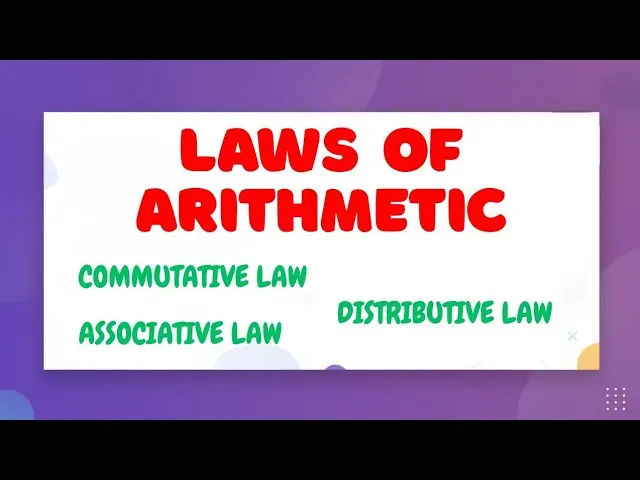
The most common arithmetic laws are the commutative, associative, distributive, identity, and inverse laws.
- The commutative law says that changing the order of numbers does not change the answer in addition and multiplication.
- 3 + 5 = 5 + 3
- 2 × 4 = 4 × 2
- The associative law says that when you are adding or multiplying, you can change the grouping of the numbers without changing the result.
- (2 + 3) + 4 = 2 + (3 + 4)
- (2 × 3) × 4 = 2 × (3 × 4)
- The distributive law connects multiplication with addition or subtraction. It tells you that multiplying a number outside the brackets by each number inside gives the same result as multiplying first and then adding or subtracting.
- 3 × (4 + 2) = (3 × 4) + (3 × 2)
- The identity law describes numbers that leave a value unchanged.
- Adding 0 keeps a number the same: 7 + 0 = 7
- Multiplying by 1 keeps a number the same: 7 × 1 = 7
- The inverse law describes pairs of operations that undo each other.
- A number plus its opposite makes 0: 6 + (−6) = 0
- A number times its reciprocal makes 1, when the number is not zero: 4 × 1/4 = 1
What to know as a beginner
It helps to remember that these laws do not all work in the same way for every operation. For example, addition and multiplication are commutative, but subtraction and division are not.
- 8 − 3 is not the same as 3 − 8
- 12 ÷ 3 is not the same as 3 ÷ 12
This is why understanding the rule matters more than memorizing a formula. The laws explain which changes are safe and which ones change the meaning of the calculation.
Practical tips
Use arithmetic laws to simplify problems step by step. If a sum looks awkward, you can often reorder or regroup numbers to make it easier. If a multiplication problem has brackets, the distributive law can help you break it into smaller parts.
When you solve a problem, check which law applies before rearranging anything. That habit helps you avoid mistakes and build confidence with numbers.
Videos come from YouTube and posts from Instagram; titles and summaries are our own. All rights belong to their creators.