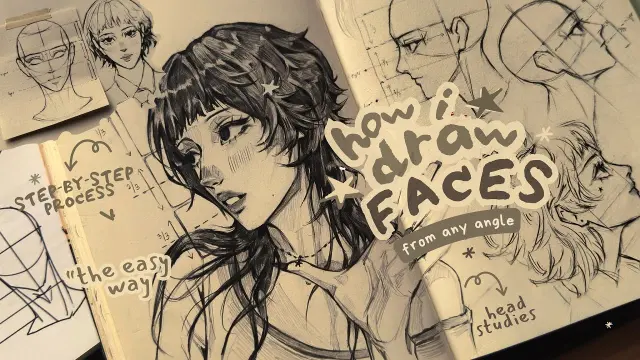
 Drawing faces and heads from any angle study
#Art Study
1 ideas
Drawing faces and heads from any angle study
Get new #Art Study ideas by email
Every Thursday: the week's best ideas, with the newest from #Art Study.
Related tags
Art Study: Learning to Draw with Purpose
An art study is a small, deliberate piece of practice: one drawing, painting or sketch made not to be a finished work, but to solve a specific problem. Where a finished piece asks you to hold many skills together, a study isolates one of them — the shape of a shoulder, the way light falls across cloth, the rhythm of a composition — so you can look at it closely without everything else competing for attention. It is the difference between performing and rehearsing.
The habit is old. In the workshop and academy traditions of Europe, students spent years drawing from plaster casts, copying the work of established artists, and sketching from the live model before they were allowed near a finished commission. Those methods survived because they work: copying forces you to see what someone else saw, and long looking, rather than quick invention, is what builds the eye. Today the same practice lives in sketchbooks, evening classes and quiet hours at a kitchen table.
Kinds of study
- Master copies: reproduce part or all of an artwork you admire, then ask what decisions the artist made to get there.
- Life and figure studies: short poses for gesture, longer ones for structure and proportion.
- Constructive studies: build the subject from simple volumes before adding detail, so the drawing stands up from any angle.
- Value and colour studies: small patches of light and dark, or narrow groups of colours, made to test a key before you commit to it.
- Composition studies: fast thumbnail sketches that try out arrangements without rendering anything.
- Observational studies out in the world: a tree, a street corner, a chair, drawn slowly.
Read more
Making a study useful
Choose one question before you start and write it down. "Where is the widest part of the skull?" is a workable study. "Get better at faces" is not — it gives you nothing to check afterwards. Keep the format modest, since a small page invites experiment and a large one invites performance.
Work from the general to the specific. Block in the big shapes, check them against each other, and only then spend time on the detail you came for; most disappointing studies fail at the proportions rather than at the rendering.
Separate practice from output. Studies are allowed to be ugly, unfinished and thrown away. Set a time limit when you tend to overwork, and stop while you can still see what you were doing.
Look back. Keep your studies in one place — a sketchbook, a folder, a stack of loose sheets — and revisit them after a few weeks. Problems that felt invisible while you were drawing often become obvious later, and progress that felt invisible becomes obvious too.
Beginners usually need less ambition and more repetition: the same subject, drawn ten times over a month, teaches more than ten subjects drawn once. Ask for feedback where you can find it, take breaks before deciding something is wrong, and remember that a study is not a test — it is a question you are putting to your own eye.
#Art Study: frequently asked questions
How do I start an art study if I've never done one before?
Pick a single subject you already like looking at and one thing about it you want to understand better, then write that question down before you begin. Keep the page small and the session short so there is no pressure to produce something finished. Repeating the same subject several times over a few weeks will teach you far more than jumping between different ones.
What supplies do I actually need for studying art?
Anything that makes a mark will do — a pencil and ordinary paper are enough to begin, and most studies are deliberately modest in scale. What matters more is having one place to keep them, whether that is a sketchbook, a folder or a pile of loose sheets. Fancy materials rarely improve a study; a clear question and the willingness to look slowly do.
Which type of study should I choose?
Match the kind to the problem you are stuck on rather than picking whatever looks most impressive. If proportion keeps failing you, constructive studies that build the subject from simple volumes will help; if your pictures feel flat, small value or colour tests are the better use of your time. Copying a work you admire is a good general starting point because it forces you to notice decisions someone else made.
Is it worth copying other artists' work, and how should I go about it?
Copying is one of the oldest training habits there is, and it works because it makes you see what another person saw instead of inventing quickly. Reproduce a section rather than the whole thing, then ask yourself why the artist placed a shape or a light where they did. The copy is a means of asking questions, not a piece to show anyone.
How do I stop my studies from turning into failed finished pieces?
Lower the stakes on purpose: use a small format, set a time limit if you tend to overwork, and stop while you can still see what you were doing. Studies are allowed to be ugly, unfinished or thrown away, so treat an awkward result as information rather than a verdict. Working from big shapes toward detail also keeps proportion problems from being buried under rendering.
What are the most common mistakes beginners make with art study?
The usual ones are starting with too much ambition, choosing a vague goal like getting better at faces, and never looking at the work again afterwards. A study needs a question specific enough to check when you are done, and it needs revisiting weeks later so that hidden problems and quiet progress both become visible. Asking for feedback and taking a break before deciding something is wrong will save you a lot of unnecessary frustration.
Videos come from YouTube and posts from Instagram; titles and summaries are our own. All rights belong to their creators.