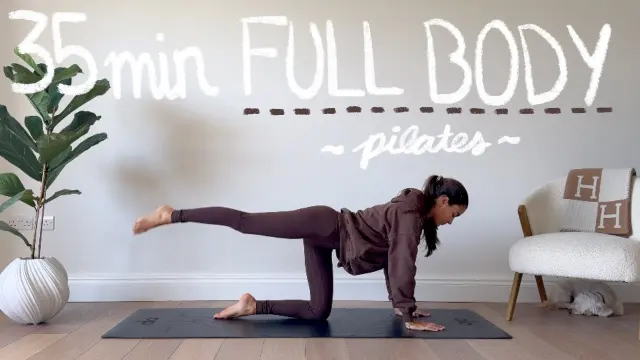
 35-Minute Full Body Mat Pilates Class to Tone and Energise
#At Home Workout
2 ideas
35-Minute Full Body Mat Pilates Class to Tone and Energise
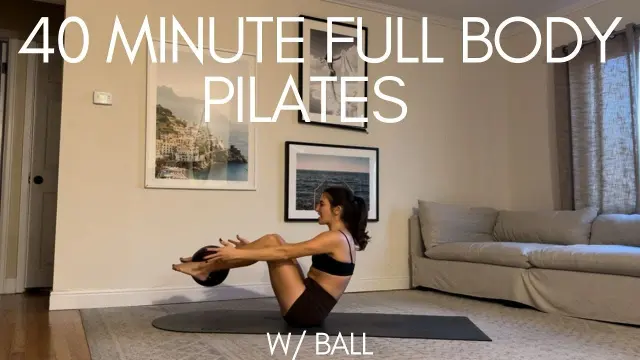 40-Minute Mat Pilates Sculpt Class Using a Small Ball
Get new #At Home Workout ideas by email
Every Thursday: the week's best ideas, with the newest from #At Home Workout.
Related tags
At-Home Workout: A Beginner's Guide to Training at Home
Training at home means exactly what it sounds like: moving your body in the space you already live in, with whatever time and equipment you happen to have. It is not a lesser version of the gym. It is a different setting with its own logic, and for many people it is the setting where exercise finally becomes a habit, because nothing has to be packed, commuted to or paid for before it can begin.
Home workouts have a long history in their own quiet way. Gymnastics, calisthenics and dance have always been practised in living rooms and courtyards, and the fitness video simply brought a teacher into that room. What changed over time is not the principle but the variety: what used to be a handful of recorded routines is now an enormous library of guided classes in every style and length.
The main kinds
Bodyweight training is the foundation. Squats, push-ups, lunges, planks and their many variations need no equipment at all and can be adjusted endlessly by changing the angle, the tempo or the number of repetitions. Mat-based practices such as Pilates, yoga and mobility work use a mat and your own attention to posture, control and breathing. Cardio sessions raise your heart rate through dance, marching, step or low-impact circuits. Resistance training with bands, dumbbells or household weights adds load for strength. Many classes mix several of these, which is often the easiest way to keep a routine interesting.
Read more
Equipment, honestly speaking
You need very little. A mat, comfortable clothing and a little floor space are enough to start, and an empty water bottle or a bag of rice can stand in for a weight if you want one. Resistance bands are inexpensive and versatile, and a chair or a wall is a perfectly good piece of apparatus. Buy more only once you know what you actually use.
Getting started
Pick a fixed time and a spot you can keep clear, and treat it as an appointment. Begin with sessions short enough that you will genuinely repeat them: fifteen or twenty minutes, two or three times a week. Learn the basic shapes first — how to squat, hinge, push, pull and hold a plank with a straight back — before adding speed or repetitions.
Warm up with a few minutes of easy movement, and finish with slower stretches. Muscle soreness a day or two after training is normal; sharp pain during a movement is not, and the right response is to stop. Work at a level where you can still speak in short sentences, and increase the difficulty gradually rather than in jumps. If you have an injury, are pregnant or have a health condition, ask a doctor or a qualified instructor what suits you before you begin.
Home training rewards consistency far more than intensity. A modest routine you return to every week will do more for you than an ambitious one you abandon.
#At Home Workout: frequently asked questions
How do I start working out at home when I've never exercised before?
Choose a fixed time and a clear bit of floor, and treat the session like an appointment you keep with yourself. Begin with very short sessions you are confident you will repeat, and learn the basic shapes first — squat, hinge, push, pull and a plank with a straight back — before worrying about speed or repetitions. Consistency matters far more than ambition, so pick something modest you will actually return to.
What equipment do I really need for a home workout?
Almost none: a mat, comfortable clothing and enough space to lie down with your arms out is a genuine starting point. A chair, a wall, a filled water bottle or a bag of rice can stand in for weights, and resistance bands are a versatile addition if you want one. It is wiser to add equipment once you notice what you keep reaching for than to buy a set in advance.
Which kind of home workout should I choose?
It depends on what you want from the session — bodyweight training builds general strength with no kit, mat-based practices like Pilates, yoga and mobility work suit posture, control and breathing, cardio circuits raise your heart rate, and resistance training adds load. Classes that mix several styles are often the easiest way to keep a routine interesting over the long run. Pick the one you find least difficult to show up for.
What are the most common mistakes people make training at home?
The usual ones are starting too hard, skipping the warm-up, and letting sessions run long enough that they become a chore to schedule. Another is treating sharp pain during a movement as something to push through — soreness afterwards is normal, pain at the time is a signal to stop. If you have an injury, are pregnant or have a health condition, ask a doctor or qualified instructor what suits you before starting.
How do I stay motivated when no one is watching?
Keep the routine small enough that it never feels like a negotiation, and anchor it to a time and place you can protect. Varying the format — a sculpting class one day, something more energetic the next — helps, as does noticing that you can speak in short sentences mid-session, which is a good sign you are working at a level you can sustain. Progress comes from the routine you return to, not the one you admire.
Can a home workout really replace going to a gym?
It is not a lesser version of the gym but a different setting with its own logic, and for many people it is where exercise finally becomes a habit because nothing has to be packed, travelled to or paid for. What you lose in equipment you gain in the ease of actually doing it regularly. Bodyweight and mat work can carry a routine a long way on their own.
Videos come from YouTube and posts from Instagram; titles and summaries are our own. All rights belong to their creators.