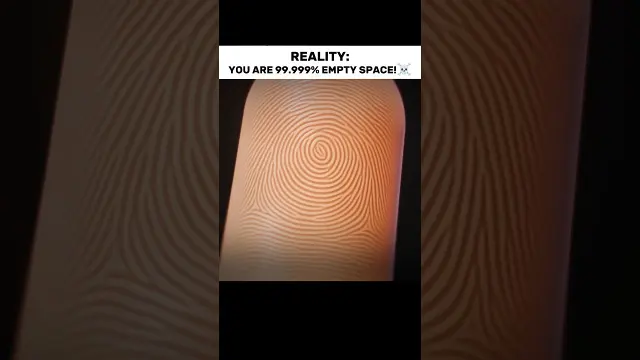
 Why the Human Body Is Almost Entirely Empty Space
#Atoms
1 ideas
Why the Human Body Is Almost Entirely Empty Space
Get new #Atoms ideas by email
Every Thursday: the week's best ideas, with the newest from #Atoms.
Related tags
Atoms: The Building Blocks of Everything
Everything you can touch, see, breathe or drink is made of the same small set of ingredients, combined in endless ways. An atom is the smallest unit of an element that still behaves like that element — the point at which slicing a substance further stops giving you that substance and gives you something else instead.
What an atom is built from
An atom has a dense centre, the nucleus, made of protons and neutrons packed together, and around it a cloud of electrons. Protons carry a positive charge, electrons a negative one, and neutrons no charge at all. An atom is electrically neutral when its protons and electrons balance out.
The nucleus holds nearly all of an atom's mass in a tiny fraction of its volume. The electrons are where the interesting chemistry happens: their arrangement decides whether an atom will bond, glow, conduct electricity or stay aloof. That arrangement is often pictured as shells or orbitals, though electrons are better imagined as a haze of probability than as planets going round.
Read more
Elements, isotopes and ions
The number of protons in the nucleus defines the element — it is the atom's identity card. Change the protons and you have a different element altogether. Neutrons can vary without changing the element, and atoms that differ only in neutron count are called isotopes; some are stable, others slowly break apart, which is what radioactivity means.
Remove or add electrons and the atom becomes an ion, carrying a net charge. Ions dissolve in water, and their coming and going is behind a great deal of everyday chemistry, from how salts form to how nerve signals travel.
How atoms join together
Atoms bond to reach a more comfortable arrangement of electrons. One atom may hand electrons to another, so the resulting ions attract each other; two may share electrons in a covalent bond; or many may pool their outer electrons and conduct freely, as in metals.
The result can be as simple as two atoms of the same element paired together, or as complicated as the folded molecules of a living cell. When bonds break and reform, energy is taken in or given out — the whole of chemistry, and much of biology, is bookkeeping about that.
Mostly empty space
Atoms are often drawn as solid balls, which is misleading. The nucleus is minuscule compared with the space the electrons occupy, so most of the volume of any object is empty in the sense that there is nothing dense there. What makes a table feel solid is not packed matter but the electric repulsion between electron clouds when you press your hand against it.
Where to begin
If you are new to the subject, start with the periodic table and learn to read one box: symbol, proton count, mass. Then learn the difference between an element, a compound and a mixture, and how to write a simple chemical formula. Models and diagrams are useful shortcuts, but treat them as sketches rather than photographs — every model leaves something out.
#Atoms: frequently asked questions
What exactly is an atom, in plain terms?
An atom is the smallest unit of an element that still behaves like that element — the point where cutting a substance further no longer gives you that substance. Each one is a dense nucleus surrounded by a cloud of electrons, and the arrangement of those electrons is what drives how it behaves.
How should a complete beginner start learning about atoms?
Start with the periodic table and learn to read a single box properly: the symbol, the proton count and the mass. From there, work out the difference between an element, a compound and a mixture, and practise writing a simple chemical formula before moving on to bonding.
What's the difference between an isotope and an ion?
Isotopes are atoms of the same element that differ only in how many neutrons they carry, which is why some are stable and some slowly break apart as radioactive. An ion is what you get after electrons are added or removed, giving the atom a net charge; ions dissolve in water and are behind everyday chemistry such as salt formation and nerve signals.
Why does a table feel solid if atoms are mostly empty space?
Because solidity comes from electric repulsion rather than from densely packed matter — the nucleus holds nearly all the mass in a tiny fraction of the atom's volume. When you press your hand down, what stops it is the push between electron clouds, not a wall of stuff.
What mistakes do people usually make when learning about atoms?
The most common one is taking diagrams literally — imagining atoms as solid balls with electrons circling like planets, when electrons are better pictured as a haze of probability. Another is mixing up element, compound and mixture, or forgetting that every model is a shortcut that leaves something out.
Videos come from YouTube and posts from Instagram; titles and summaries are our own. All rights belong to their creators.