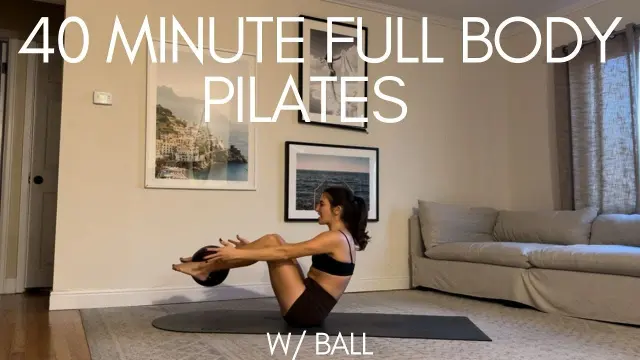
 40-Minute Mat Pilates Sculpt Class Using a Small Ball
#Ball Props
1 ideas
40-Minute Mat Pilates Sculpt Class Using a Small Ball
Get new #Ball Props ideas by email
Every Thursday: the week's best ideas, with the newest from #Ball Props.
Related tags
Ball Props: A Guide to Small Balls in Pilates and Mat Work
A ball is one of the quietest pieces of equipment you can bring to a mat, and one of the most useful. A strap gives you something to hold and a ring gives you something to press, but a ball gives you something to feel. It rolls when you lose your centre, it softens when you grip too hard, and it makes small adjustments in your body suddenly very easy to notice. That feedback is the whole point.
What a ball prop actually does
In mat work, a ball is used in a few different ways: as support under the lower back, head or feet; as a target squeezed between the knees, palms or ankles to bring a muscle group into the exercise; as a moving surface that makes balance slightly less automatic; and as a tool for slow, gentle release work on tight spots. None of these depend on strength or flexibility. They depend on attention, which is why teachers reach for a ball when they want a class to slow down and feel more.
Where it comes from
Read more
Props became a familiar part of modern Pilates practice as teachers looked for ways to help a body find an exercise rather than force it. The small ball in particular arrived in studios from the rehabilitation world, where light, unstable surfaces were used to make movement more exploratory and less mechanical. From there it moved into general mat classes, home practice and gentle training for every level.
The main kinds you will meet
- A small soft ball, roughly the size of a melon, is the classic mat prop: light, easy to squeeze, good for support and for feedback between the knees or hands.
- A mini stability ball is slightly firmer and rounder, so it holds its shape under body weight and can be used under the back, hips or feet.
- A larger stability ball is a seat and a surface rather than a hand prop; you sit or lie on it, and it asks more of your balance.
- Small textured or spiky balls, and peanut-shaped doubles, are used for slow release work along the back, hips and feet rather than for the main exercise.
Starting out
Choose a ball that feels slightly under-inflated rather than rock hard; a little give makes it easier to work with. Begin with one or two exercises you already know and add the ball to them, rather than learning new movements and a new prop at once. Breathe normally, keep the pressure light, and stop if anything pinches or stings.
Practical tips
- Match the ball to the job: soft for squeezing, firm for support, large for sitting.
- Move slowly enough that you could stop at any point.
- Keep the ball clean and store it away from heat, which dulls the surface over time.
- If you have an injury or a condition that affects your movement, ask a qualified instructor or health professional before adding load or instability.
Used well, a ball is less a piece of equipment than a quiet teacher, always telling you exactly where you are.
#Ball Props: frequently asked questions
What does a ball prop actually add to a mat session?
A ball gives you feedback rather than resistance — it rolls when your alignment drifts and yields when you squeeze too hard, so you notice small adjustments almost immediately. That makes it useful for support under the back, head or feet, for squeezing between knees or palms to wake up a muscle group, and for slow release work on tight spots. It asks for attention rather than strength or flexibility, which is why it suits every level.
Which kind of ball should I pick for mat work?
Match it to the job: a soft ball about the size of a melon is the classic hand-and-knee prop, a firmer mini ball holds its shape under body weight for support under the back, hips or feet, and a large stability ball is something you sit or lie on rather than hold. Textured and peanut-shaped balls are best kept for slow release along the back, hips and feet. If you only want one, a soft ball covers the widest range of everyday mat exercises.
How do I start using a ball without overcomplicating my practice?
Pick a slightly under-inflated ball, since a little give is easier to work with than a rock-hard one. Take exercises you already know well and add the ball to them instead of learning new movements and a new prop at the same time. Keep the pressure light, breathe normally, and stop if anything pinches or stings.
How should I look after a ball prop so it lasts?
Wipe it down after use and keep it out of heat and direct sun, which dulls the surface and makes it slick over time. Store it loosely rather than under a pile of equipment, and give it a little air if it starts to feel too firm to work with comfortably. A clean, slightly soft ball simply behaves better under your hands and feet.
What mistakes do people make when they first use a ball?
The most common is gripping or pressing too hard, which turns a feedback tool into a contest of effort. Another is moving faster than the ball allows, so the body rushes past the small corrections the prop is there to reveal, and a third is inflating it fully so it barely responds. Slow down, press lightly, and stay where you could stop at any moment.
Can a ball be used for a full sculpting class, or only for warm-ups?
A ball works well across a whole mat session, not just as a warm-up extra — squeezing it between the knees, palms or ankles brings a muscle group into an exercise you already know, which is how teachers build a longer sequence. A class built around a small ball usually mixes support work, squeeze work and balance work in the same flow. If you have an injury or a condition that affects your movement, check with a qualified instructor or health professional before adding load or instability.
Videos come from YouTube and posts from Instagram; titles and summaries are our own. All rights belong to their creators.