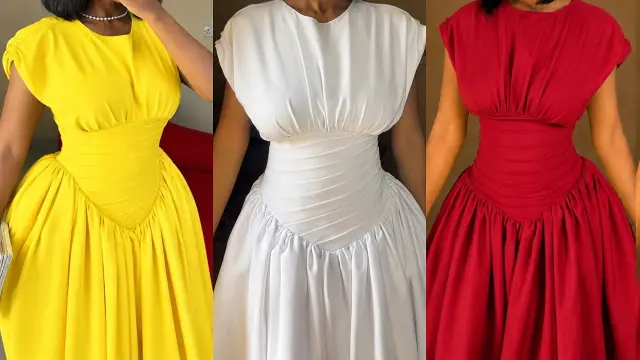
 How to Cut and Sew a Trendy Batwing Gathered Dress
#Basque Waist
1 ideas
How to Cut and Sew a Trendy Batwing Gathered Dress
Get new #Basque Waist ideas by email
Every Thursday: the week's best ideas, with the newest from #Basque Waist.
Related tags
Basque Waist Explained: The Pointed Waistline in Dress Design
A basque waist is a waistline that does not sit in a straight horizontal line around the body. Instead it drops below the natural waist and comes to a point, or a shallow V, at the centre front, sometimes extending into a small peplum or flare over the hips. The seam that creates it is usually called a basque seam, and the shape it makes is the reason the detail has stayed in dressmaking for well over a century.
The name comes from the basque, a close-fitting bodice that extends from the bust down over the hips. In nineteenth-century dressmaking the basque was a separate garment or a bodice cut long enough to cover the top of the skirt, and the pointed front edge was one of its common variations. Corsetry and evening dress kept the idea alive, and it reappears in bridal, formal and historical-inspired sewing because it does something few other seams can: it lengthens the torso and narrows the waist by drawing the eye to a point.
How the shape is built
The point is created by the pattern, not by gathering or pulling. The bodice front is cut longer at the centre than at the sides, and the skirt or lower panel is shaped to match, so the two seams meet along a V. Most versions are drafted as a panel seam running from the bust or armhole down to the point, which means the waist is controlled by several short seams rather than one continuous join.
Read more
This has practical consequences. Because the seam sits on a curve and ends in a sharp angle, it needs clipping or notching at the point so the fabric can turn cleanly, and it benefits from stay tape or a strip of interfacing along the seam line to stop the point from stretching or drooping. A crisp, stable fabric holds the shape best; soft, fluid fabrics give a gentler, more draped version.
Main variations
- A short point just below the natural waist, the most wearable form and easy to combine with a simple gathered or A-line skirt.
- A deep point reaching towards the hips, often seen in corset-style bodices and formal wear.
- A double-pointed or curved basque, where the V is softened or repeated at the sides.
- A basque with a peplum, in which the pointed section extends into a short flared layer over the skirt.
What beginners should know
Fit matters more here than with a straight waistline, because any tension shows at the point. Make a toile first, check that the point sits centred and level when the body moves and sits, and be prepared to adjust the depth of the V rather than only the width. Choose a pattern with a marked basque seam rather than trying to convert a straight waist, and press the point carefully over a pressing ham so it keeps a rounded rather than flattened finish. Boning or a firm stay at the centre front helps the point hold its line in structured fabrics.
Worn well, a basque waist is flattering without being fussy: it defines the middle, gives a garment a clear focal point, and works as readily on a simple day dress as on a formal gown.
#Basque Waist: frequently asked questions
What exactly is a basque waist, and where does the name come from?
It is a waistline that dips below the natural waist and finishes in a point or shallow V at the centre front, rather than running straight around the body. The term comes from the basque, a close-fitting bodice that extended down over the hips and was often cut with a pointed front edge. The detail has survived in dressmaking because that downward point draws the eye inward and makes the torso look longer.
What is needed to sew a basque waist, and how should a beginner start?
Begin with a pattern that already includes a marked basque seam, since converting a straight waistline is far harder than it looks. You will also want stay tape or a strip of interfacing for the seam line, and a pressing ham for shaping the point. Making a toile first is the sensible opening move, so you can check the point sits centred and level before cutting into your good fabric.
Which variation of basque waist should I pick?
A short point just under the natural waist is the easiest to wear and pairs well with a simple gathered or A-line skirt. A deep point suits corset-style bodices and formalwear, while a softened or double-pointed version is a gentler option if a sharp V feels too dramatic. If you want extra movement over the hips, a basque that extends into a short peplum gives you that without changing the bodice fit.
What fabrics hold a basque waist best?
Crisp, stable fabrics keep the point sharp and keep it from collapsing as it is worn. Soft, fluid fabrics will still work, but they produce a looser, more draped interpretation of the shape rather than a defined angle. In structured fabrics, a firm stay or a little boning at the centre front helps the point keep its line.
How do I press and care for a basque waist so the point stays sharp?
Clip or notch the seam right at the point so the fabric can turn cleanly, then press it over a pressing ham so the tip finishes rounded rather than flattened. Pressing on a flat surface tends to crush the shape you worked to build. On a finished garment, store it so the point is not folded back on itself, and refresh it with steam rather than a hard iron.
What are the most common mistakes with a basque waist?
The usual one is treating the shape as a fitting problem of width alone, when adjusting the depth of the V is often what actually fixes the fit. Another is skipping the stay tape, which lets the point stretch or droop with wear. Finally, check the seam while seated as well as standing, because tension at the point shows up fastest when the body moves.
Videos come from YouTube and posts from Instagram; titles and summaries are our own. All rights belong to their creators.