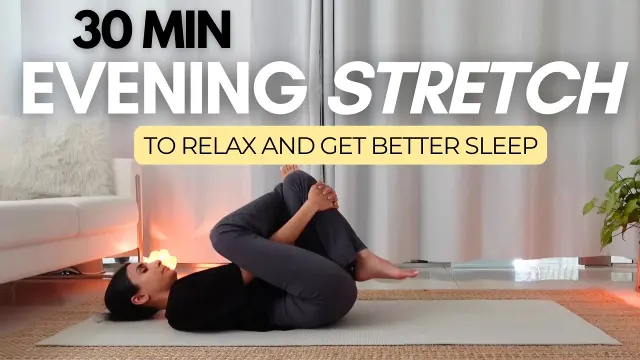
 30 Minute Evening Yoga to Melt Away Tension
#Bedtime Yoga
1 ideas
30 Minute Evening Yoga to Melt Away Tension
Get new #Bedtime Yoga ideas by email
Every Thursday: the week's best ideas, with the newest from #Bedtime Yoga.
Related tags
Bedtime Yoga: A Gentle Evening Practice
Bedtime yoga is a quiet, low-intensity form of yoga practised in the evening, usually in the hour or so before sleep. It borrows postures and breathing techniques from older traditions, particularly hatha and restorative yoga, but strips away anything strenuous. The aim is not fitness or flexibility gains, though both may come with time; it is simply to slow the body and mind down after a long day, easing the transition from doing to resting.
Unlike a morning practice, which often builds heat and energy, an evening practice is built on softness. Movements are held longer, the breath is slowed deliberately, and the room is kept dim and warm. Many people practise in comfortable clothes on a mat or simply on a rug beside the bed, and some do the whole thing lying down.
Common styles
Restorative yoga is the closest match to a bedtime practice: postures are supported with cushions and blankets and held for several minutes, so the body can let go without effort. Yin yoga works similarly but with a little more stretch, targeting connective tissue in long, still holds. Gentle hatha sequences, with slow sun salutations and seated folds, also suit the evening. Some people prefer a purely breath-based practice, with no postures at all, or a short guided body scan.
Read more
Poses often used
The postures chosen tend to be ones that feel soothing and require no balance. Forward folds release the back and shoulders after hours of sitting. A reclining twist or a supported bridge can ease stiffness in the spine. Legs-up-the-wall is a favourite because it asks nothing of you beyond lying still. Seated neck and shoulder rolls often open a session, and a long savasana in bed closes it.
What beginners should know
Start with ten or fifteen minutes rather than an hour. Choose three or four poses and repeat them rather than learning something new each night; repetition is what makes a practice feel restful. Move slowly enough that you can breathe evenly throughout, and never push into discomfort. If a pose pinches or aches, come out of it and prop yourself differently. A cushion under the hips, a folded blanket under the knees or a scarf to hold between the hands can make almost any pose accessible.
Practical tips
Keep the lights low and put your phone out of reach. Practise in the same place at roughly the same time so it becomes a cue for the body rather than a decision you have to make. Breathe in through the nose, out through the nose, and let each exhale be a little longer than the inhale. Afterwards, go straight to bed rather than returning to a screen or to chores.
If you are pregnant, recovering from injury or managing a health condition, check with a qualified teacher or your doctor about which postures suit you. Bedtime yoga is gentle by design, but gentle does not mean one-size-fits-all, and the best practice is the one adapted to your own body.
#Bedtime Yoga: frequently asked questions
How do I start a bedtime yoga practice at home?
Begin with a short session rather than a long one, and pick only a few soothing postures you can repeat night after night. Repetition is what turns the movements into a cue for rest, so resist the urge to learn something new each evening. Move slowly enough that your breathing stays even throughout, and go to bed straight afterwards instead of picking up a screen or a chore.
What do I need for bedtime yoga?
Very little: comfortable clothes, a mat or simply a rug beside the bed, and a dim, warm room. A cushion under the hips, a folded blanket under the knees and a scarf to hold between the hands are enough to make almost any posture feel supported. Keep your phone out of reach so the practice stays uninterrupted.
Which style of bedtime yoga should I choose?
Restorative styles suit the evening best, because postures are propped with cushions and held long enough for the body to let go without effort. Gentle seated and folding sequences work well too, as does a purely breath-based practice or a guided body scan if you would rather not move at all. The right choice is simply the one that leaves you feeling calmer than when you started.
What mistakes do beginners make with bedtime yoga?
The most common is doing too much too soon: a long, ambitious session in the evening tends to leave people wired rather than settled. Another is pushing into a posture that pinches or aches instead of coming out of it and propping differently. Treating it as a performance to improve rather than a wind-down to enjoy defeats the point.
How does bedtime yoga differ from a morning practice?
A morning practice usually builds heat and energy, while an evening one is built on softness. Postures are held longer, the breath is slowed deliberately, and nothing strenuous is included. The goal is not fitness or flexibility but easing the shift from doing to resting.
How do I make bedtime yoga a habit?
Practise in the same place at roughly the same time so it becomes something your body expects rather than a decision you have to make each night. Keep the lights low, breathe in and out through the nose, and let each exhale run slightly longer than the inhale. If you are pregnant, recovering from an injury or managing a health condition, it is worth asking a qualified teacher or your doctor which postures suit you, since gentle does not mean one-size-fits-all.
Videos come from YouTube and posts from Instagram; titles and summaries are our own. All rights belong to their creators.