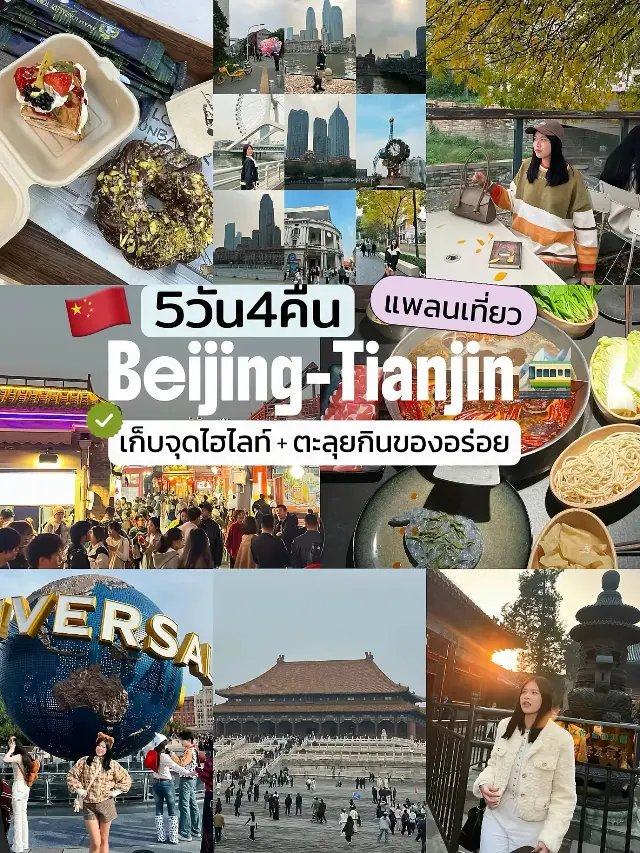
 Five-Day Beijing and Tianjin Travel Itinerary
#Beijing
1 ideas
Five-Day Beijing and Tianjin Travel Itinerary
Get new #Beijing ideas by email
Every Thursday: the week's best ideas, with the newest from #Beijing.
Related tags
Beijing: A Traveller's Guide to China's Imperial Capital
Beijing is the capital of China and one of the country's oldest and most storied cities. It sits in the north of the country, on a broad plain ringed by mountains, and it wears its long history openly: imperial palaces, temple roofs and grey-brick lanes sit side by side with wide avenues and modern towers. For a visitor, the pleasure of the city is exactly that layering — grand ceremony in one street, ordinary daily life in the next.
A city built in layers
Beijing's historic core was planned along a north–south axis, and much of the city's identity comes from that sense of order. At its heart lies the imperial palace complex, a walled sequence of courtyards and halls that is now a museum and the single most visited sight in the city. Beyond it are the altars and temples where emperors performed state rituals, the lakeside gardens of the imperial retreat to the northwest, and the drum and bell towers that once marked the hours for the whole capital. Many of the old city walls are gone, but their gates survive in place names, so reading a map becomes a small lesson in history.
Hutongs and everyday life
Read more
The hutong — the narrow alleys lined with walled courtyard houses — is the traditional texture of the city. Some districts have been preserved and are still lived in, with bicycles propped against the walls, washing strung overhead and neighbours chatting at the doorway. Others have been quietly turned into small shops, cafés and guesthouses. Walking them slowly, ideally in the morning when the lanes are busiest, gives a far better sense of Beijing than any single monument.
Parks, temples and the seasons
Public parks are central to life here. Early in the day you will find people practising slow movement exercises, dancing in groups, playing cards, singing opera excerpts or walking caged birds. Temples, meanwhile, remain active places of worship as well as historic sites, so visit quietly and follow posted rules about photography. The climate is continental: winters are cold and dry, summers hot and humid, spring can be windy and dusty, and autumn is generally the clearest and most comfortable season.
What to eat
Beijing cooking is robust and unfussy. Roast duck is the signature dish, carved at the table and wrapped in thin pancakes with scallion and sauce. Also worth seeking out are dumplings, wheat noodles, hotpot, savoury breakfast crepes cooked on street griddles, and sweets made from glutinous rice. Meals are usually shared, tea is refilled constantly, and small neighbourhood restaurants are often the most rewarding.
Practical tips
- The subway is extensive, cheap and signed in English; a stored-value transit card makes buses and trains simpler.
- Carry your passport with you, as it is the standard identification for visitors.
- Have your destination written in Chinese characters to show a driver or a passer-by.
- Distances between sights are large, so wear comfortable shoes and plan two or three stops a day rather than six.
- Distances in the old city are best covered on foot and by bicycle, but traffic is heavy, so stay alert.
Take Beijing slowly, and it rewards you: give yourself time to sit in a park, eat a long lunch and wander a lane without a destination.
#Beijing: frequently asked questions
How should I plan a first trip to Beijing?
Group your days by area instead of chasing a long checklist, because the sights are spread across a large city and travel between them eats up time. Give the imperial core a morning of its own, then let the hutongs, parks and temple districts fill the rest at a slower pace. Leaving room to sit in a park or linger over lunch is part of seeing the city properly.
What is the easiest way to get around Beijing?
The subway covers the city well, is inexpensive and is signed in English, and a stored-value transit card makes both trains and buses simpler to use. For the old lanes, walking and cycling are far better than driving, though traffic is heavy enough that you should stay alert. Carry your passport as identification and keep your destination written in Chinese characters for drivers and passers-by.
When is the best time of year to visit Beijing?
Autumn is generally the clearest and most comfortable season, which makes it the easiest time for long days of walking. Spring can be windy and dusty, summers are hot and humid, and winters are cold and dry, so pack according to which of those you can handle. Whatever the season, early mornings are the liveliest time in parks and alleys.
What food should I try in Beijing?
Roast duck is the signature dish, carved at the table and eaten wrapped in thin pancakes with scallion and sauce, and it is worth planning a meal around. Beyond that, look for dumplings, wheat noodles, hotpot, savoury breakfast crepes cooked on street griddles and sweets made from glutinous rice. Meals are usually shared, so small neighbourhood restaurants often give the best value and the warmest welcome.
What do visitors most often get wrong in Beijing?
The common mistake is cramming too many sights into one day; distances are large and the city rewards a slower pace. Another is treating the hutongs as an attraction rather than a neighbourhood, when they are still lived in and best walked quietly, especially in the morning. Forgetting to carry your passport or to have addresses written in Chinese characters also causes avoidable trouble.
How should I behave when visiting temples and old neighbourhoods?
Many temples are still active places of worship rather than museums, so keep your voice low, follow the posted rules about photography and dress considerately. In the lanes, remember that doorways and courtyards are people's homes, so ask before photographing anyone and keep out of private entrances. A little restraint is what lets these places stay worth visiting.
Videos come from YouTube and posts from Instagram; titles and summaries are our own. All rights belong to their creators.