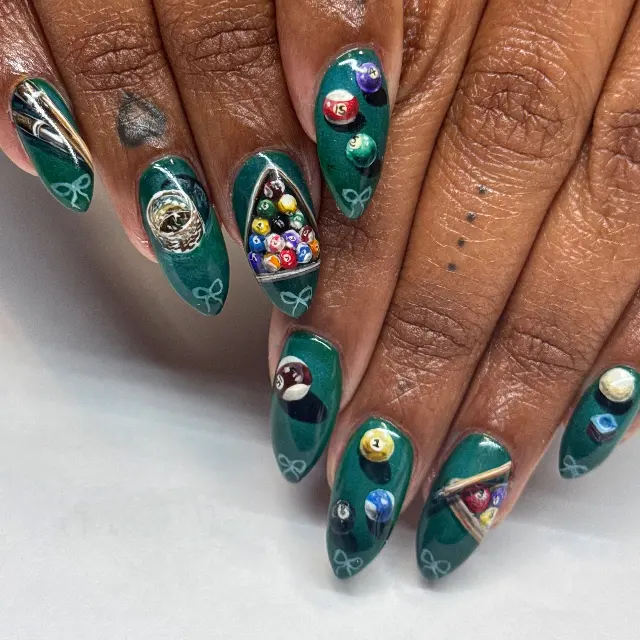
 Hand-painted billiards nail art with a pool table theme
#Billiards
1 ideas
Hand-painted billiards nail art with a pool table theme
Get new #Billiards ideas by email
Every Thursday: the week's best ideas, with the newest from #Billiards.
Related tags
Billiards: A Beginner's Guide to the Table
Billiards is the family of games played on a cloth-covered table with a cue, a set of balls and, depending on the game, six pockets along the rails. The word itself is used in two ways: in some places it names the whole family of cue sports, and in others it refers specifically to carom billiards, played on a table with no pockets at all, where the aim is to strike the other balls with your own.
Where it comes from
Cue games grew out of lawn games — versions of croquet and ground billiards — that were brought indoors on rainy days, first in Europe and later refined in France and Britain. The table shrank, the grass became cloth, and a wooden stick replaced the mallet. Over the centuries the equipment settled into the familiar form: slate under the cloth to keep the surface flat, cushions that rebound predictably, and chalked leather tips on the cue for grip.
The main games
Read more
The pockets define the game more than anything else.
- Eight-ball, the most widely recognised, splits the object balls into solids and stripes, with the eight ball played last.
- Nine-ball uses balls numbered one to nine and rewards position play and a strong break.
- Snooker, played on a much larger table, uses many reds and a set of coloured balls, and is as much a game of safety and patience as of potting.
- Carom games, played without pockets, score by making the cue ball contact two other balls, often with heavy spin.
- Bank and one-pocket variants reward precision and defensive thinking over raw scoring.
What beginners should know
Start with the stance before the shot. Feet comfortably apart, weight balanced, head directly over the cue so that you see the line of the shot with both eyes. Hold the cue lightly — the back hand guides, it does not strangle — and keep the bridge hand steady on the cloth. Aim, then stroke smoothly through the ball rather than poking at it.
Learning centre-ball striking first is worth the patience: no spin, no sidespin, just a clean hit along the line. Spin and English are refinements, not shortcuts, and they punish a wobbly stroke.
Practical tips
- Chalk before every shot; a smooth, even layer of chalk prevents miscues.
- Walk around the table between shots to read the angles instead of leaning awkwardly across it.
- Aim to control the cue ball's resting place, not only to pot — position is most of the game.
- Practise straight-in shots and simple safeties before attempting trick shots.
- Respect the table: no sitting on the rails, no drinks on the cloth, and let your opponent take their shot undisturbed.
Billiards rewards calm repetition more than natural flair. A few quiet habits — a stable stance, a smooth stroke, and thinking one ball ahead — will carry you much further than any dramatic shot.
#Billiards: frequently asked questions
How do I get started with billiards as a complete beginner?
Start with the stance and the stroke rather than with shots you have seen on television: feet set comfortably apart, weight balanced, head over the cue so both eyes read the line. Practise plain centre-ball hits until the cue travels smoothly through the ball instead of being poked at it. Everything else — spin, angles, safeties — builds on that clean, repeatable contact.
What do I actually need before I can play?
You need very little of your own: a cue, a cube of chalk, and flat shoes you can stand steadily in. The table, balls and cloth are supplied wherever you play, so it is worth trying a few different cues to find a weight that feels comfortable in your back hand. Chalk before every shot, since an even layer on the tip is what stops the cue slipping.
Which kind of billiards should I learn first?
The pocket games are the friendliest entry point, because the goal is obvious — send the object ball into a pocket — and tables for them are easy to find. Carom games, played on a table with no pockets at all, are a different pleasure and reward touch and spin rather than potting. Pick whichever the table in front of you allows, and learn one properly before dabbling in the others.
How should I look after a billiards table?
Keep drinks and food well away from the cloth, brush it down regularly to lift chalk dust, and cover the table when it is not in use. Never sit on the rails or lean your weight on the cushions, since that is what distorts them and spoils the rebound. If the table is your own, keep the room dry and stable so the slate beneath the cloth stays flat.
What do beginners most often get wrong?
Gripping the cue far too tightly and stabbing at the ball instead of stroking through it are the two habits that hold people back longest. Another is reaching for spin before the plain centre-ball shot is reliable, which punishes an unsteady stroke and teaches nothing. Leaning awkwardly across the table rather than walking around to read the angle is the fourth — position is most of the game.
Any ideas for a billiards-themed occasion?
Lean into the look of the game: deep green felt tones, chalk blue, dark wood and a touch of brass work well for invitations, table settings and dress codes. Smaller details carry it further — cue-shaped props, a chalk-and-felt colour palette for nails or cupcakes, and a scoreboard used as a guest book. Keep the actual playing area clear of food and drink so the theme never costs you the cloth.
Videos come from YouTube and posts from Instagram; titles and summaries are our own. All rights belong to their creators.