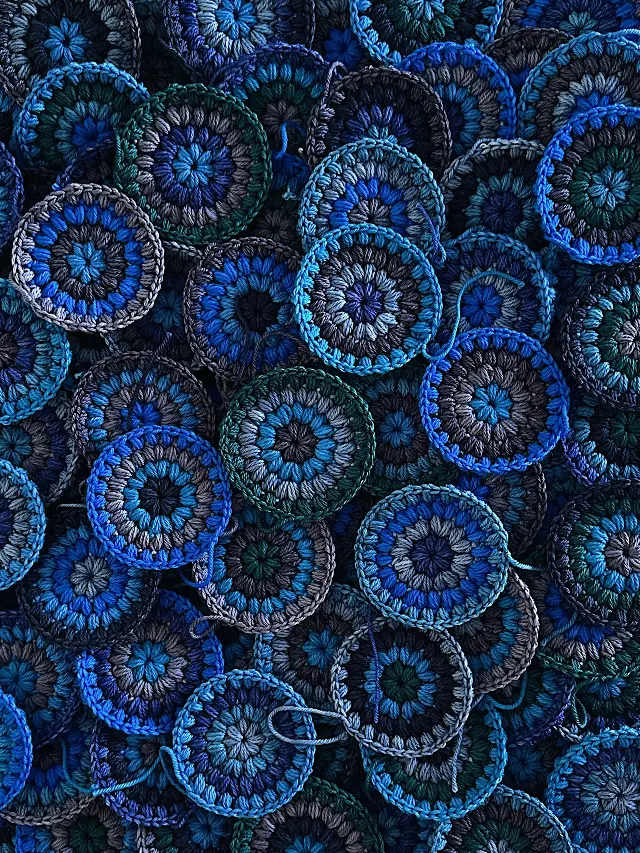
 Blue granny square blanket built from a midnight-themed yarn palette
#Blanket Pattern
1 ideas
Blue granny square blanket built from a midnight-themed yarn palette
Get new #Blanket Pattern ideas by email
Every Thursday: the week's best ideas, with the newest from #Blanket Pattern.
Related tags
Blanket Patterns: A Beginner's Guide to Making One
A blanket is one of the most satisfying things a person can make by hand. It is also one of the largest, which is why so many makers rely on a pattern: a written plan that tells you what stitches or shapes to work, in what order, and how the pieces come together. Patterns turn an intimidating amount of yarn into a series of small, manageable steps.
What a pattern actually gives you
Most patterns contain the same core information, whatever the craft. There is a materials list, a suggested yarn weight or fabric quantity, the tools required, a gauge or finished size, and then the instructions themselves, often written in rows or rounds with repeats marked in brackets. Quilt patterns work differently, describing how to cut pieces and assemble blocks rather than stitches, but the logic is the same: measure, repeat, join.
The single most useful habit is to check gauge before you commit. A small sample square tells you whether your hands work tighter or looser than the designer's, and it is far easier to change your hook or needle at the start than to discover halfway through that the blanket will be a different size than you planned.
Read more
The main families of blanket patterns
In crochet, the classic is the motif blanket, built from repeated squares, hexagons or circles that are joined at the end. Granny squares are the best-known example, and they suit people who like portable projects and colour play. Ripple and chevron patterns create wavy stripes from simple increases and decreases, while filet work builds pictures from solid and open blocks.
In knitting, blankets are usually worked flat in one piece or in strips: stripes, mitred squares, lace panels, textured stitches, or sampler blankets that change pattern every few rows to keep interest high. Log cabin and other block-based designs come from the quilting tradition, where strips are sewn around a central square and the blanket grows outward.
Choosing materials
Natural fibres such as wool and cotton wear well and breathe; synthetic yarns are durable and easy to wash, which matters for anything used daily. Choose a smooth, light-coloured yarn for your first project so you can see your stitches clearly. Circular needles and large hooks are kinder to the hands and arms than short straight tools, simply because a blanket's weight has somewhere to rest.
Starting out
Pick a pattern with one repeating element rather than many. A single-block blanket teaches you joining, seaming and finishing without asking you to memorise a dozen instructions. Make one block completely before you make forty, and keep a note of the hook or needle you used.
Finishing and care
Blocking opens out stitches and evens the edges. Weave in ends as you go, rather than leaving them all for the end, and always wash a sample of your yarn before committing it to a whole blanket.
#Blanket Pattern: frequently asked questions
How do I start a blanket pattern if I have never made one before?
Begin with a pattern built around a single repeating element, such as a motif square or a simple striped repeat, so you are learning the joining and finishing steps rather than memorising many different instructions. Work one unit all the way through — including the edging and the seam — before you commit to making the rest, and jot down the hook or needle size you used so the whole blanket stays consistent.
What do I need to have ready before I begin a blanket pattern?
You need the yarn and tools the pattern lists, plus a copy of the pattern itself so you can read the materials list, the finished size and the repeats before you buy anything. Making a small sample square first is the most useful preparation, because it shows whether your hands work tighter or looser than the designer's and lets you change tools while it is still easy to do so.
Which kind of blanket pattern should I choose?
The choice usually comes down to how you like to work: motif patterns are portable and forgiving of colour changes, ripple and chevron patterns give wavy stripes from simple shaping, and flat or block-based patterns suit people who prefer one continuous project. If you are making the blanket for daily use, lean towards a pattern whose finished texture will hold up to regular washing rather than one with a lot of open, snag-prone detail.
How do I look after a hand-made blanket once it is finished?
Wash a sample of your yarn before you commit it to a whole blanket, so you know whether it shrinks, bleeds or softens, and then follow that same method on the finished piece. Blocking afterwards opens out the stitches and evens the edges, and storing the blanket folded rather than hanging it keeps its weight from stretching the fabric out of shape.
What mistakes do people make most often with blanket patterns?
Skipping the gauge or sample square is the classic one, because a small difference in tension becomes a large difference in size over a blanket's width, and it is far harder to fix at the end than at the start. Leaving all the yarn ends to weave in at the very end is the other common regret — dealing with them as you go keeps the finishing stage short and bearable.
Do you have ideas for a blanket with a particular look or occasion?
Working from a limited colour palette gives even a simple motif blanket a strong, deliberate character — a dark, moody set of blues across repeated granny squares, for example, reads as considered rather than random. For a gift, choose a pattern whose repeat you enjoy, since the pleasure of the making tends to show in the finished piece.
Videos come from YouTube and posts from Instagram; titles and summaries are our own. All rights belong to their creators.