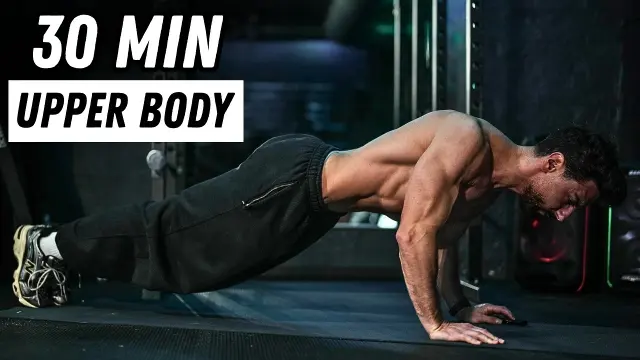
 30-Minute No-Equipment Upper Body Workout With Rowan Row
#Bodyweight Training
1 ideas
30-Minute No-Equipment Upper Body Workout With Rowan Row
Get new #Bodyweight Training ideas by email
Every Thursday: the week's best ideas, with the newest from #Bodyweight Training.
Related tags
Bodyweight Training: A Beginner's Guide to Moving Well
Bodyweight training is strength work that uses the resistance of your own body instead of weights or machines. You push, pull, squat, hinge, carry and balance, and gravity provides the load. It is one of the oldest and most accessible ways to train: it needs no gym, no equipment and very little space, which is why it has stayed useful for so long and across so many traditions.
Where it comes from
Forms of bodyweight movement appear in almost every culture, from gymnastic traditions and martial arts to military calisthenics and yoga. The modern interest in it grew partly as a reaction to gym culture: people wanted strength they could use anywhere. Today it overlaps with gymnastics, parkour, mobility work and general fitness.
The main kinds
Read more
- Calisthenics: the classic push-up, pull-up, squat and dip family, often built toward harder variations.
- Gymnastics strength: slower, more controlled work such as holds, levers and handstands.
- Mobility and movement practice: crawling, balancing and ground work that trains coordination as much as strength.
- Conditioning circuits: bodyweight exercises arranged in rounds to raise the heart rate.
- Yoga and Pilates: bodyweight work with a strong emphasis on control, breathing and alignment.
What it trains
Done with care and progression, bodyweight training builds strength, balance, coordination and a sense of control over your own body. It also teaches you to move through full ranges of motion, which many machine-based routines skip.
What beginners should know
Start with the version of a movement you can do with good form, not the version that looks impressive. A push-up against a wall or an elevated surface counts. An assisted squat counts. Consistency beats intensity, especially in the first weeks.
- Warm up briefly before you begin: easy movement, joint circles, a few slow repetitions.
- Learn the basic patterns first: push, pull, squat, hinge, carry, and some kind of core work.
- Progress by changing leverage, range of motion, tempo or repetitions, not by adding weight.
- Train two to three times a week at first, with rest days between sessions.
- Stop a movement if you feel sharp pain. Muscle effort is fine; joint pain is not.
Practical tips
Film yourself occasionally, or train in front of a mirror. What feels correct and what looks correct are often different. Write down what you did, so progress is visible over months rather than guessed at week to week. Keep pull work in your routine, since pushing movements tend to dominate at home. If you are returning from injury, pregnant, or managing a health condition, ask a qualified professional before starting something new.
The appeal of bodyweight training is that it travels with you. A small amount of space and a little patience are enough to begin, and the same movements keep giving for years.
#Bodyweight Training: frequently asked questions
How do I start bodyweight training with no equipment at all?
Begin with the easiest version of each basic movement pattern — push, pull, squat, hinge, carry and core — and use a wall, a doorway or a raised surface for support rather than trying to force the hard version. A short warm-up of easy movement and a few slow repetitions is enough before you begin. Keep sessions short and repeatable at first, because showing up regularly matters more than going hard.
Do I need a gym, mat or any gear for bodyweight training?
No. Gravity supplies the resistance, so a small patch of floor and a little space to move is genuinely sufficient. A sturdy ledge, bar or doorway is helpful for pull work, and a mat adds comfort, but nothing is required beyond that to get started.
Which style of bodyweight training should I choose?
It depends on what you enjoy and what you want from it: calisthenics builds toward harder push, pull, squat and dip variations, gymnastics-style work favours controlled holds and handstands, mobility practice trains coordination and ground movement, circuits raise your heart rate, and yoga or Pilates emphasise control and alignment. Try a couple of styles for a few sessions each and notice which one you actually look forward to doing. That one will be easier to keep up.
How do I make a bodyweight exercise harder without adding weights?
Progress by shifting leverage, increasing range of motion, slowing the tempo or adding repetitions. Moving from an incline push-up to a floor push-up, or from a shallow squat to a deeper one, changes the load without any equipment. Because progress comes in small steps, film yourself now and then or check a mirror so you can see what is actually changing.
What mistakes do beginners make most often in bodyweight training?
The common ones are chasing the impressive-looking variation before good form is there, pushing so hard that recovery and consistency suffer, and letting pushing movements crowd out pulling work at home. Sharp joint pain is a signal to stop rather than push through, while ordinary muscle effort is expected. Writing down what you did each session keeps progress visible instead of guessed at.
Can I build a routine around bodyweight training if I have limited space or travel often?
Yes — that portability is exactly why the method has lasted. A short warm-up, a few sets of the basic patterns and some core work fit into almost any room, and the same movements keep working for years as you make them harder. If you are returning from injury, pregnant or managing a health condition, check with a qualified professional before starting something new.
Videos come from YouTube and posts from Instagram; titles and summaries are our own. All rights belong to their creators.