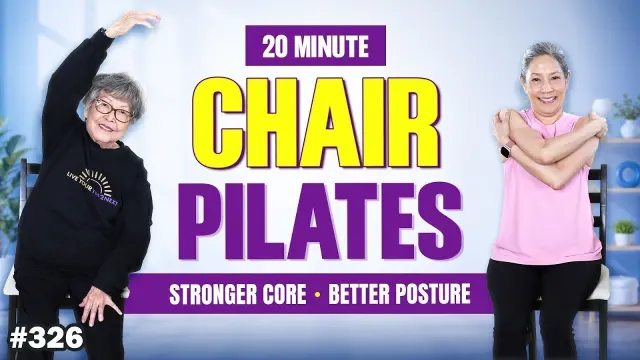
 Gentle 20-Minute Chair Pilates Routine for Seniors and Beginners
#Chair Pilates
1 ideas
Gentle 20-Minute Chair Pilates Routine for Seniors and Beginners
Get new #Chair Pilates ideas by email
Every Thursday: the week's best ideas, with the newest from #Chair Pilates.
Related tags
Chair Pilates: A Gentle Guide for Every Body
Chair Pilates is a form of exercise that takes the principles of Pilates — controlled movement, steady breathing, and attention to alignment — and adapts them to a chair. Instead of lying on a mat, you sit, stand beside the chair, or use it for support. It is not a separate discipline with its own rules so much as a practical way into the same work, and it opens the method to people who find getting down to the floor difficult, uncomfortable, or simply unappealing.
The approach grew out of Pilates itself, developed in the early twentieth century by Joseph Pilates as a system of strengthening the body through precise, deliberate movement. Classical Pilates uses mats and specialised equipment, but teachers soon recognised that the same exercises could be modified for people recovering from injury, working in offices, or living with limited mobility. The chair became a natural tool: it is stable, it is everywhere, and it changes the angle of the body enough to make many movements accessible.
What it is used for
Chair Pilates is most often practised for general strength and mobility, particularly in the core, back, hips and shoulders. Because sitting removes the challenge of balancing the whole bodyweight, it lets you focus on the quality of each movement. Many people use it to break up long periods of sitting, to stay active as they get older, or as a gentle starting point before moving to mat work. Physiotherapists and movement teachers sometimes draw on similar seated exercises during rehabilitation, though chair Pilates as taught in a class is general exercise, not treatment.
Read more
The main kinds of movement
Most sessions combine a few categories. Seated spinal work — gentle rounding and lengthening of the spine — improves the way you sit and move. Seated leg and hip exercises, such as leg extensions and knee lifts, build strength in the lower body. Arm work with or without light resistance targets the shoulders and upper back, which often complain after hours at a desk. Many routines finish with standing exercises done beside or behind the chair, using it for balance while the legs do more of the work. Breathing is woven throughout: a slow inhale and a long exhale timed with the movement.
What beginners should know
Start with a chair that is stable and the right height — when you sit, your knees should be roughly level with your hips, and your feet flat on the floor. Choose a firm seat rather than something soft and deep. Begin with short sessions and few repetitions, and pay more attention to control than to how many times you repeat a movement. If something pinches or hurts, stop; mild effort in the muscles is fine, sharp pain is not.
Move slowly enough that you could pause at any point. Let your breath set the rhythm rather than rushing through. And if you have a health condition, are pregnant, or are returning from surgery or injury, check with a qualified professional before starting — a teacher experienced in adapted exercise can show you variations that suit your body.
#Chair Pilates: frequently asked questions
Do I need any special equipment to start Chair Pilates?
No — the chair you already have is the main piece of equipment. Look for something stable with a firm seat, at a height where your knees sit roughly level with your hips and your feet rest flat on the floor. A light resistance band is optional if you want more work for the arms and shoulders, but it is not required.
How do I know if Chair Pilates is the right choice for me?
It suits anyone who wants controlled, low-impact movement and finds floor work awkward, uncomfortable or hard to get down to. It is often picked up by people who sit for long stretches, by older adults wanting to stay active, or by anyone easing into Pilates before trying mat exercises. If your goal is high-intensity training, it is probably not the right fit.
How should a first session be structured?
Keep it short and simple, combining a little seated spinal work, some leg and hip movements, and a few arm exercises, then finish with standing moves using the chair for balance. Do fewer repetitions than you think you need and prioritise control over quantity, moving slowly enough that you could pause mid-movement. Let a slow inhale and a longer exhale set the pace throughout.
What are the most common mistakes beginners make?
The usual ones are rushing through repetitions, using a chair that is too soft or too low, and holding the breath instead of letting it drive the rhythm. Another is ignoring discomfort — mild muscular effort is expected, but anything sharp or pinching is a signal to stop. Slowing down and checking your alignment fixes most of these.
Is Chair Pilates safe if I have an injury or a health condition?
Chair Pilates taught in a class is general exercise rather than treatment, so it is worth speaking to a qualified professional first if you are pregnant, recovering from surgery or injury, or managing a health condition. A teacher experienced in adapted exercise can suggest variations that suit your body. Stop whenever something feels painful rather than merely effortful.
Videos come from YouTube and posts from Instagram; titles and summaries are our own. All rights belong to their creators.