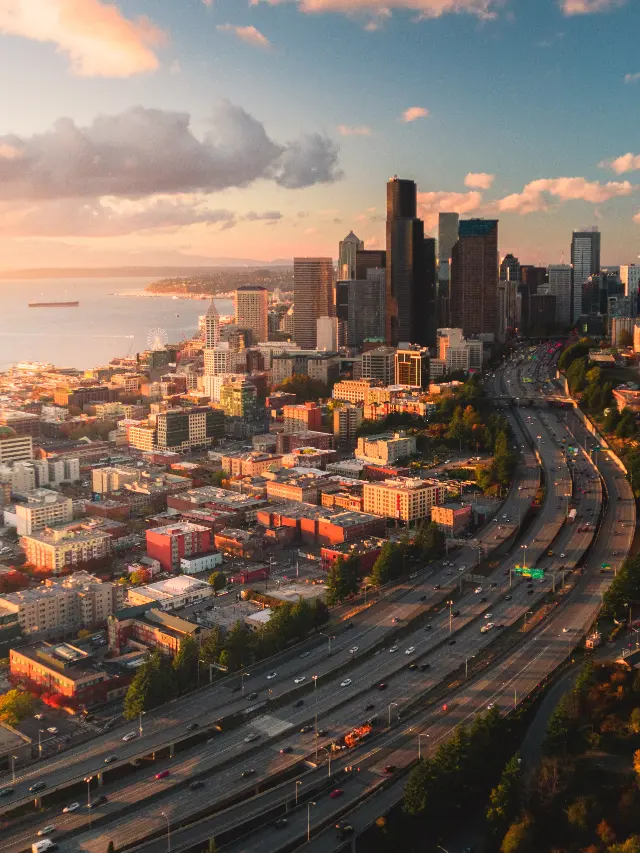
 Seattle Views from Street Level and from the Air
#City Views
1 ideas
Seattle Views from Street Level and from the Air
Get new #City Views ideas by email
Every Thursday: the week's best ideas, with the newest from #City Views.
Related tags
City Views: How to Find, Read and Enjoy a Skyline
A city view is the city seen as a whole — a skyline, a river bend, a grid of roofs, a scatter of lights after dark. Wherever people build upward and densely, they also climb to look back at what they have made. Hilltops, bell towers, cathedral domes and harbour walls served as viewpoints long before anyone thought of them as attractions; the habit of walking somewhere high to see the town below is centuries old. Today the same instinct sends you to a rooftop café, a bridge, a park on a ridge, or simply the top deck of a bus.
The kinds of vantage point
City views come in a few recognisable types, and each gives a different picture.
- The high overlook. A hill, a tower, an observation level. You see the shape of the whole place: where the dense centre sits, how the river cuts it, how far the sprawl runs.
- The low crossing. A bridge, a waterfront promenade, a ferry deck. The city shows its profile rather than its plan, and the water doubles it.
- The street-level gap. A view framed by buildings — a long avenue closing on a monument, a courtyard opening onto a dome. Narrow, deliberate, and often the most memorable.
- The ordinary roof. A car park, a station footbridge, a friend's balcony. Unglamorous, close, and good for watching daily life rather than architecture.
Read more
What makes a view worth your time
Good views are usually about relationship rather than height. Look for contrast: old against new, a green edge meeting a hard one, water beside stone. Depth matters too — a view with foreground, middle and distance reads more clearly than a flat wall of towers. And orientation helps: knowing which direction the sun sets tells you where the light will fall and when the windows will begin to glow.
Practical advice
Go twice if you can. A place at midday and the same place at dusk are two different cities, and the change itself is half the pleasure. Early morning is quiet, clear and often the best light; late afternoon gives long shadows and warm tones. Weather is not the enemy it seems — after rain the air cleans up and distances sharpen, and a grey sky can suit a skyline better than hard sun.
Bring less than you think. Binoculars or a camera with a modest zoom will show details you would otherwise miss, but plenty of people simply sit and look, which is the point. If you are photographing, find a strong line — a river, a road, a row of lamps — and let it lead the eye. Steady yourself against a wall or railing for low light.
Be mindful of where you stand: not every rooftop is open to visitors, and private terraces, construction sites and railings are not invitations. Use the official paths, terraces and towers, and respect the people who live behind the windows you are admiring.
Finally, look down as well as out. The most interesting city view is often the one that includes the street directly below — the small traffic, the queue at a stall, the life that makes the skyline mean anything at all.
Videos come from YouTube and posts from Instagram; titles and summaries are our own. All rights belong to their creators.