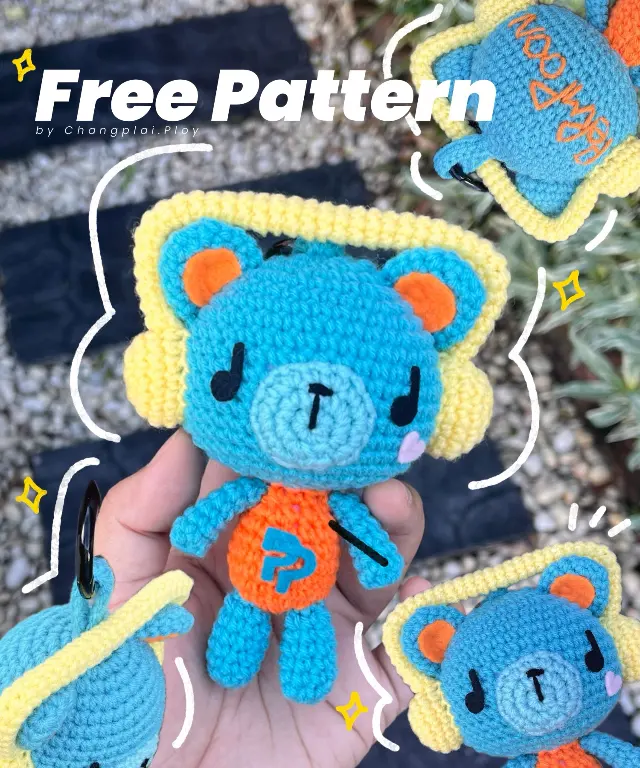
 Free Crochet Pattern for PeRmPoom, a Blue Character With Yellow Headphones
#Crochet Character
1 ideas
Free Crochet Pattern for PeRmPoom, a Blue Character With Yellow Headphones
Get new #Crochet Character ideas by email
Every Thursday: the week's best ideas, with the newest from #Crochet Character.
Related tags
Crochet Characters: A Guide to Making Little Figures
A crochet character is a small figure worked in yarn, usually in the round and stuffed as it grows. The craft sits at the meeting point of soft sculpture and doll-making: you are not following a flat pattern but building a body, one increasing and decreasing round at a time. Most people call the technique amigurumi, a Japanese word that joined "crocheted" and "stuffed toy" and travelled around the world with the spread of online patterns.
Where the characters come from
The appeal is that almost anything can become a character. Some makers work from stories, films and games, translating a familiar silhouette into yarn. Others invent their own creatures and give them names, outfits and small backstories. A third group works from whatever a child in the family has drawn, which is often the most charming result of all.
The main kinds
Read more
Simple one-piece characters are worked from the head down in a continuous spiral, with arms and legs either crocheted in as you go or sewn on afterwards. Jointed figures have separate limbs attached with buttons or yarn, so they can sit and pose. Flat characters, worked as two matching shapes and joined at the edge, are quicker and make good wall hangings or appliqué. Then there is the whole family of small creatures — animals, monsters, imaginary beings — where a basic body shape is varied only by ears, tails and colour.
What beginners should know
Start with a single-colour character in a smooth, light-coloured yarn, which shows your stitches and hides small gaps. Work tightly: a firm fabric holds the stuffing in and keeps the shape crisp, so choose a hook a size or two smaller than the yarn label suggests. Use a stitch marker in the first stitch of each round, because in a continuous spiral it is easy to lose your place.
Shaping happens through increases and decreases. A round head is usually a flat circle that curves over the top and closes at the bottom; limbs are narrow tubes. Learn the invisible decrease early — it keeps the fabric neat where the rounds narrow.
Faces and finishing
Less is more with faces. Two small eyes placed low on the head read as friendly, while eyes set high read as surprised. Embroider features with yarn rather than attaching small plastic parts if the figure will be handled by a baby. Stuff firmly but in small pieces, adding more before the opening closes, so the head stays round rather than lumpy.
Finally, secure every end inside the body rather than trimming it short, and give the character one detail that is entirely your own — a crooked scarf, a mismatched button, a slightly odd ear. That is what turns a pattern into a character.
#Crochet Character: frequently asked questions
How do I start a crochet character if I've never made one before?
Begin with a simple one-piece figure worked in a continuous spiral from the head down, since it avoids sewing and lets you learn shaping as you go. Pick a smooth, light-coloured yarn so your stitches are easy to see and small gaps are less obvious. Keep a stitch marker in the first stitch of each round, because in a spiral it is very easy to lose your place.
What supplies do I need to make a crochet character?
You need yarn, a hook slightly smaller than the yarn label recommends, stuffing, and a stitch marker or a scrap of contrasting yarn. A blunt tapestry needle for sewing on parts and hiding ends is essential, and embroidery yarn or safety eyes finish the face. Tight fabric is what holds the stuffing in and keeps the shape crisp, so hook size matters more than any other choice.
Which kind of crochet character should I choose?
One-piece figures are the easiest starting point, while jointed characters with button-attached limbs suit makers who want a figure that can sit and pose. Flat characters worked as two joined shapes are faster and work well as wall hangings or appliqué, and small creatures let you vary a basic body with ears, tails and colour alone. Match the style to how the finished piece will be used — a figure handled by a baby should have embroidered features rather than small attached parts.
How do I care for a finished crochet character?
Spot clean with a damp cloth and mild soap whenever possible, and press gently rather than rubbing, since the stuffing can shift. If it needs a fuller wash, hand-wash in cool water, squeeze rather than wring, and reshape it while damp before letting it air dry. Keep it away from hot dryers and direct sun, which can shrink or fade the yarn.
What are the most common mistakes when making crochet characters?
Working too loosely is the usual culprit — the fabric gapes, the stuffing shows and the shape sags, so go down a hook size and keep your tension firm. Another common problem is stuffing in large clumps at the end, which leaves the head lumpy; add small pieces as you close the opening instead. Finally, beginners often trim yarn ends short rather than securing them inside the body, and place faces too high, which makes a character look startled rather than friendly.
What can I make a crochet character for?
They work as gifts for babies and children, as shelf companions for someone who loves a particular story or game, and as decorations for a nursery or a party table. Makers also recreate a child's own drawing in yarn, which tends to be the most treasured result. Adding one personal detail — a crooked scarf, an odd ear, a mismatched button — is what makes a pattern feel like a real character.
Videos come from YouTube and posts from Instagram; titles and summaries are our own. All rights belong to their creators.