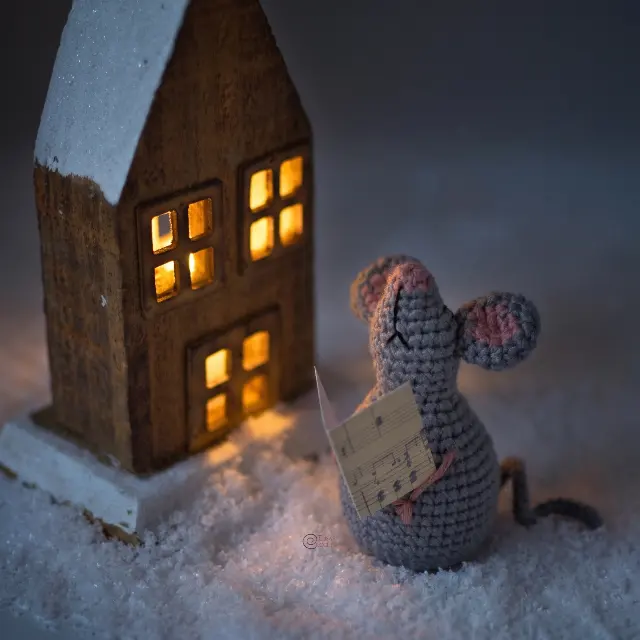
 Crocheted amigurumi mouse dressed for Christmas carols
#Crochet Mouse
1 ideas
Crocheted amigurumi mouse dressed for Christmas carols
Get new #Crochet Mouse ideas by email
Every Thursday: the week's best ideas, with the newest from #Crochet Mouse.
Related tags
Crochet Mouse: Amigurumi Mice and Little Characters
A crochet mouse is a small soft toy worked in yarn, usually in the round, and shaped into the familiar form of a mouse: a rounded body that narrows into a pointed snout, two round ears, four tiny paws and a long thin tail. Most are made in the amigurumi tradition, the Japanese craft of crocheting or knitting small stuffed figures in continuous spirals of single crochet. Mice are among the friendliest subjects in that tradition, because their shape is simple and forgiving, and because they carry so much story with them — nursery rhymes, picture books, winter tales and quiet bedtime companions.
Why mice make a good first project
The mouse is a forgiving animal to build. There is no complicated anatomy to get right: a ball of a body, a cone of a nose, two flat circles and a tail. If a stitch count drifts by one or two, the mouse simply looks a little more surprised. Small toys like these also use very little yarn, which makes them a natural home for the ends of skeins left over from larger projects.
What you need to know before you start
Read more
- Work in continuous rounds and mark the first stitch of each round so you do not lose your place.
- Use a hook a size or two smaller than the yarn label suggests, and crochet fairly tightly, so the stuffing does not show through the fabric.
- Smooth cotton and acrylic yarns show the shape most clearly; fluffy yarns hide small mistakes but also hide the shaping.
- Learn the magic ring, the single crochet, the increase and the invisible decrease. These four are almost the whole vocabulary of a mouse.
- Count your stitches at the end of every round. Amigurumi is mostly arithmetic, and the counting is where the shape lives.
Shapes, features and variations
The snout is usually made by decreasing steadily over several rounds, then stuffing the tip firmly so it holds its point. Ears are flat circles, worked in the round and flattened, or small ovals folded in half and stitched on. Whiskers can be embroidered with a few long stitches of fine thread. The tail is often a simple chain worked back with slip stitches, or a narrow tube of single crochet for a plumper look.
From there the variations are endless: a dormouse in a nightcap, a field mouse in a tiny waistcoat, a rattle with a bell sealed inside, a finger puppet, a miniature keyring mouse, or a simple cat toy stuffed with catnip.
A note on safety and finishing
Stuff little by little rather than all at once, shaping with your fingers as you go, and leave the toy slightly softer than you think it needs to be. For anything intended for a baby or young child, embroider the eyes and nose in yarn instead of using plastic parts, and sew every ear, limb and tail securely with the same yarn, finishing the ends inside the body.
A crochet mouse is small enough to finish in an evening, which is part of its charm: you can make one, then another, and give each a different character.
#Crochet Mouse: frequently asked questions
How do I start a crochet mouse if I'm a beginner?
Start by practising the small set of stitches the whole toy is built from: the magic ring, single crochet, increase and invisible decrease. Then work the body in continuous rounds, marking the first stitch of each round so you always know where you are. The mouse shape is forgiving, so a small slip in the stitch count changes its expression rather than ruining it.
What do I need to make one?
You need a smooth yarn, a hook smaller than the one the yarn label suggests, stuffing, a stitch marker and a blunt needle for sewing up. Fine thread or embroidery floss is handy for whiskers and facial features. Smooth cotton and acrylic show the shaping best, while fluffy yarns hide small mistakes but blur the shape.
Which kind of crochet mouse should I make?
Let the person who will use it decide: a soft bedtime companion with embroidered features suits a baby, a firm little toy stuffed with catnip suits a cat, and a tiny keyring or finger puppet suits a small gift. Dressed versions — a nightcap, a waistcoat, a carol-singing outfit — are a good way to give each mouse its own character. Think about size and who handles it before choosing the details.
How should I care for a finished crochet mouse?
Treat it gently: spot clean with a damp cloth and mild soap, then let it air dry away from direct heat. Machine washing tends to shift the stuffing and distort the shaping, so it is best avoided. If the mouse lives with a pet, check regularly for loose stitches and repair them before they open up.
What are the most common mistakes to avoid?
Losing your place in the rounds and stuffing the toy all at once are the usual culprits — count your stitches as you go and add stuffing in small amounts, shaping with your fingers. Crocheting too loosely lets the filling show through, and sewing ears or limbs on with a few careless stitches invites them to come off. For anything for a baby or young child, embroider the eyes and nose in yarn rather than attaching plastic parts.
What occasions is a crochet mouse good for?
It works as a welcome gift for a new baby, a small handmade present for a birthday, a seasonal ornament, or a stocking filler. Because it uses very little yarn and can be finished in an evening, it is also a good way to use up the ends of skeins left over from bigger projects.
Videos come from YouTube and posts from Instagram; titles and summaries are our own. All rights belong to their creators.