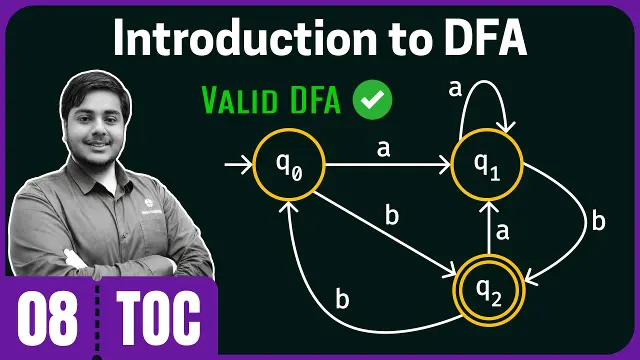
 Introduction to Deterministic Finite Automata
#Deterministic Finite Automata
2 ideas
Introduction to Deterministic Finite Automata
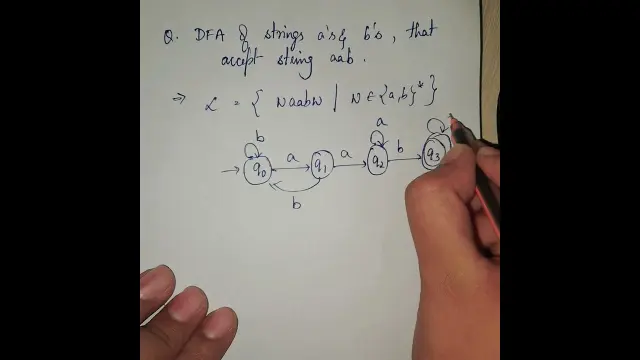 Designing a DFA for Strings Containing the Substring AAB
Get new #Deterministic Finite Automata ideas by email
Every Thursday: the week's best ideas, with the newest from #Deterministic Finite Automata.
Related tags
Deterministic Finite Automata
Deterministic finite automata, usually called DFAs, are one of the simplest and most important models in theoretical computer science. They describe machines that read a string of symbols one character at a time and decide whether the string belongs to a particular language. “Deterministic” means that for every state and every possible input symbol, there is exactly one next state.
What a DFA is
A DFA is made up of a finite set of states, a starting state, one or more accepting states, and a set of transitions between states. As the machine reads each symbol in the input, it moves from state to state according to the transition rules. When the input ends, the machine accepts the string if it is in an accepting state, and rejects it otherwise.
This idea is useful because it gives a precise way to describe patterns in strings. DFAs are often used to recognize simple regular languages, such as strings that contain a certain substring, have an even number of a symbol, or follow a fixed pattern.
Read more
Where DFAs come from
DFAs come from automata theory, a branch of mathematics and computer science that studies abstract machines and what they can compute. They are closely connected to regular expressions and regular languages. In fact, every DFA recognizes a regular language, and every regular language can be recognized by some DFA.
Because DFAs are so limited in memory, they cannot handle every kind of language. They do not “remember” unbounded information the way more powerful machines can. But that simplicity is also their strength: they are easy to analyze, and their behavior is completely predictable.
Common uses
DFAs are used to model pattern matching, lexical analysis, and simple state-based systems. When a problem can be described as a sequence of states with fixed rules, a DFA is often a natural fit. They are especially helpful for understanding how a system reacts to input step by step.
How to read one
When you look at a DFA, start with the initial state. Then follow the arrows for each symbol in the input, one at a time. A DFA must have a defined transition for every symbol from every state, so there is always exactly one path to follow as you read the string.
A good way to understand a DFA is to ask what each state represents. Often, each state corresponds to how much of the pattern has been matched so far, or to some property of the input, such as parity or position.
Tips for beginners
- Think of states as memory for a very small amount of information.
- Make sure every state has a transition for every symbol in the alphabet.
- Mark the accepting states clearly; they determine which strings are accepted.
- If you are designing a DFA, describe what each state means before drawing arrows.
- Test the machine on short examples first, then longer strings.
Common kinds of DFA problems
Many beginner exercises ask you to build a DFA for strings that:
- contain a given substring
- end with a particular pattern
- have an even or odd number of certain symbols
- avoid a forbidden substring
- satisfy a simple condition based on repetition or order
Once you see the logic behind the states, these machines become much easier to work with. The main skill is learning how to turn a language description into a small set of states and transitions.
Videos come from YouTube and posts from Instagram; titles and summaries are our own. All rights belong to their creators.