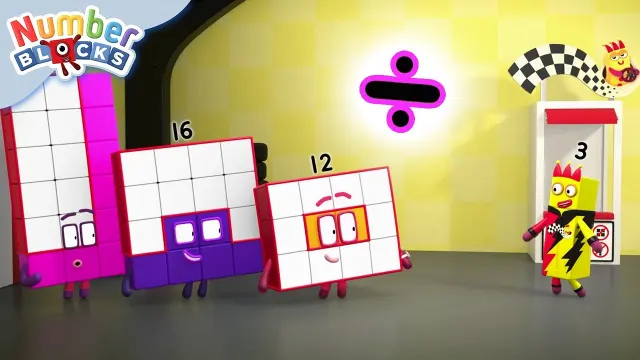
 Numberblocks Cartoon Explains Division at the Go-Kart Track
#Division for Kids
1 ideas
Numberblocks Cartoon Explains Division at the Go-Kart Track
Get new #Division for Kids ideas by email
Every Thursday: the week's best ideas, with the newest from #Division for Kids.
Related tags
Division for Kids: A Simple Guide to Sharing and Grouping
Division is one of the four basic operations in arithmetic, alongside addition, subtraction and multiplication. Put simply, it means splitting a quantity into equal parts, or finding out how many equal groups fit inside a larger amount. For a child, the idea is already familiar long before the word appears: dividing a bag of sweets fairly between friends, cutting a cake into slices, or dealing cards around a table are all division in action.
Two ways to picture it
Children understand division more easily when they meet it as something they can see and touch. There are two useful pictures, and both are worth showing.
The first is sharing. If twelve grapes are shared between three children, each child receives four. The question is: how many in each group?
The second is grouping. If you have twelve grapes and put four on each plate, how many plates do you need? Three. Here the question is: how many groups?
Read more
Both give the same answer, but the second picture becomes especially handy later, when children meet division with a remainder, because it shows clearly what is left over and why it cannot make another full group.
Building up from what they know
Division grows out of multiplication, and it helps enormously to treat them as a pair. Once a child knows that four times three is twelve, the related facts follow naturally: twelve shared between four gives three, and twelve shared between three gives four. Practising these fact families together, rather than as separate sums, builds confidence and reduces the sense of a new and mysterious topic.
Repeated subtraction is another gentle route in. How many times can you take five from twenty before nothing is left? Counting the steps gives the answer. Arrays, where objects are arranged in rows and columns, tie the two operations together visually: a rectangle of three rows of four can be read as multiplication one way and as division the other.
What beginners should know
Introduce the vocabulary alongside the idea: divide, share, group, equal, remainder. Use real objects first, then drawings, and only then the symbols. The division sign and the fraction form are different ways of writing the same instruction, and children benefit from meeting both slowly. Remainders deserve their own unhurried time, since they challenge the early assumption that numbers always divide neatly.
Practical tips
Keep sessions short and hands-on. Let your child do the sorting and the counting aloud while you ask open questions: how many in each group, how do you know it is fair, what happens to the ones left over. Mistakes are useful information, not failures, so ask how they arrived at an answer rather than simply correcting it. Board games, cooking, sharing out toys and dividing pocket money all offer natural practice without worksheets. Praise the thinking as much as the result, and let the speed come later.
#Division for Kids: frequently asked questions
How do I start teaching division to a young child?
Begin with something physical and familiar — sharing out grapes, dealing cards, or cutting a cake into equal slices — so the idea arrives before the word does. Let your child do the sorting and the counting aloud while you ask simple questions about how many go in each group and whether the shares came out fair. Only once the hands-on idea feels comfortable should you move on to drawings and then to written symbols.
What should my child already know before meeting division?
Division sits most easily on top of solid multiplication, so knowing a few times-table facts well makes the related division facts follow naturally. Treating multiplication and division as a pair — the same facts read in two directions — removes much of the sense of a strange new topic. Repeated subtraction and rows-and-columns arrays are gentle ways to connect the two before formal notation appears.
Should I show sharing or grouping first?
Both pictures are worth showing, since they ask slightly different questions: sharing asks how many go in each group, while grouping asks how many groups you can make. Sharing tends to feel more natural to begin with because it matches everyday fairness. Grouping becomes especially useful later, because it makes clear why something is left over and cannot form another full group.
How do I explain remainders without confusing my child?
Remainders challenge the early assumption that numbers always divide neatly, so give them their own unhurried time rather than tucking them into a lesson on something else. Set out objects and group them so your child can see exactly what is left and why it cannot make another full group. Talking through the leftover pieces out loud usually does more than any explanation from you.
What are the common mistakes when teaching division at home?
Rushing to symbols and worksheets before the hands-on idea has settled is the usual misstep, along with treating a wrong answer as a failure rather than a clue. When something goes wrong, ask how your child arrived at the answer instead of simply correcting it, because the reasoning tells you where the confusion sits. Keep sessions short, praise the thinking as much as the result, and let speed come later.
Any everyday ways to practise division besides worksheets?
Board games, cooking, sharing out toys and dividing pocket money all give natural practice without anything feeling like a lesson. Watching a number-based cartoon together and pausing to talk about what happened is another low-pressure route in. The best practice tends to be the kind your child does not notice is practice at all.
Videos come from YouTube and posts from Instagram; titles and summaries are our own. All rights belong to their creators.