 Quick Division Shortcuts and Mental Math Tricks
#Division Trick
1 ideas
Quick Division Shortcuts and Mental Math Tricks
Get new #Division Trick ideas by email
Every Thursday: the week's best ideas, with the newest from #Division Trick.
Related tags
Division Tricks and Mental Math Shortcuts
Division is the process of splitting a number into equal parts or working out how many times one number fits into another. It is one of the four basic operations in mathematics, and it shows up everywhere: sharing fairly, measuring ingredients, comparing quantities, budgeting, and checking answers in everyday calculations.
What division tricks are
A division trick is a shortcut that helps you calculate more quickly or more confidently, especially when working without a calculator. Some tricks make an exact answer easier to find. Others help you estimate a result or check whether your answer makes sense.
The most useful division tricks are based on patterns in numbers. If you understand how numbers relate to powers of 10, halves, quarters, and common factors, division becomes much easier. These methods are especially helpful for mental math, but they can also save time on paper.
Read more
Useful kinds of division shortcuts
A few division patterns appear often:
- Dividing by 2, 4, and 8 can often be done by repeated halving.
- Dividing by 10, 100, or 1000 means moving the decimal point left.
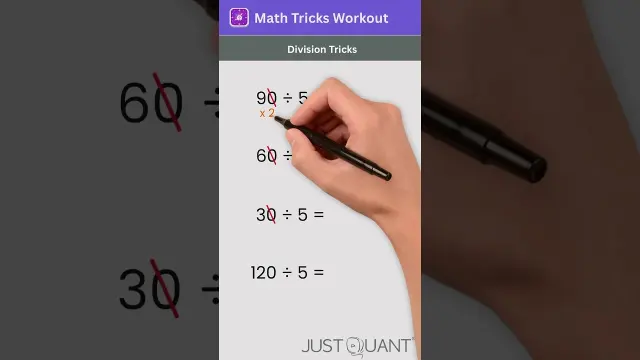
- Dividing by 5 can be handled by thinking of halves of tens.
- Dividing by 9, 3, or 6 can sometimes be simplified by breaking numbers into smaller parts.
- Dividing by 25 can be easier if you think in quarters of 100.
You can also use factor splitting. For example, if a number divides evenly into parts, you can divide step by step. This is useful when one divisor is harder to work with directly.
Mental math tips
When you divide mentally, it helps to look for a simpler route:
- Break a large number into friendly chunks.
- Use estimation first so you know the answer should be around a certain size.
- Check if the division is exact or if there will be a remainder.
- Round numbers when you only need an approximate result.
- Use multiplication to check your answer, because division and multiplication are inverse operations.
If you are dividing by a larger number, ask yourself how many times that number fits into the leading digits of the dividend. Then build the answer step by step. With practice, this becomes faster and more natural.
What beginners should know
A common mistake is trying to rush before understanding the basics. It is better to know what division means: sharing into equal groups or finding how many groups are in a total. Once that idea is clear, shortcuts make more sense.
It also helps to remember multiplication facts well. Division tricks depend heavily on knowing times tables, factors, and simple number relationships. The stronger your multiplication skills, the easier division becomes.
Practical advice
If you want to get better at division tricks, start small. Practice with easy numbers first, then move to larger ones. Work slowly at the beginning, and say the steps in your head if that helps. Over time, you will notice patterns more quickly and need fewer steps.
The most reliable shortcut is the one you understand. A good division trick should make the problem simpler, not more confusing. If a method feels unclear, fall back on long division or estimation until the pattern becomes familiar.
Videos come from YouTube and posts from Instagram; titles and summaries are our own. All rights belong to their creators.