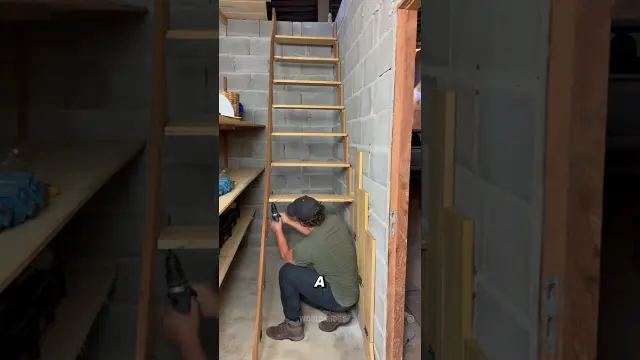
 Custom Folding Staircase Built With Heavy-Duty Hinges
#DIY Home
1 ideas
Custom Folding Staircase Built With Heavy-Duty Hinges
Get new #DIY Home ideas by email
Every Thursday: the week's best ideas, with the newest from #DIY Home.
Related tags
DIY Home Projects: A Beginner's Guide
DIY home is the practice of improving, repairing and personalising the place you live in yourself, rather than hiring someone to do it for you. The idea is simple: the person who lives in a space usually understands it best, and the act of making and mending by hand turns a house into something you have a hand in shaping. It covers everything from hanging a shelf to repainting a room, mending a chair to building a small piece of furniture from scratch.
Where it comes from
Doing things yourself around the house is older than the phrase. Households have always repaired, patched and adapted what they owned, often out of necessity. What changed is the modern context: ready-made materials, accessible tools and a wide culture of shared knowledge in books, classes and workshops. At its heart, DIY home is a continuation of ordinary household self-reliance, refreshed by the idea that making something is worth doing for its own sake.
The main kinds of projects
Read more
- Repairs and maintenance: fixing a loose hinge, patching a wall, replacing a tap washer, re-sealing a bathroom joint. Unglamorous, but these are the projects that protect everything else.
- Decorating: painting, wallpapering, tiling a splashback, changing handles and fittings to refresh a room without rebuilding it.
- Carpentry and building: shelves, simple storage, a bench, a small table. This is where DIY turns into genuine making.
- Upcycling and reusing: giving old furniture or salvaged timber a second life, which saves money and keeps useful things out of the skip.
- Small renovations: laying a floor, building a wardrobe insert, converting a cupboard into a workspace.
What beginners should know
Start smaller than you think you need to. A beginner who paints one wall well learns more than one who starts with a whole room and runs out of patience halfway. Choose projects where a mistake is cheap and visible early, so you can correct it before it spreads.
Read and watch more than one explanation of the same task. Different people solve the same problem differently, and seeing two or three approaches helps you understand why a technique works instead of just copying it.
Buy the right tool for the job once you know you will use it again, and borrow or hire the expensive things you only need occasionally. A drill, a decent tape measure, a spirit level, clamps and a sharp saw cover an enormous amount of ground.
Measure twice, cut once, and always check that a surface is level and square before you build on it. Most DIY frustration comes from a wobbly starting point, not from a lack of skill.
Practical habits
Work with the electricity and water switched off when a task involves either, and know your own limits. Gas, structural work, roofing and anything you are unsure about are jobs for a qualified tradesperson, and calling one is not a failure. Ventilate when you paint or sand, wear eye and ear protection, and keep a first aid kit and a fire extinguisher nearby.
Finally, accept the learning curve. DIY home is a skill built slowly, project by project. Your first shelf may be imperfect; your fifth will be square, solid and entirely yours.
#DIY Home: frequently asked questions
How should a complete beginner get started with DIY home projects?
Pick something deliberately modest, like repainting a single wall or re-hanging a door that sticks, so any slip stays small and easy to undo. Finishing one small job properly teaches you far more than half-finishing a big one, and it builds the confidence to take on the next. Only scale up once you have a feel for how long a task realistically takes.
What tools do I actually need before starting, and what can I skip?
A drill, a reliable tape measure, a spirit level, a set of clamps and one sharp saw will carry you through a surprising range of jobs. For anything expensive or specialised that you will only reach for once, borrow it or hire it rather than buying. Investing in good quality makes sense for the tools you will use again and again.
Which DIY project should I choose first?
Prioritise repairs and small decorating jobs, because they protect the rest of the house and forgive inexperience. Patching a wall, fixing a loose hinge or refreshing fittings gives quick visible progress with little risk. Save carpentry, bigger builds and anything structural for later, once your hands know what they are doing.
How do I keep a home that I've worked on in good condition?
Treat small maintenance tasks as ongoing rather than something you get to eventually, since a loose hinge or tired seal is much cheaper to fix now than later. Check joints, seals and surfaces whenever you notice a change, and deal with damp or wear promptly. Keeping your tools tidy and stored together also makes it easy to act while a problem is still minor.
What are the most common mistakes people make?
The big one is starting too large, running out of patience and leaving a room half-finished. The second is building on a surface that is not level or square, which causes problems that no amount of skill further down the line can rescue. Always measure more than once before cutting, and read several explanations of a technique so you understand why it works.
When should I stop and call a professional instead?
Gas work, structural alterations, roofing and anything involving wiring or plumbing beyond the simplest tasks belong with a qualified tradesperson. Being honest about your own limits protects both your home and your safety. Hiring someone for the parts you should not touch is good judgement, not a defeat.
Videos come from YouTube and posts from Instagram; titles and summaries are our own. All rights belong to their creators.