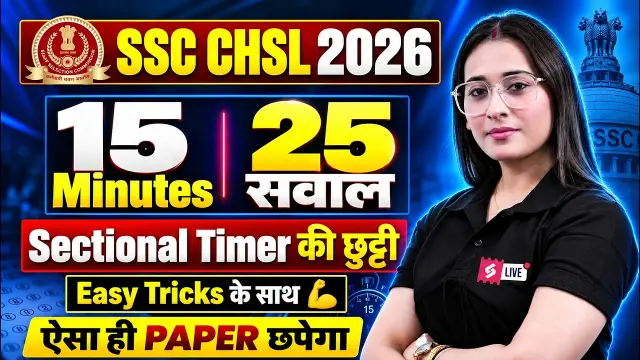
 SSC CHSL English Mock Test: Twenty-Five Questions in Fifteen Minutes
#English Mock Test
1 ideas
SSC CHSL English Mock Test: Twenty-Five Questions in Fifteen Minutes
Get new #English Mock Test ideas by email
Every Thursday: the week's best ideas, with the newest from #English Mock Test.
Related tags
How to Get the Most Out of an English Mock Test
An English mock test is a practice paper built to imitate the real thing: the same mix of sections, the same time pressure, the same instructions you will meet on the day of an exam. Its purpose is not to judge you. It exists so that the exam becomes familiar before it becomes decisive — so that the grammar questions, the reading passages and the clock all stop being surprises.
Mock tests appear wherever English is tested formally: school and university exams, competitive recruitment papers, and language proficiency tests. Because they mirror a real format, they are usually divided into sections — grammar and usage, vocabulary, sentence correction or rearrangement, comprehension, sometimes writing. Some are full-length and timed; others focus on a single area, and a third kind, the diagnostic test, is simply an honest starting point taken before any preparation.
Why practice under time matters
Reading English slowly and carefully is a different skill from reading it in fifteen minutes with twenty-five questions waiting. A timed mock test trains the second. You learn how long a comprehension passage really takes you, where you tend to linger, and which questions you should skip and return to rather than let them eat the clock. Nothing else quite reproduces that lesson.
Read more
Sitting the test properly
A mock test only works if you respect it. Sit in one stretch, without your phone, without a dictionary, without pausing the timer. Use a rough sheet for working but keep your answers on the paper. If a question confuses you, mark it and move on exactly as you would in the real hall. Finishing early and then going back is fine; stopping halfway to look something up is not, because the score you get afterwards will mean nothing.
The review is the real work
Most of the value comes after you finish. Mark the paper honestly, then go through every wrong answer and ask why it went wrong. Did you not know the rule? Did you misread the question? Did you rush? Keep a small error log: the word, the rule, the correction, in your own words. Patterns show up quickly — the same preposition, the same tense, the same habit of guessing from the sound of a sentence rather than its grammar.
For reading sections, revisit the passage and find the exact line that supports the correct answer. Learning to locate evidence is more useful than memorising answers.
Practical habits
- Take one full mock a week rather than five in a panic; spaced practice sticks.
- Alternate full-length papers with short sectional tests on your weakest area.
- Keep a vocabulary notebook of words you met inside questions, not lists copied from elsewhere.
- Revisit old papers a fortnight later; a mistake repeated twice is a lesson worth writing down.
Do not read your score as a verdict on your English. It is a snapshot of one attempt under one set of conditions, and it will move as your habits move. The point of a mock test is to make your mistakes cheap, early and visible — before they cost you anything that matters.
#English Mock Test: frequently asked questions
What exactly is an English mock test, and how do I begin?
It is a practice paper built to copy the format of the real exam — the same sections, the same instructions, the same time pressure — so that nothing on the day comes as a surprise. Begin by picking a paper that matches the exam you are actually facing, then sit it once under genuine conditions before you change anything about how you study.
What do I need in order to sit a mock test properly?
A quiet, uninterrupted stretch of time, a rough sheet for working, and the discipline to keep your phone and dictionary out of reach. Answers stay on the paper and the timer keeps running, because a score earned with help tells you nothing useful about your readiness.
Which kind should I choose — full-length, sectional, or diagnostic?
A diagnostic paper taken before any preparation gives you an honest picture of where you actually stand. After that, alternate full-length papers with short sectional tests aimed at your weakest area, so you build stamina and repair gaps at the same time.
How do I get real value out of reviewing the paper?
Mark it honestly, then go through every wrong answer and ask why it went wrong: a rule you did not know, a question you misread, or a rush you could have avoided. Keep a small error log in your own words, and for reading sections go back to the passage and find the exact line that supports the correct answer.
What mistakes do people commonly make with mock tests?
Cramming many papers in a panic instead of spacing them out, and pausing the clock or looking things up halfway through. Another common one is reading the score as a verdict on their English rather than as a snapshot of a single attempt.
Videos come from YouTube and posts from Instagram; titles and summaries are our own. All rights belong to their creators.