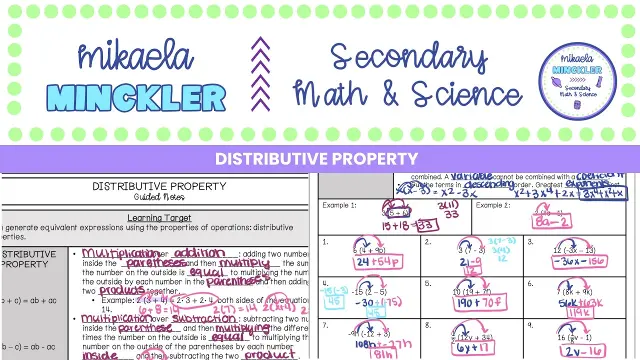
 Distributive Property: Guided Notes Lesson for Sixth Grade Math
#Expressions
1 ideas
Distributive Property: Guided Notes Lesson for Sixth Grade Math
Get new #Expressions ideas by email
Every Thursday: the week's best ideas, with the newest from #Expressions.
Related tags
Understanding Mathematical Expressions: A Beginner's Guide
A mathematical expression is a combination of numbers, variables and operation signs that represents a value. It is one of the first real tools of algebra, and it shows up long before you notice you are doing algebra at all. Something as simple as 7 + 4 is an expression, and so is 3x − 5y + 2.
What makes an expression an expression
The key thing to understand is that an expression has no equals sign. It is a phrase, not a sentence. It describes an amount without claiming that amount is equal to anything. An equation, by contrast, states that two things are equal, which is why equations can be solved and expressions can only be simplified or evaluated. If you find yourself looking for a value to "solve for," check whether there is an equals sign — if not, there is nothing to solve, only something to rewrite more neatly.
The parts and their names
Read more
Expressions are built from a few familiar pieces. A constant is a plain number whose value never changes. A variable is a letter standing in for a number you do not yet know or one that can vary. A coefficient is the number multiplying a variable, so in 5x the coefficient is 5. Terms are the chunks separated by plus and minus signs, and like terms are those with the same variable part, which is why 4x and 9x can be combined but 4x and 4y cannot.
Evaluating and simplifying
Evaluating means substituting a value for the variable and working out the result. Simplifying means rewriting the expression in a shorter equivalent form without changing its value. Both depend on the order of operations: work through parentheses first, then exponents, then multiplication and division from left to right, then addition and subtraction from left to right. A very common beginner mistake is treating 2 + 3 × 4 as 20 rather than 14, or dropping a minus sign when a subtraction sits in front of a bracket.
The distributive property
One rule earns special attention because it comes up constantly: a(b + c) = ab + ac. Multiplying what is outside the parentheses by each term inside lets you remove brackets and combine like terms afterwards. Watch the signs carefully here, especially with negatives, since −3(x − 4) becomes −3x + 12, not −3x − 12.
Practical habits for beginners
Write each step on its own line so you can retrace your work. Circle or underline like terms before combining them. Substitute your answer back in to check that the simplified form really matches the original for a sample number. And keep variables in alphabetical order in your final answer — it is a small convention, but it makes your work much easier to read, both for you and for anyone marking it.
#Expressions: frequently asked questions
How do I know whether something is an expression or an equation?
Look for an equals sign: an expression is a phrase that describes an amount, while an equation is a sentence claiming two amounts are equal. That is why you simplify or evaluate an expression but solve an equation. If there is nothing to solve for, you are working with an expression.
What is the difference between evaluating and simplifying?
Evaluating means replacing the variable with a given value and calculating the result, so you end up with a single number. Simplifying means rewriting the expression in a shorter equivalent form, such as combining like terms, without changing what it is worth. The second keeps the variables; the first replaces them.
Which order should I follow when working through an expression?
Handle parentheses first, then exponents, then multiplication and division from left to right, and finally addition and subtraction from left to right. Most beginner errors come from doing the operations in the order they happen to be written. Writing each step on its own line makes the sequence easy to check.
Why can I combine some terms but not others?
Terms can only be combined when their variable parts match exactly, because they represent the same kind of amount. A term in one variable and a term in another are different quantities, so they stay separate. Underlining the like terms before you combine them saves a lot of confusion.
What is the most common mistake when removing brackets?
Sign errors, especially when a negative number or a minus sign sits in front of the bracket. Every term inside must be multiplied by what is outside, and each sign has to be carried through carefully. Substituting a sample value back into the original and the simplified version is a quick way to catch a slip.
Videos come from YouTube and posts from Instagram; titles and summaries are our own. All rights belong to their creators.