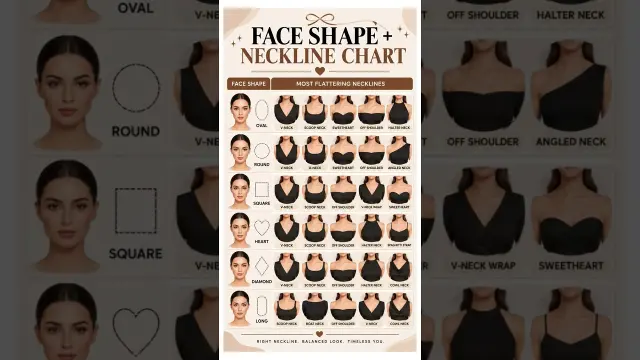
 Face shape and neckline style guide for outfit inspiration
#Face Shape
1 ideas
Face shape and neckline style guide for outfit inspiration
Get new #Face Shape ideas by email
Every Thursday: the week's best ideas, with the newest from #Face Shape.
Related tags
Face Shape: A Friendly Guide to Finding Yours and Styling It
Face shape is simply the outline your face makes when you look at it straight on: the width of your forehead, cheekbones and jaw, and how those widths compare. It is a description of proportion, not a measure of beauty, and it is far less fixed than it sounds. Bone structure gives you a starting point, but hair, glasses, weight changes and the way you hold your head all shift the picture. Think of it as a helpful reference rather than a rulebook.
How to find yours
Tie your hair back, stand in front of a mirror in even light and look directly ahead. Trace the outline of your face with your eyes, or take a photo at eye level and draw over it. Then ask yourself three questions: is your face clearly longer than it is wide, or roughly equal? Is your forehead wider than your jaw, narrower, or about the same? And is your jawline softly curved, or more angular and defined?
Most people do not fit neatly into a single category, and that is completely normal. Many faces sit between two shapes, and one side may read slightly differently from the other.
Read more
The common shapes
- Oval: the length is a little greater than the width, with the forehead slightly wider than the jaw and a softly rounded chin. Often described as the most balanced, which is why almost any style tends to work.
- Round: width and length are close, with full cheeks and a gently curved jawline. The overall impression is soft and youthful.
- Square: the forehead, cheekbones and jaw are similar in width, with a stronger, more angular jaw. The impression is defined and structured.
- Heart: a wider forehead and cheekbones narrowing to a pointed or narrow chin, sometimes with a widow's peak.
- Oblong or rectangular: noticeably longer than wide, with a fairly even width from forehead to jaw.
- Diamond: cheekbones are the widest point, with a narrower forehead and chin.
- Triangle: the jaw is the widest part, tapering upward to a narrower forehead.
What to do with the information
The usual aim is balance: adding width where a face is narrow, softening where it is angular, or creating length where it is short. These are gentle suggestions, not corrections.
- Hair: volume and length change your outline more than anything else. Round and square faces often suit styles with height at the crown and some length past the jaw, while long faces can carry width at the sides beautifully. A fringe is a quick way to shorten a longer face or soften a wide forehead.
- Glasses: frames that contrast with your outline tend to flatter. Angular frames bring structure to round faces, rounded frames soften square ones, and frames that follow the brow line generally sit comfortably.
- Necklines: a wide, shallow neckline adds width, while a deep V or a high collar lengthens. Balance a strong jaw with softer, curved necklines, and echo a pointed chin with a V.
- Makeup: a little light and shade can shift emphasis, but subtlety usually looks better than contouring heavily.
Experiment in small ways and trust your own eye. The shape that suits you best is the one you feel at home in.
#Face Shape: frequently asked questions
How do I work out my own face shape?
Pull your hair back, find even light and look straight into a mirror, then trace the outline of your face with your eyes or on a photo taken at eye level. Compare the length to the width, check whether your forehead or jaw is broader, and notice whether your jawline curves softly or looks more angular. Most people land between two shapes rather than in one neat box, and that is normal.
What do I actually need to get started?
Nothing more than a mirror, decent lighting and a way to tie your hair back so your outline is visible. A photo taken straight on is handy if you want to draw over it or compare angles later. Everything else, like hair styling, glasses or necklines, comes after you have a rough idea of your proportions.
How do I choose hairstyles or glasses for my face shape?
The usual goal is balance: add width where the face is narrow, soften what looks angular, or bring length to a shorter outline. Hair with height at the crown and some length past the jaw tends to suit rounder and squarer faces, while longer faces carry side width well. For glasses, frames that contrast with your outline usually flatter, and frames that follow the brow line tend to sit comfortably.
Which face shapes are considered the most versatile?
Oval faces, where the length is a little greater than the width and the forehead is slightly broader than the jaw, are often called the most balanced because so many styles work on them. That said, every shape has looks that flatter it, and the aim is proportion rather than fitting a category. Treat the labels as a reference point, not a rulebook.
How do I pick a neckline for an occasion?
Wide, shallow necklines add width across the shoulders, while a deep V or a high collar draws the eye downward and lengthens the line. Softer curved necklines balance a strong jaw, and a V shape echoes a pointed chin nicely. Choose the one that feels right for the event and comfortable on you.
What mistakes should I avoid?
The main one is treating your face shape as a fixed verdict and ruling out styles you actually like. Heavy contouring and rigid rules tend to look harsher than subtle adjustments, and bone structure shifts with hair, glasses, weight and how you hold your head. Experiment in small ways and trust your own eye.
Videos come from YouTube and posts from Instagram; titles and summaries are our own. All rights belong to their creators.