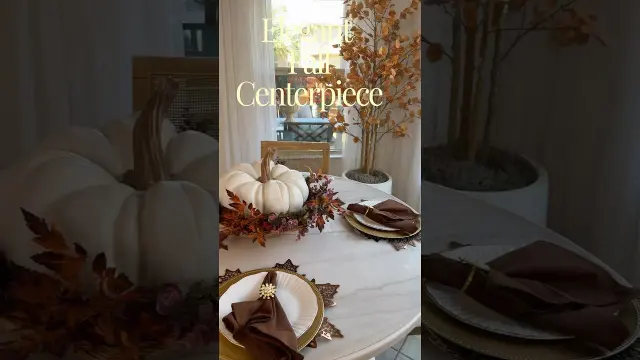
 Elegant and Cozy Fall Tablescape Centerpiece Styling
#Fall Centerpiece
1 ideas
Elegant and Cozy Fall Tablescape Centerpiece Styling
Get new #Fall Centerpiece ideas by email
Every Thursday: the week's best ideas, with the newest from #Fall Centerpiece.
Related tags
Fall Centerpiece Ideas: A Guide to Autumn Table Styling
A fall centerpiece is the arrangement that sits at the heart of a table in autumn — on a dining table, a sideboard, a porch bench or a windowsill — and carries the colours and textures of the season. It is less a single object than a way of gathering things: gourds, dried stems, leaves, candles, fruit, textiles. The idea grows out of harvest decoration, the long tradition of marking the end of the growing season with what the garden and the fields have produced, and it has softened over time into something anyone can put together with a basket and an afternoon.
The building blocks
Most autumn arrangements rest on a few familiar materials. Pumpkins and squash in their many shapes and sizes do the heavy lifting, from small decorative gourds lined along a runner to one large specimen on its own. Dried and fresh branches — eucalyptus, birch, magnolia leaves, twigs with berries — give height and movement. Candles add warmth, whether tall tapers in holders or a cluster of pillars at different heights. Fruit such as apples, pears and crabapples brings colour and a quiet nod to the harvest. Textiles, linen runners, woven baskets and wooden boards, tie the whole thing to the table beneath.
Styles worth knowing
Read more
The natural, gathered look uses foraged material loosely arranged, deliberately uneven, with the odd bare stem. A more formal approach keeps shapes symmetrical and colours restrained — cream pumpkins, brass candlesticks, a single repeated element in a row. Rustic arrangements lean on raw wood, burlap, dried corn and moss. Modern, minimal versions use one type of object in quantity: a line of small gourds, a single branch in a tall vessel, three candles of the same height. None of these is more correct than another; the one that suits your room is the right one.
Getting the proportions right
Scale matters more than any individual ingredient. A centerpiece should either be clearly shorter than eye level when people are seated across from each other, or tall and narrow enough to see around. Long tables usually want length rather than height; round tables suit a single generous cluster. Work in odd numbers, vary heights, and leave a little empty space so the arrangement can breathe.
Practical tips for beginners
Choose a colour story before you shop — warm rusts and oranges, muted greens and creams, or deep plum and gold — and let one or two accents repeat through the piece. Build from the bottom up: place the largest items first, then fill gaps with smaller ones, then add stems last. If you are using fresh material, condition it by trimming stems and keeping them in water where possible, and keep candles clear of anything dry. Real pumpkins last well in cool rooms; dried stems and gourds can be packed away and reused year after year. Above all, keep it simple enough that you can remake it in a few minutes, so the table stays dressed through the whole season.
#Fall Centerpiece: frequently asked questions
How do I start a fall centerpiece if I have never made one before?
Start by deciding where the piece will live and how much room it has, since a long dining table calls for something spread along its length while a round table wants one generous cluster. Pick a colour story first, then gather a few materials that repeat those tones. Build from the bottom up by placing the largest items before filling in gaps and adding stems, so the arrangement stays balanced as it grows.
What materials do I actually need to put one together?
You only need a handful of things: something substantial like pumpkins, squash or gourds, something with height such as branches or dried stems, and something warm like candles. Fruit, a woven basket, a wooden board or a linen runner ties the arrangement to the table it sits on. Foraged twigs and leaves work just as well as bought material, which keeps the whole thing simple and inexpensive to remake.
Which style of fall centerpiece should I choose for my home?
Look at the room rather than at trends: a relaxed, gathered arrangement of foraged stems and gourds suits casual spaces, while restrained colours and symmetrical shapes read as more formal. Rustic versions lean on raw wood, moss and dried corn, and minimal ones repeat a single element in a row for a cleaner look. None of these is more correct than another, so pick the one that matches what is already in the room.
How do I keep a fall centerpiece looking good through the season?
Keep fresh stems trimmed and in water where possible, and set pumpkins in a cool spot so they hold up longer. Keep candles well clear of anything dry, since dried material and open flame are a poor pairing. Dried stems, gourds and baskets can be packed away and brought out again the following year, so choose materials you can reuse.
What are the most common mistakes people make with fall centerpieces?
The most frequent problem is scale: a piece that blocks the view across the table makes conversation awkward, so aim for something clearly low or tall and narrow. Another is crowding — leaving a little empty space lets the arrangement breathe and shows off the individual pieces. Finally, overcomplicating it makes the table hard to refresh, so keep it simple enough that you can remake it in a few minutes.
Videos come from YouTube and posts from Instagram; titles and summaries are our own. All rights belong to their creators.