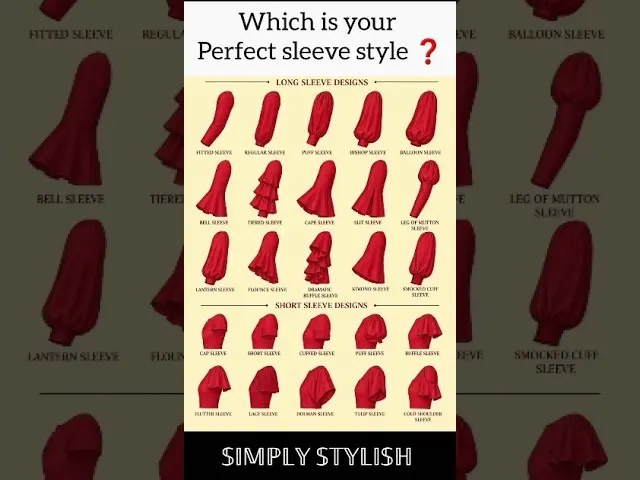
 Chart of 25 Long and Short Sleeve Designs With Their Names
#Fashion Chart
1 ideas
Chart of 25 Long and Short Sleeve Designs With Their Names
Get new #Fashion Chart ideas by email
Every Thursday: the week's best ideas, with the newest from #Fashion Chart.
Related tags
Fashion Charts: Naming the Parts of a Garment
A fashion chart is a reference sheet that sets a simple line drawing beside the word for what it shows. Instead of a glossary you have to read through, you get a picture and a name in the same glance, which is why these charts are pinned up in sewing rooms, design studios and wardrobe corners alike. They are less about telling you what to wear than about giving you the vocabulary to say what you are looking at.
Where the idea comes from
Illustrated garment references grew out of dressmaking and pattern-cutting instruction, where a student has to recognise a shape before they can draft or sew it. Tailoring manuals, home-economics textbooks and the backs of sewing patterns all relied on the same device: a neat flat sketch with a caption. Designers and manufacturers still use flat drawings to communicate a garment precisely, because a drawing carries proportion and construction in a way a paragraph cannot.
What a chart usually covers
Read more
Most charts stay within one family of details, so the differences between neighbours are easy to see.
- Necklines: scoop, square, boat, V, halter, sweetheart, off-shoulder.
- Collars: shirt, stand, shawl, notch, Peter Pan, sailor.
- Sleeves: set-in, raglan, dolman, puff, bell, cap, bishop, kimono.
- Skirts and trousers: A-line, pencil, pleated, wrap, straight, wide leg.
- Silhouettes and lengths: fitted, relaxed, empire, column, midi, maxi.
Some charts go further and cover pleats, pockets, cuffs, closures or fabric weaves, but the principle is the same: one category, drawn consistently, so comparison does the teaching.
How to read one properly
Start with the outline and ignore the fabric, the styling and the colour — those change and the shape does not. Check whether you are looking at a front view or a back view, since a yoke or a seam often only appears on one. Then compare the drawing with its nearest neighbour on the sheet rather than with the whole page; the difference between a halter and a sweetheart neckline, or a trumpet and a flared sleeve, is usually a matter of a few centimetres of line.
If you want to make your own
Choose a single category, draw everything in flat line at the same scale, and keep the proportions of the body consistent so the garments can be judged against each other. Label each item with the everyday name first and the technical term second, if there is one. A chart you have drawn yourself, even roughly, tends to stick in the memory far better than one you have only read.
Videos come from YouTube and posts from Instagram; titles and summaries are our own. All rights belong to their creators.