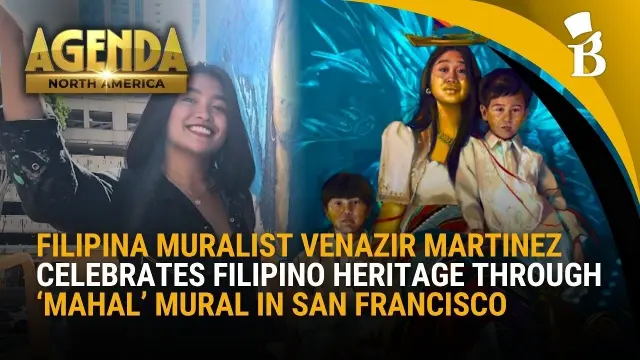
 Muralist Venazir Martinez Paints Filipino Love in San Francisco
#Filipino Artists
1 ideas
Muralist Venazir Martinez Paints Filipino Love in San Francisco
Get new #Filipino Artists ideas by email
Every Thursday: the week's best ideas, with the newest from #Filipino Artists.
Related tags
Filipino Artists: A Guide to Art in the Philippines
The Philippines is a country of more than seven thousand islands, and its art is just as scattered and varied. When you follow the work of Filipino artists, you are not looking at a single tradition but at many: highland weaving, coastal carving, Islamic woodwork in the south, church painting under Spanish rule, and a restless contemporary scene that reaches from Manila galleries to studios in the diaspora.
Where it comes from
Long before colonial contact, communities across the archipelago made objects of daily and spiritual use — textiles, baskets, pottery, beads, weapons and carved figures — and many of those crafts are still practised by families who have held the knowledge for generations. Trade with neighbouring Asia brought further motifs and materials. Three centuries of Spanish rule then layered in Catholic imagery and European academic painting, followed by American-style art schools in the twentieth century. Filipino artists have always worked with that layered inheritance rather than pretending it isn't there.
The main strands
Read more
Folk and traditional arts remain the deepest root. Weaving is perhaps the best known, with regions producing distinctive cloth in cotton, abaca and pineapple fibre, often with geometric patterns passed down through families. Woodcarving and metalwork flourish too, and in Mindanao the flowing okir and ukkil motifs of Islamic-influenced design give architecture, tools and textiles their characteristic curves.
Painting developed strongly from the nineteenth century onward, when Filipino painters trained in Europe turned to local subjects — landscapes, markets, rural life — and later to modernism, abstraction and social realism. That last strand still matters: many artists treat their work as a way of documenting labour, poverty, migration or political life.
Contemporary practice
Today's Filipino artists work across painting, sculpture, photography, video, installation, textiles and digital media. Murals and street art have become a visible part of city life, often carrying community stories. Many artists also live and work abroad while keeping ties at home, so the conversation moves back and forth across oceans.
What beginners should know
Art here is deeply regional. What you find in the Cordillera is not what you find in Iloilo, Cebu, Zamboanga or Manila, so look at particular communities rather than a vague national style. Learn to recognise the difference between a craft tradition and a contemporary artist's reinterpretation of it, and treat the first with particular care — it belongs to living communities, not to the open market of ideas.
Practical tips
Visit museum collections and regional galleries when you can, and independent spaces where new work is shown. Read the wall text rather than only the images; context carries a lot here. If you follow artists online, hashtags are a good way to find them, but treat social media as a starting point and seek out longer interviews and exhibition catalogues. And if you buy, prefer work that names its maker and its community fairly.
#Filipino Artists: frequently asked questions
How do I start exploring Filipino art if I know almost nothing about it?
Start with a single region or tradition rather than trying to grasp the whole country at once, since the art of the highlands, the coastal south and Manila's contemporary scene have very different histories. Museum collections and regional galleries are the easiest entry point, and the wall text will teach you more than the images alone. Follow one thread you like — weaving, carving, or painting — and let it lead you outward.
What should I learn before buying a piece of Filipino art or craft?
Learn to tell a living craft tradition apart from a contemporary artist's reinterpretation of it, because the two carry different obligations and different meanings. A traditional textile or carving usually belongs to a specific community and family lineage, so buy from sellers who name the maker and the community honestly. For paintings and newer work, ask about the artist's background and exhibition history rather than relying on a hashtag.
How can I follow Filipino artists online without getting a shallow view?
Hashtags and social feeds are a reasonable starting point for discovering names, but they flatten context. Once you find artists you like, look for longer interviews, exhibition catalogues and gallery write-ups that explain where the work sits. Treat social media as a doorway into that reading, not as the reading itself.
Is Filipino art one style I can learn to recognise?
No — it is many traditions layered over each other, from highland weaving and Islamic-influenced woodwork to church painting and a contemporary scene spread across Manila and the diaspora. What you see in one province may have little in common with another, so look at particular communities instead of hunting for a single national look. The layering is the through-line, not a shared visual language.
What kinds of pieces work well as a gift or for a specific occasion?
Small textiles, baskets, ceramics and carved objects tend to suit everyday gifting, while a painting or print works better for someone who has space and a real interest in the artist. If the piece comes from a craft tradition, pass along what you learned about the community that made it — the story is part of the gift. For weddings and family occasions, a commissioned or locally made object often means more than something imported.
What mistakes do beginners make with Filipino art?
The common ones are treating the country as a single art scene, and mistaking community craft for free-floating design inspiration that anyone can borrow. Another is buying anonymously — from sellers who cannot say who made the work or where it came from. Slow down, read the context, and favour work that credits its maker fairly.
Videos come from YouTube and posts from Instagram; titles and summaries are our own. All rights belong to their creators.