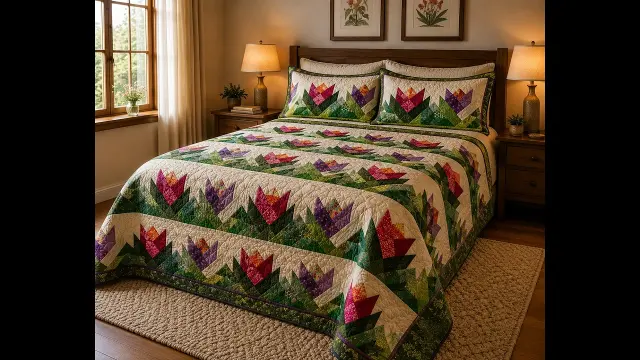
 Simple Tulip Quilt Block Pattern and Layout Idea
#Floral Quilt
1 ideas
Simple Tulip Quilt Block Pattern and Layout Idea
Get new #Floral Quilt ideas by email
Every Thursday: the week's best ideas, with the newest from #Floral Quilt.
Related tags
Floral Quilts: Patterns, Blocks, and Sewing Ideas
What a floral quilt is
A floral quilt is any quilt that uses flower motifs as its main design idea. The flowers may appear in the fabric print, in pieced blocks shaped like petals and blossoms, or in appliqué details stitched onto a plain background. Floral quilts have a long home-sewing tradition because flowers are familiar, decorative, and easy to adapt to many styles.
You’ll see floral quilts in many forms. Some look traditional and cottage-like, with small prints and soft colours. Others feel bold and graphic, using large blossoms or simple repeating shapes. Some quilts are built entirely from flower blocks, while others use floral fabric as an accent among solids or geometric patches.
Common styles and approaches
Read more
There are several classic ways to make a floral quilt:
- Pieced flower blocks: The quilt is made from squares, triangles, and other shapes arranged into blossoms, leaves, and stems.
- Appliqué floral quilts: Flower shapes are cut from fabric and sewn onto a background, either by hand or machine.
- Floral print quilts: The beauty comes mainly from printed fabric, often paired with plain fabrics to let the prints stand out.
- Mixed motifs: Flowers are combined with borders, stars, baskets, or simple patchwork for a more varied look.
If you like a gentle, romantic feel, small repeating prints and soft colours work well. If you prefer something cleaner and more modern, try larger floral shapes, more open space, and stronger contrast between fabrics.
Fabrics, colour, and design
Floral quilts can be as subtle or as lively as you want. When choosing fabrics, it helps to think about scale, contrast, and balance.
- Small prints often read as texture from a distance.
- Large floral prints create focal points and can make a quilt feel bold.
- Solids or calm tonal fabrics give the eye a place to rest.
- Dark backgrounds can make light flowers glow, while light backgrounds keep the quilt airy.
A good floral quilt usually needs a mix of busy and quiet areas. Too many strong prints together can feel crowded, so pairing floral fabrics with solids or simple coordinates often gives the best result.
Techniques beginners should know
If you are new to quilting, start with one simple block repeated across the quilt. Repetition makes piecing easier and gives the quilt a pleasing rhythm. Press seams carefully as you sew, and try to keep your seam allowances consistent so the blocks fit together well.
For appliqué, begin with larger shapes rather than tiny petals. Clean edges, slow stitching, and careful placement matter more than complicated detail. If you are using printed florals, practice arranging the fabrics first so the colours feel balanced across the quilt top.
A few practical tips can help:
- Prewash fabrics if you want to reduce later shrinkage and colour bleeding.
- Cut accurately, especially when using many small pieces.
- Lay out the quilt before sewing the rows together.
- Use a simple binding colour that supports the overall design.
Finishing and use
Floral quilts are popular for bed covers, throws, nursery quilts, wall hangings, and decorative lap quilts. The quilting stitches can stay simple if the fabric pattern already does much of the visual work. Straight-line quilting gives a modern look, while gentle curves or echo quilting can echo the softness of petals and vines.
However you make it, a floral quilt feels timeless because flowers never go out of place in the home. It can be sweet or elegant, rustic or refined, but it always brings a sense of comfort and warmth.
#Floral Quilt: frequently asked questions
How do I start making a floral quilt if I'm a beginner?
Pick one simple flower block and repeat it across the whole quilt, which keeps the piecing predictable and gives the design a steady rhythm. Practice on a small project first, sew with consistent seam allowances, and press each seam as you go so the blocks line up. Building up accuracy on an easy repeat is easier than jumping straight into a complicated layout.
What supplies do I need to make a floral quilt?
You need fabric for the quilt top, a backing, batting for the middle layer, and something for the binding, plus thread, pins, a rotary cutter or good scissors, and a ruler for accurate cutting. An iron matters as much as the sewing tools, since careful pressing is what makes blocks fit together. For appliqué, add fusible web or templates if you plan to cut flower shapes.
Which style of floral quilt should I choose?
Choose soft, small repeating prints with gentle colours if you want a traditional, cottage-like look, or large blossoms with open space and strong contrast if you prefer something modern and graphic. Think about where the quilt will live too: a nursery or bed cover usually suits calmer fabrics, while a wall hanging can carry bolder motifs. If you enjoy handwork, appliqué gives you shaped flowers; if you like structure, pieced flower blocks may suit you better.
How do I care for a floral quilt so it lasts?
Prewashing fabrics before you sew reduces later shrinkage and helps prevent colours from bleeding into one another. Once finished, wash gently and avoid harsh heat, since strong washing and drying are what wear out stitching and fade prints over time. Store the quilt folded loosely away from direct sun, and air it rather than over-washing it.
How do I stop a floral quilt from looking too busy?
Give the eye somewhere to rest by mixing busy prints with solids or quiet tonal fabrics, and let one large floral print act as the focal point rather than several at once. Small prints tend to read as texture from a distance, so they can fill space without adding clutter. Laying out the whole quilt top before sewing the rows is the easiest way to spot a section that feels crowded.
What are common mistakes to avoid in a floral quilt?
The most frequent problems are inaccurate cutting, wobbly seam allowances, and skipping the layout stage, all of which show up later as blocks that don't line up. Trying tiny petals or fussy detail on a first appliqué project is another common frustration, so start with larger shapes. Choosing a binding that competes with the flowers is a small mistake that can weaken an otherwise lovely design.
Videos come from YouTube and posts from Instagram; titles and summaries are our own. All rights belong to their creators.