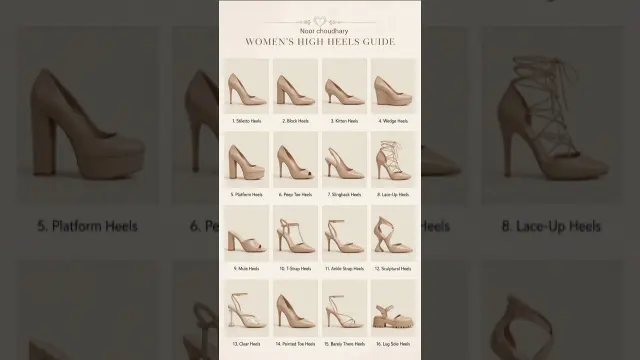
 Ultimate footwear reference guide for heel types
#Footwear Guide
1 ideas
Ultimate footwear reference guide for heel types
Get new #Footwear Guide ideas by email
Every Thursday: the week's best ideas, with the newest from #Footwear Guide.
Related tags
Footwear Guide: How to Understand and Choose Shoes
Footwear is the quiet foundation of everything you wear. Shoes protect the feet from weather, rough ground and strain, and they also change how you stand, walk and feel. Long before anyone thought of them as fashion, people wrapped and stitched coverings around their feet for warmth and protection, and the basic idea has not changed much since. What has changed is variety: there is now a shoe for nearly every situation, and understanding the vocabulary makes choosing one far easier.
The parts of a shoe
Most shoes, however different they look, are built from the same few elements. The upper is the material that covers the foot, usually leather, suede, canvas, woven textile or a synthetic. The sole sits underneath, often with a softer midsole for cushioning and a harder outsole for grip. The heel lifts the back of the foot, the insole is the layer you stand on, and the lining is what your foot touches inside. The closure — laces, a buckle, elastic, a zip or none at all — decides how the shoe holds the foot. A shoe's shape is built on a last, the mould that gives it its volume and width.
Main kinds of footwear
Read more
- Everyday shoes: simple lace-ups, loafers and slip-ons made for walking and working.
- Formal shoes: oxfords, derbies and pumps, cut cleanly and finished carefully.
- Athletic shoes: designed around a specific movement, with cushioning and flexibility where that activity needs it.
- Boots and outdoor footwear: higher-cut shoes with a sturdier sole and more protection.
- Sandals and open shoes: minimal coverage for warm weather, held on by straps.
- Heeled shoes: from a low block heel to a flat to a fine stiletto, or a wedge that runs the full length of the sole. Each changes balance and posture differently.
Finding a good fit
Fit matters more than any label on the box. Feet change size over a lifetime and often swell slightly during the day, so try shoes later rather than first thing in the morning. Stand up and walk: your longest toe should have a little room in front, and the widest part of your foot should sit at the widest part of the shoe. Check the width as carefully as the length, since a shoe that is long enough but too narrow will never feel right. Heels and dress shoes should feel comfortable at the moment you buy them; there is no gentle breaking-in period that fixes a bad shape.
Materials and everyday care
Leather softens and moulds with wear and can be revived with polish; suede needs a brush and protection from rain; canvas and textile are light and breathe but stain more easily; rubber soles grip well and wear down eventually. Rotate your shoes rather than wearing one pair daily, let them dry slowly and away from direct heat, use shoe trees to hold their shape, and clean off dirt before it settles in. Repairing is often worth it — a new sole or a replaced heel can extend a favourite pair by years, and it is usually the more thoughtful choice as well.
#Footwear Guide: frequently asked questions
How do I start building a footwear collection that actually works?
Begin with the situations you actually walk into: a pair for everyday errands and work, something a little smarter for occasions, and footwear suited to weather and ground where you live. Add the specialised pairs, like athletic or outdoor shoes, only when an activity calls for them. Buying for real routines rather than imagined ones keeps the collection small and useful.
What should I check first when trying on a new pair?
Try shoes later in the day, when feet are naturally a bit fuller, and always stand and walk rather than judging them sitting down. Feel for space ahead of your longest toe and make sure the widest part of your foot lines up with the widest part of the shoe, checking width as closely as length. If a dress shoe or heel pinches now, it will keep pinching, so trust that first impression.
How do I choose the right kind of shoe for a particular occasion?
Start with the ground you will be standing on and how long you will be on your feet, then match the formality to the setting. Clean-cut leather styles suit dressier occasions, simple lace-ups and loafers cover most everyday situations, and sturdier boots handle rough or wet conditions better. The right pair is the one that fits the setting and still feels good after a few hours.
What is the best way to look after shoes day to day?
Give pairs a rest between wears, let them air out slowly away from radiators or direct sun, and clear off dirt before it works into the material. Leather responds well to polish, suede wants a brush and protection from wet weather, and shoe trees help everything keep its shape. When a sole or heel wears through, repairing it is often the smarter move than replacing the pair.
What mistakes do people make most often with footwear?
The common ones are buying for the label or the look and ignoring how the shoe actually feels, and settling for the right length while overlooking width. Another is wearing the same pair every single day, which wears it out far faster and never gives it a chance to dry properly. Skipping basic cleaning and small repairs early is what shortens a shoe's life most.
How do different heel styles change the way a shoe feels?
A low block heel spreads weight over a wider base and tends to feel steadier, while a fine stiletto concentrates it and demands more balance. A wedge runs the full length of the sole and gives a different, more even footing, and a flat keeps you closest to the ground. Try each shape standing and walking before deciding, since the same height can feel quite different from one design to another.
Videos come from YouTube and posts from Instagram; titles and summaries are our own. All rights belong to their creators.