 What Is a Fuzzy Set? A Short Visual Explanation of Fuzzy Sets
#Fuzzy Sets
1 ideas
What Is a Fuzzy Set? A Short Visual Explanation of Fuzzy Sets
Get new #Fuzzy Sets ideas by email
Every Thursday: the week's best ideas, with the newest from #Fuzzy Sets.
Related tags
Fuzzy Sets: A Gentle Introduction to Gradual Truth
Most of the sets you meet in mathematics are strict. An object either belongs to a set or it does not, and there is nothing in between. A number is prime or it is not; a person is registered as a voter or they are not. This is enormously useful, but it struggles with the words we actually use. Is a person tall? Is the water warm? Is the traffic heavy? Everyday categories fade at the edges, and forcing them into yes-or-no boxes throws away information that matters.
A fuzzy set keeps that information. Instead of asking whether an element is inside the set, it asks how strongly it belongs, recorded as a value between zero and one. A person who is one and a half metres tall might belong to "tall" with a membership of 0.1, someone at one and eighty with 0.6, and someone at two metres with as much as 0.9. Nobody has to draw a hard line, because the line is replaced by a slope.
Membership as a matter of degree
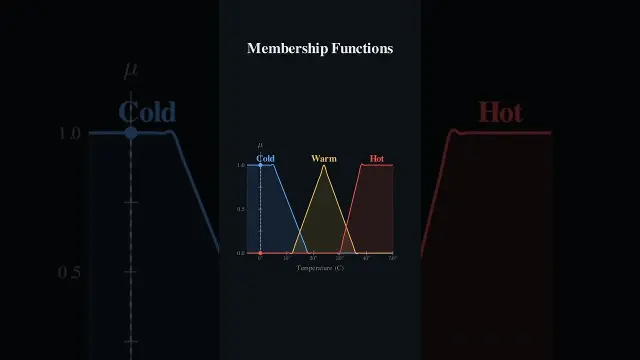
The central object is the membership function: a curve that assigns each element its degree of belonging. It might be a triangle, a smooth bell, a shoulder that rises and then plateaus, or any shape that captures how a category behaves. Everything else in the theory is built on top of this idea. Intersection becomes "the smaller of the two degrees", union becomes "the larger", and negation becomes "one minus the degree". These are choices rather than carved-in-stone rules, and different applications pick different ones.
Read more
Where the idea comes from
Fuzzy set theory grew out of engineering and systems thinking, as a way of formalising the imprecise language that people use when they describe and control real processes. Instead of describing a system with exact thresholds, you describe it with rules phrased much as a skilled operator would phrase them: if the temperature is a little high and rising fast, open the valve quite a lot. The membership functions translate those words into numbers.
Kinds and techniques
- Fuzzy numbers and fuzzy intervals, used when a quantity is only known approximately.
- Linguistic hedges such as very, slightly and more or less, which reshape a membership curve rather than just relabelling it.
- Fuzzy clustering and classification, where items may sit partly in several groups at once.
- Higher-order fuzzy sets, whose membership values are themselves fuzzy, for handling doubt about the doubt.
- Fuzzy rule systems that chain conditions into conclusions, often combined with conventional control logic.
Practical tips for beginners
Start from the question, not the mathematics. Sketch the membership curve for a word you use casually, then ask whether the shape behaves sensibly at the extremes. Keep the number of categories small at first; overlapping shapes are normal and often desirable. Remember that a fuzzy result usually needs a final step that turns it back into a single actionable number.
Where it turns up
You meet fuzzy reasoning in washing machines that judge how dirty the load is, in cameras that decide what counts as sharp focus, in braking and climate systems, and in decision tools that weigh competing criteria. Anywhere a rule is easier to state in words than in thresholds, fuzzy sets offer a way to keep the words and still compute with them.
#Fuzzy Sets: frequently asked questions
What exactly is a fuzzy set, in plain language?
It is a way of grouping things when the boundary of the group is not sharp: rather than an item being in or out, each one gets a degree of belonging that runs from fully out to fully in. That lets everyday words like tall, warm or heavy be handled by a computer without pretending they have exact cut-offs.
How do I get started learning about fuzzy sets?
Begin with the word or category you want to model rather than with the theory, and sketch how belonging should rise or fall as the measurement changes. Once that curve looks sensible at the extremes, the formal operations of combining, negating and chaining rules are far easier to pick up.
How do I choose the right membership function shape?
Match the shape to how the category really behaves: a triangle when there is a natural peak, a shoulder when everything past some point counts fully, a smooth curve when the transition is gradual. The goal is a curve that responds sensibly rather than one that looks mathematically impressive.
Is fuzzy membership the same thing as probability?
No. Probability describes how likely it is that something falls into an ordinary, sharp-edged category, while fuzzy membership describes how much it belongs to a category whose edges fade. The doubt is about where the category ends, not about whether an outcome will happen.
What mistakes do beginners usually make?
The most common is defining too many categories at once, which makes the rules hard to read and tune; a few overlapping shapes usually do more useful work than many narrow ones. The other frequent slip is forgetting the final step that turns the fuzzy result back into one concrete, usable value.
How do fuzzy rules actually produce an answer?
Conditions are phrased the way a skilled operator would say them, such as opening a valve more when the temperature is high and still climbing, and each one is checked against the membership curves. The resulting degrees are combined into a conclusion, which is then converted into a single setting or decision.
Videos come from YouTube and posts from Instagram; titles and summaries are our own. All rights belong to their creators.