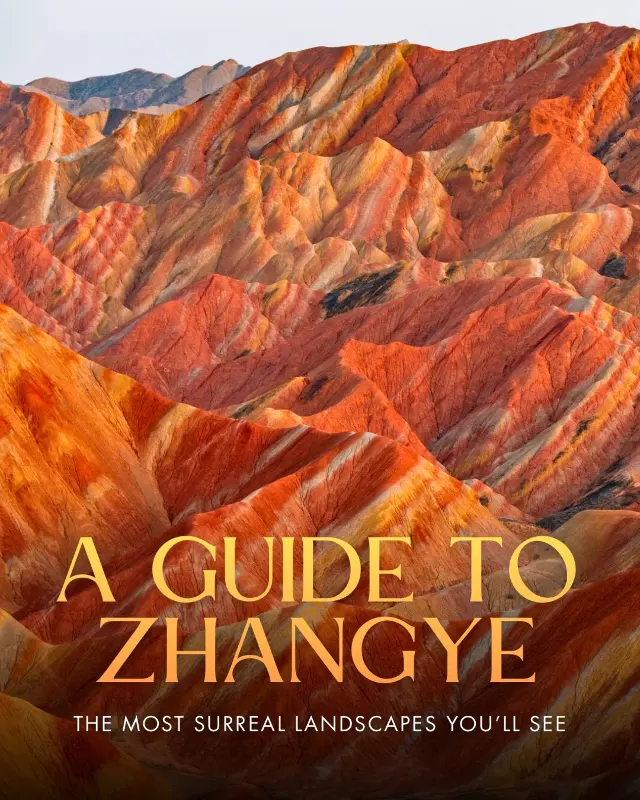
 Zhangye's Rainbow Mountains and Pingshan Lake Canyon in Gansu
#Gansu
1 ideas
Zhangye's Rainbow Mountains and Pingshan Lake Canyon in Gansu
Get new #Gansu ideas by email
Every Thursday: the week's best ideas, with the newest from #Gansu.
Related tags
Gansu: A Guide to China's Silk Road Corridor
Gansu sits in north-central China, stretched thin and long like a shoulder bone between the Tibetan Plateau and the Gobi. Its shape is the key to understanding it: a narrow corridor of habitable land running northwest, flanked by high mountains on one side and desert on the other. That corridor is the Hexi Corridor, and for centuries it was the road that carried silk, horses, spices, ideas and religions between China and Central Asia.
A province shaped by a road
The Hexi Corridor is the spine of Gansu and of the northern Silk Road. Cities strung along it — Wuwei, Zhangye, Jiuquan, Dunhuang — grew up as relay points where travellers restocked and traded. The corridor also carried Buddhism eastward, which is why some of the province's most remarkable sites are religious.
What people come to see
Dunhuang is the best-known stop. The Mogao Caves, cut into a cliff outside town, hold centuries of painted murals and sculpture made by monks and patrons over a long stretch of history. Nearby are sand dunes that rise directly beside an oasis, a landscape that has been described in Chinese poetry for a very long time.
Jiayuguan marks the western end of the Ming-era Great Wall, a fortress set against bare hills. Zhangye is known for its striped, rainbow-coloured rock formations and for a large reclining Buddha in its old temple. Further south, in the Tibetan-influenced region around Xiahe, Labrang Monastery is a major centre of monastic learning, with rows of prayer wheels and pilgrims circling at dawn.
Read more
Geography and climate
Gansu covers a huge range of terrain: deserts and gobi gravel plains, irrigated oases, alpine meadows in the Qilian Mountains, and the Yellow River cutting through the capital, Lanzhou. The province is dry overall, with strong sun and sharp temperature swings between day and night. Altitude matters — some areas sit high enough that you should take the first day slowly.
Food and daily life
Gansu's cooking reflects its position as a crossroads. Wheat, not rice, is the staple in most of the province, and hand-pulled noodles are close to a civic religion, especially in Lanzhou, where beef noodle soup is eaten at breakfast. Lamb features heavily, often simply roasted or simmered with spices, and there is a strong Muslim culinary tradition in many towns.
Practical advice for a first visit
Distances are large, so plan around a few bases rather than trying to see everything. Internal flights and the high-speed rail line along the corridor make the main cities easy to link. Bring layers, sun protection and lip balm. Respect local customs at monasteries and mosques: ask before photographing people or interiors. Learn a few words of Mandarin and be patient with menus outside the cities. Gansu rewards slow travel — the province's real character shows in its markets, teahouses and long, quiet landscapes.
#Gansu: frequently asked questions
What is Gansu best known for?
Gansu is best known as the corridor that carried the northern Silk Road, a long narrow strip of habitable land squeezed between mountains and desert. Along it sit the painted cave temples outside Dunhuang, a fortress at the western end of the Great Wall, and rainbow-striped hills at Zhangye. It is a place people visit for landscape and history rather than for cities.
How do I get around Gansu when the distances are so large?
Pick a small number of bases along the corridor and travel between them rather than trying to cover the whole province. Short flights and the high-speed rail line linking the main corridor cities make hopping between stops easy, and local buses or hired cars cover the last stretch to sites outside town. Leaving room in the plan matters more than a tight itinerary here.
Which places should a first-time visitor choose?
Dunhuang and Jiayuguan are the classic pair for Silk Road history, while Zhangye adds the striped rock formations and an old temple with a huge reclining Buddha. If you want a completely different register, head south to the Tibetan-influenced town of Xiahe and its monastery. Three or four bases is usually a satisfying trip.
What should I pack for the climate and altitude?
Gansu is dry, sunny and swings sharply between day and night, so layers, sun protection and lip balm do more for you than a heavy coat. Some areas sit high enough that it pays to ease in gently at the start of a trip instead of pushing hard on arrival. Water and a hat are worth keeping within reach at all times.
What food should I try in Gansu?
Wheat rather than rice is the staple across most of the province, and hand-pulled noodles are the thing to seek out, especially the beef noodle soup eaten in Lanzhou at breakfast. Lamb turns up everywhere, often just roasted or simmered with spices, and many towns have a strong Muslim cooking tradition worth exploring. Menus get less translated outside the cities, so patience and a few words of Mandarin help.
What are common mistakes visitors make in Gansu?
The most common is underestimating distance and trying to see everything in one trip, which turns the journey into long hours of transit. Another is treating monasteries and mosques as photo opportunities: ask before photographing people or interiors and follow local custom. Finally, packing for a single climate ignores how much terrain and altitude the province covers.
Videos come from YouTube and posts from Instagram; titles and summaries are our own. All rights belong to their creators.