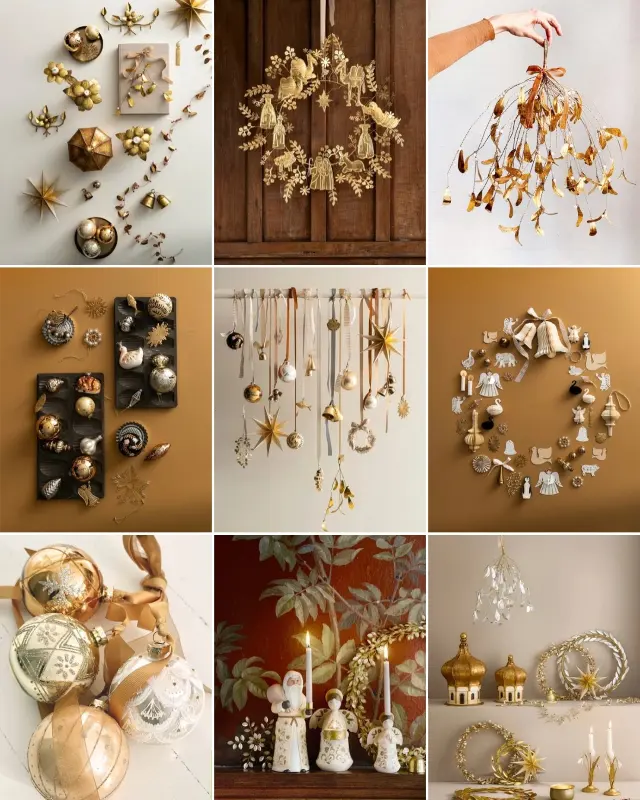
 Why gold ornaments work with every Christmas colour palette
#Gold Ornaments
1 ideas
Why gold ornaments work with every Christmas colour palette
Get new #Gold Ornaments ideas by email
Every Thursday: the week's best ideas, with the newest from #Gold Ornaments.
Related tags
Gold Ornaments: A Guide to Care, Style and Meaning
Gold has been worked into ornament for thousands of years, and it remains one of the few materials that reads as precious in almost any setting. Part of the reason is practical: gold does not corrode or tarnish, so a piece made today can look much the same in a generation's time. Part of it is visual — the metal holds light softly rather than flashing it back, which is why it flatters so many colours and so many rooms.
The word covers two related things. In jewellery, a gold ornament is a personal piece: a chain, a bangle, an earring, a ring. In the home, it usually means a decorative object — a gilded frame, a figurine, a bauble hung on a tree or arranged in a bowl. Both traditions share the same instincts, and much of the care advice overlaps.
The main kinds
- Solid gold: the metal all the way through, usually alloyed with copper, silver or zinc to give it strength and a particular tone. Yellow, rose and white are the familiar shades.
- Gold-plated or gold-filled: a base metal such as brass or silver covered with a thin layer of gold. These give the look at a lower cost but wear at the edges over time.
- Gilded and gold-leaf decoration: a thin sheet of gold applied to wood, glass, ceramic or plaster, common in frames, mirrors and festive ornaments.
- Imitation gold: lacquered brass, gold-toned glass or coated resin. Perfectly attractive, and worth recognising so you know what you are caring for.
Read more
What to know before you buy
Look for a hallmark or maker's mark, which tells you the metal's purity. Hold the piece in daylight rather than shop lighting, and turn it over — the back and the fastening tell you more about quality than the front does. For decorations, check the hanging loop and the weight; a heavy bauble needs a firm branch and a proper hook.
Looking after your pieces
Jewellery fades faster from habits than from age. Put perfume, hairspray and lotion on first, then the ornament, and take it off before swimming or showering — chlorine and salt are unkind to alloys and to plated surfaces. Store pieces separately in soft pouches so chains do not scratch each other, and wipe them with a dry cloth after wearing.
Wash solid gold occasionally in warm water with a drop of mild soap, using a soft brush, then dry thoroughly. Plated and gilded items should be dusted only — never scrubbed, since the gold layer is thin.
Decorative ornaments ask for gentler handling still. Lift them by the base or the loop rather than the gilded surface, keep gold-leaf frames out of direct sun, and store seasonal pieces wrapped in acid-free tissue rather than newspaper, whose ink can transfer.
Styling notes
Gold sits comfortably beside almost everything, but it works best when you decide how much of it a space will hold. A single gold ornament among matte ceramics or dark wood draws the eye; a whole shelf of it can feel rich or restless, depending on the light. Mixing gold with silver is entirely a matter of taste, and the easiest way to make it look deliberate is to repeat each metal at least twice.
Warm-toned gold tends to harmonise with reds, greens, creams and deep blues; cooler gold suits greys, whites and pale stone. In jewellery, the same logic applies to skin and clothing — try a piece against your wrist in daylight before deciding.
#Gold Ornaments: frequently asked questions
How can I tell whether a gold ornament is solid gold, plated, or imitation?
Turn the piece over and look for a hallmark or maker's mark, which is where the purity of the metal is usually stated. Check the edges and the fastening, since a plated or gilded surface tends to thin there first and reveal the base metal underneath. Weight and colour are clues too, but they are far less reliable than a stamp.
Which shade of gold should I choose for something I plan to wear often?
Yellow gold reads warm and traditional, rose gold has a softer blush, and white gold looks cooler and more neutral, so the choice is mostly about what suits your wardrobe and colouring. Hold the piece against your wrist in daylight rather than deciding under shop lighting, which flatters almost everything. If you are wavering, pick the tone that appears elsewhere in the jewellery you already reach for.
What everyday habits keep gold jewellery looking its best?
Apply perfume, hairspray and lotion before putting the piece on, and take it off before showering or swimming, since chlorine and salt attack alloys and plated surfaces. Store pieces separately in soft pouches so chains do not rub against each other, and give them a wipe with a dry cloth after wearing. Solid gold can be washed now and then in warm water with a little mild soap and a soft brush, then dried well.
How should I clean a gilded frame or a gold-leaf decoration?
Dust it gently and stop there — never scrub or soak it, because the gold layer is far thinner than on jewellery. Lift the object by its base or hanging loop rather than gripping the gilded face, and keep frames away from direct sun so the surface does not dull unevenly. Seasonal pieces are best wrapped in acid-free tissue when stored, since printed paper can transfer ink onto the surface.
How do I use a single gold ornament in a room without it feeling out of place?
Let it sit against matte ceramics, dark wood or plain plaster so the metal has something quiet to contrast with, and the eye goes straight to it. Warm-toned gold tends to harmonise with reds, greens, creams and deep blues, while cooler gold sits more easily with greys, whites and pale stone. If you are mixing metals, repeat each one elsewhere in the room so the pairing looks intended rather than accidental.
What mistakes do people commonly make with gold ornaments?
The most frequent is polishing plated or gilded pieces as if they were solid, which wears the thin gold layer away rather than restoring it. Another is buying under shop lighting without turning the piece over or checking how it hangs, and a third is cramming a whole shelf with gold so it reads as busy rather than rich. Storing seasonal decorations in ordinary newspaper is a quiet mistake too, because the ink can mark the surface.
Videos come from YouTube and posts from Instagram; titles and summaries are our own. All rights belong to their creators.