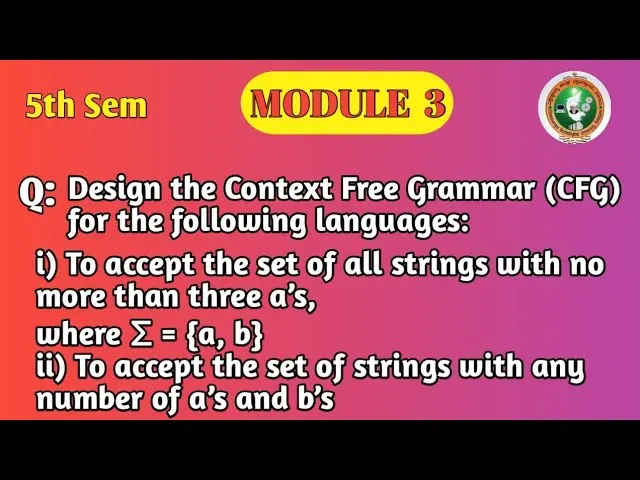
 Designing Context Free Grammars for Specific Languages
#Grammar Design
1 ideas
Designing Context Free Grammars for Specific Languages
Get new #Grammar Design ideas by email
Every Thursday: the week's best ideas, with the newest from #Grammar Design.
Related tags
Grammar Design for Languages and Syntax
Grammar design is the art of defining how a language is structured. In computing, a grammar describes the forms that valid sentences, commands, or expressions can take. It is the backbone of many programming languages, markup languages, query languages, and rule systems. A well-designed grammar makes a language easier to read, parse, and use consistently.
At its core, grammar design is about rules. Those rules say what counts as a valid token sequence and how parts of a sentence fit together. A grammar can be very strict, as in formal languages used by compilers, or more flexible, as in specifications for human-readable data formats. The main aim is the same: to remove ambiguity and define structure clearly.
Why grammar design matters
A grammar shapes both the user experience and the implementation. If the rules are too complicated, the language becomes hard to learn and easy to misuse. If they are too loose, the same input may be interpreted in more than one way. Good grammar design helps readers understand intent quickly and helps parsers process text reliably.
Read more
It also affects extensibility. A language that leaves room for future growth needs rules that are clear without being unnecessarily rigid. This is why designers often think carefully about precedence, grouping, optional parts, and repetition.
Common grammar styles
Different kinds of grammars serve different needs. Some of the most common are:
- Context-free grammars, which are widely used for programming language syntax.
- Regular grammars, which are simpler and often used for token patterns.
- Backus–Naur Form and similar notations, which are common ways to write grammar rules clearly.
- EBNF, which adds conveniences such as optional elements and repetition.
You do not always need the most powerful grammar possible. Often, the best choice is the simplest one that describes the language accurately.
Principles of good design
When you design a grammar, start with the real use case. Ask what the language needs to express and how people will read or write it. Keep the structure consistent. Similar ideas should be expressed in similar ways, so users can build intuition.
Try to reduce ambiguity wherever possible. If a phrase could be read in two ways, consider changing the rule structure or adding explicit separators. Decide early how you want to handle nesting, operator order, optional elements, and empty input.
Practical tips for beginners
Begin with examples. Write several valid and invalid samples before formalizing the rules. This helps you see patterns and spot awkward cases. Then build the grammar from the outside in: identify the largest structures first, then define their parts.
A few useful habits:
- Use descriptive rule names.
- Keep rules small and focused.
- Avoid unnecessary special cases.
- Test the grammar against real examples.
- Prefer clarity over cleverness.
A grammar should describe a language in a way that is precise, readable, and maintainable. If you keep the rules simple and consistent, you give the language a strong foundation that is easier for both people and machines to work with.
Videos come from YouTube and posts from Instagram; titles and summaries are our own. All rights belong to their creators.