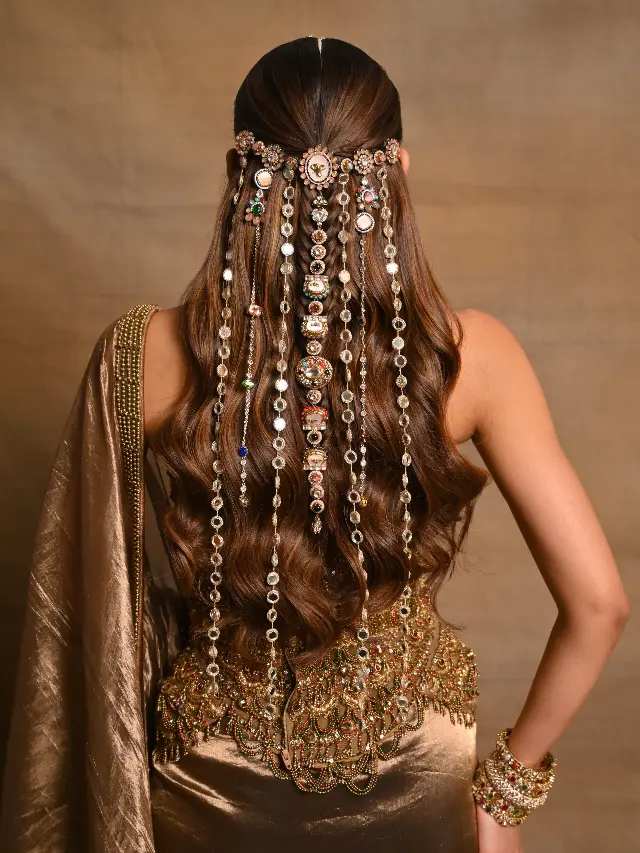
 Bejewelled chain hair accessory styled for a regal look
#Hair Chain
1 ideas
Bejewelled chain hair accessory styled for a regal look
Get new #Hair Chain ideas by email
Every Thursday: the week's best ideas, with the newest from #Hair Chain.
Related tags
Hair Chains: A Guide to Wearing Chain Hair Jewellery
A hair chain is a piece of jewellery made to sit in the hair rather than around the neck or wrist. It is usually a fine metal chain, sometimes set with pearls, crystals, beads or small charms, fixed to the hair with clips, pins or combs so that it drapes across the head, along a parting, or down through a braid or ponytail. It adds shine and movement without cutting or colouring anything, which is part of why it appeals to people who want a dramatic look for a day and their usual hair back the next morning.
Where the idea comes from
Decorating the hair with metal and stone is an old habit in many parts of the world. Chain-like hair ornaments appear in South Asian bridal jewellery, where a piece rests along the centre parting and against the forehead, and in Mediterranean and Middle Eastern traditions where fine chains and coins were worn over the hair. Across North Africa and West Asia, braids have long been threaded with chains, discs and beads as both ornament and a way to hold a style in place. What looks like a modern accessory is usually a simplified version of something with a long history behind it.
The main kinds
Read more
Hair chains vary mostly in how they attach and how far they travel.
- Forehead chains sit across the front of the head, anchored in the parting, and often end in a single pendant at the centre.
- Halo or crown chains run around the head like a delicate circlet, usually fixed with small combs at either side.
- Braid chains are threaded into a plait, woven between sections, or wrapped around the length of a ponytail.
- Scattered chains use several fine strands pinned at different points so they fall loosely through the hair.
- Comb and clip pieces attach to a single point and drape freely, which makes them the easiest to place.
Materials matter as much as shape: gold and silver tones read as classic, pearls and opals as soft and bridal, coloured crystals as festive. Very fine chains disappear into dark hair; heavier links and matte finishes show up better in pale or very curly hair.
What beginners should know
Start with a single strand rather than a set. A chain fixed at one point is simple to position and easy to adjust, while multi-strand pieces need a plan before you begin. Work with hair that is dry and lightly styled, since chains slide out of freshly conditioned or very silky hair. Place the anchor points first, then let the chain fall naturally, and check the whole shape in a mirror from a few angles, including from behind. Grippy pins and small silicone-backed clips hold better than smooth ones, and a little backcombing under a clip gives it something to grip.
Wear hair chains with simpler earrings, or none, so the focus stays where you put it. For weddings, festivals and celebrations they suit almost any length of hair; for everyday wear, one thin strand along a parting is enough. Store chains flat or hanging, fasten them before spraying styling products, and take them out before sleeping to avoid tangling and pulling. Handled gently, a good hair chain lasts for years and works with styles you already know how to do.
#Hair Chain: frequently asked questions
How do I start wearing a hair chain if I've never tried one?
Begin with a piece that clips or combs into a single spot and drapes from there, since that kind lets you see the effect straight away and shift it if the placement looks off. Multi-strand designs ask you to plan the anchor points before you begin, which is harder on a first attempt. Put it in dry, lightly styled hair rather than freshly conditioned hair, where it tends to slip.
What do I need to keep a hair chain in place all day?
Small clips with a grippy silicone backing and strong pins work much better than smooth ones, so look at the fastenings rather than only the chain. A light backcombing under each clip gives the metal something to hold on to, especially in fine or straight hair. Fasten everything before you use sprays or serums, since product makes the hair slick.
Which style of hair chain should I choose for my hair type and event?
A forehead or halo chain reads as formal and bridal, while a braid or ponytail wrap is more relaxed, and a thin strand along the parting is the usual choice for ordinary days. Very fine chains can vanish into dark hair, so heavier links or matte finishes show up better on pale or very curly hair. Match the material to the mood: pearls and opals look soft, coloured crystals look festive.
How do I care for a hair chain so it lasts?
Keep it flat in a box or hanging from a hook rather than loose in a bag, where it kinks and tangles with other jewellery. Take it out before sleeping and undo it gently, since pulling a chain through a braid is what damages both the piece and the hair. Stored and handled this way, a good chain keeps its shape for a long time.
What are the common mistakes people make with hair chains?
The usual ones are starting with a complicated multi-strand set, using smooth clips that slide, and putting the piece in silky, freshly conditioned hair. Another is wearing large statement earrings alongside it, which splits the attention instead of keeping it on the hair. Check the whole shape in a mirror from the back as well as the front before you leave.
Can I wear a hair chain for everyday looks, not just weddings?
Yes — one fine strand along the parting is enough for daily wear and looks deliberate without being costume-like. Save the halo, scattered and beaded pieces for celebrations and festivals, where they suit almost any hair length. Keeping the rest of your jewellery simple lets the chain do the work.
Videos come from YouTube and posts from Instagram; titles and summaries are our own. All rights belong to their creators.