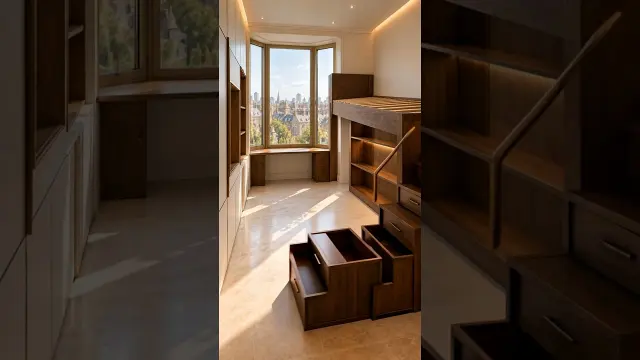
 Tiny bedroom loft bed makeover with hidden staircase storage
#Hidden Storage
2 ideas
Tiny bedroom loft bed makeover with hidden staircase storage
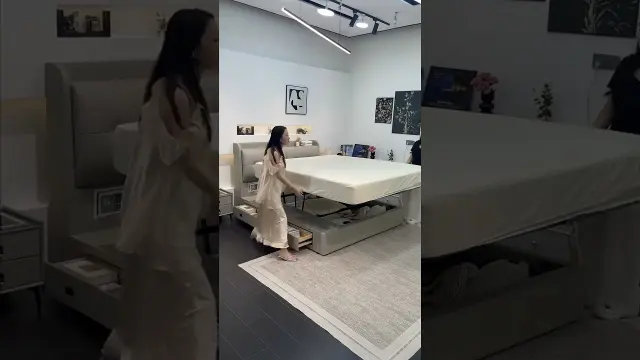 Smart Storage Bed Transformation With Hidden Compartments
Get new #Hidden Storage ideas by email
Every Thursday: the week's best ideas, with the newest from #Hidden Storage.
Related tags
Hidden Storage Ideas: Clever Spaces You Didn't Know You Had
Hidden storage is the practice of building storage into something that already has another job — a bed, a staircase, a bench, a wall — so that the things you own disappear into the structure instead of sitting on top of it. It differs from ordinary tidying in one key way: the goal is not just to put things away, but to design the container so it looks like nothing is being stored at all. The approach is old. Beds with drawers underneath, chests built into window seats and cupboards tucked under stairs have long appeared in homes where floor space was scarce, and the idea has simply grown more refined as furniture design has become more modular.
The main kinds
Most hidden storage falls into a few familiar families.
- Furniture that stores: beds with lift-up platforms or deep drawers, ottomans that open, benches with lift-off lids, coffee tables with compartments beneath the top.
- Architectural storage: drawers built into the risers of a staircase, cupboards set into sloped ceilings or under-stair voids, shelving recessed into the depth of a wall.
- Disguised storage: cabinets that read as panelling, mirrors or picture frames that swing open, doors finished to match the wall around them.
- Vertical and overhead storage: high cupboards that run to the ceiling, racks and rails that make use of the space above doors.
Read more
What beginners should think about first
Start by measuring rather than shopping. Knowing the exact depth of a wall, the height under a bed frame or the inside dimensions of a bench will tell you what will realistically fit, and it prevents the common mistake of buying a container that swallows nothing useful.
Think about what you are actually storing before you decide where. Hidden storage suits things you need occasionally and want out of sight — bedding, out-of-season clothing, tools, paperwork, children's toys, spare household supplies. It suits poorly anything you reach for several times a day, because lifting a mattress or moving a bench quickly becomes a chore. Keep daily items in open, easy places; reserve the concealed spaces for the rest.
Weight matters too. Drawers under a bed carry a lot, and a lift-up mechanism should be checked for how it feels when full. Anything fixed into a wall needs proper anchoring, and stairs and shelving are best planned before installation rather than after.
Making it work over time
Label what goes inside, even if nobody sees it. A concealed space that becomes a mystery box fills with things you forget you own. Keep a rough inventory in your head — bedding in the bed, tools in the stair drawers — so that "where did that go?" has an answer.
Finally, leave a little emptiness. Hidden storage works best when it is not packed to the lid, since a compartment that closes easily is one you will keep using.
#Hidden Storage: frequently asked questions
How should I get started with hidden storage?
Begin by measuring the spaces you already have — wall depth, the clearance beneath a bed, the inside of a bench — and only then go looking for containers or fittings. Decide what you want to conceal before you settle on where, since the items themselves usually point to the right spot. Starting small with one piece of furniture is easier than planning a whole room at once.
Which type of hidden storage should I choose?
It depends on whether you can alter the room or only the furniture: built-in drawers, recessed shelving and under-stair cupboards give the most capacity but need planning and proper fixing, while storage beds, lift-lid benches and compartment tables can be added without touching the structure. Disguised pieces such as panelling-style cabinets or hinged mirrors are worth considering where the look of the room matters as much as the volume. Weigh how often you will open it — a mechanism that feels awkward when full will soon stop being used.
What should I keep in hidden storage, and what should stay out?
Concealed compartments suit things you need only now and then and would rather not see: spare bedding, off-season clothes, paperwork, toys, tools and household supplies. Anything you reach for daily is better kept in the open, because lifting a mattress or shifting a bench quickly turns into a nuisance. Matching the container to the frequency of use is what makes the arrangement last.
How do I care for hidden storage so it stays useful?
Give each compartment a label or a fixed purpose, so you always know what lives where and nothing turns into a forgotten pile. Leave some breathing room inside — a lid or drawer that closes without a fight is one you will keep opening. Wipe out concealed cavities occasionally, since they collect dust quietly and are easy to overlook.
What are common mistakes people make with hidden storage?
The usual one is buying a container before measuring, which ends in a unit that hides nothing of any size. Another is overloading: drawers beneath a bed take a lot of weight, and lift-up fittings need checking for how they behave when full. Anything fixed to a wall also needs proper anchoring, and stairs or shelving are far easier to plan before installation than to change afterwards.
Any ideas for adding hidden storage to a small bedroom?
A raised bed with drawers or a lift-up platform is the classic answer, freeing the floor beneath for everything that would otherwise sit out. Stair treads leading to a loft can be built as drawers, and the space above a door or along a ceiling line can take shallow cupboards. Recessed shelving set into the depth of a wall disappears into the room without stealing floor space.
Videos come from YouTube and posts from Instagram; titles and summaries are our own. All rights belong to their creators.