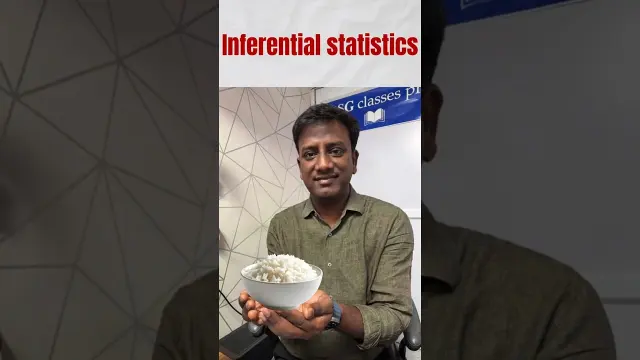
 Inferential Statistics Basics and Population Samples
#Inferential Statistics
4 ideas
Inferential Statistics Basics and Population Samples
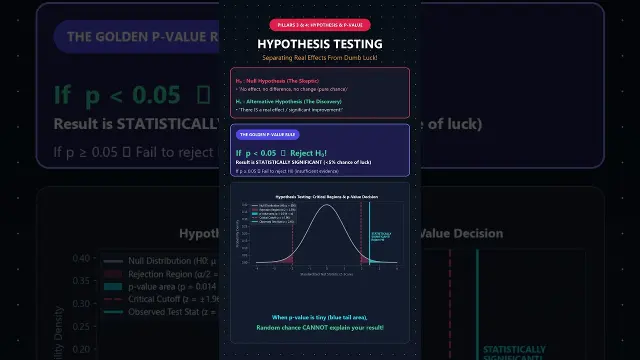 Masterclass on Inferential Statistics and Sampling
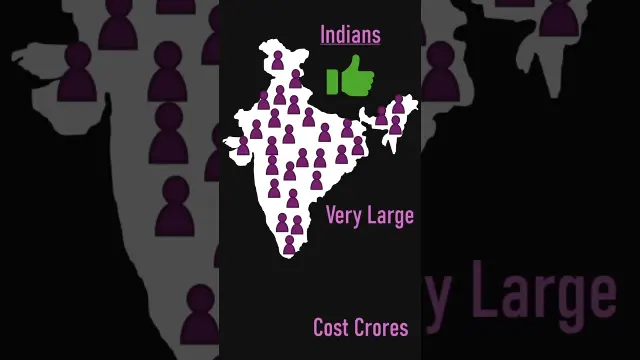 Inferential Statistics Concepts Explained
 The Foundations and Limits of Inferential Statistics
Get new #Inferential Statistics ideas by email
Every Thursday: the week's best ideas, with the newest from #Inferential Statistics.
Related tags
Inferential Statistics: Drawing Conclusions from Data
Inferential statistics is the branch of statistics concerned with going beyond the data you actually have. Where descriptive statistics simply summarises what was measured — averages, spreads, counts — inference asks what those measurements allow you to say about a wider group you could never observe in full. You weigh a bag of grain by the handful, not by the sack; inferential statistics is the disciplined version of that everyday leap.
The subject grew out of practical problems: agricultural trials, quality control in manufacturing, public health surveys and actuarial work. Over the twentieth century it developed into a formal framework built on probability theory, and it now underpins clinical research, market research, economics, engineering, polling and any field where decisions must be made from partial evidence.
Sampling comes first
Nearly everything in inference rests on how the data were collected. A probability sample — one where every member of the population has a known chance of being selected — is what lets you attach a measure of uncertainty to your conclusions. Random sampling, stratified sampling and cluster sampling are the standard designs. Convenience samples, however large, carry hidden biases that no amount of arithmetic can repair. Beginners should treat the sampling method as the first question to ask of any study, not the last.
Read more
The two main tools
Estimation produces a best guess about a population value, usually a mean, proportion or difference, together with an interval that expresses how precise that guess is. A confidence interval is the everyday form of this: a range that would contain the true value in a stated proportion of repeated samples.
Hypothesis testing takes a starting assumption — typically that nothing is going on — and asks how surprising the observed data would be if that assumption held. The resulting p-value is widely misread. It is not the probability that the assumption is true, nor the probability that a finding will replicate; it is a statement about data, conditional on a model.
Assumptions and their limits
Most classical procedures assume independent observations, an appropriate model shape and, for small samples, roughly normal distributions. Violate these and the arithmetic still runs, but the conclusions weaken. Modern practice adds resampling methods such as bootstrapping, which build uncertainty estimates from the data itself with fewer structural assumptions.
Practical advice
- State the population and the sampling mechanism before choosing a method.
- Distinguish statistical significance from practical importance; a large sample makes trivial differences detectable.
- Report intervals alongside point estimates, since an interval communicates uncertainty that a single number hides.
- Remember that many comparisons inflate the chance of a spurious result; adjust or replicate.
- Correlation supports prediction, not causation, unless the design genuinely isolates a cause.
Inference is best understood as careful argument under uncertainty rather than a machine for producing truth. Used with attention to how the data arose, it is one of the most powerful reasoning tools available; used mechanically, it can lend false authority to fragile claims.
#Inferential Statistics: frequently asked questions
How do I start learning inferential statistics as a beginner?
Start by getting clear on the population you want to understand and how the sample was collected. Then learn the two core ideas: estimating a population value and testing a claim about it. Once those are familiar, the rest becomes a matter of choosing the right method for the data and the question.
What do I need before I can use inferential statistics correctly?
You need a sample collected in a way that gives each member of the population a fair chance of being included, or at least a design you can defend. It also helps to know whether the observations are independent and whether the data fit the assumptions of the method you want to use.
How do I choose between estimation and hypothesis testing?
Use estimation when you want the best answer and a sense of how uncertain it is, such as a likely population mean or proportion. Use hypothesis testing when you need to evaluate a specific claim, but remember that a test result should be read as evidence about the data, not as a final proof.
What is the most common mistake people make with inferential statistics?
A frequent mistake is treating a convenient sample as if it were representative, even when the sampling process was biased. Another common error is reading a p-value as the probability that a result is true, when it only describes how unusual the data are under a model.
How should I care for or check my statistical results before relying on them?
Check whether the sampling method was sound, whether the assumptions of the procedure are reasonable, and whether the conclusion is practical as well as statistically noticeable. It is also wise to report an interval with any estimate and to be cautious when many comparisons are being made.
Videos come from YouTube and posts from Instagram; titles and summaries are our own. All rights belong to their creators.