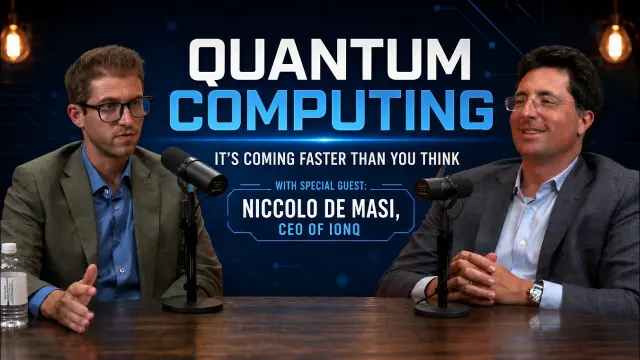
 IonQ CEO Niccolo de Masi on Quantum Computing and Q-Day
#IonQ
1 ideas
IonQ CEO Niccolo de Masi on Quantum Computing and Q-Day
Get new #IonQ ideas by email
Every Thursday: the week's best ideas, with the newest from #IonQ.
Related tags
IonQ and Trapped-Ion Quantum Computing Explained
IonQ is a quantum computing company with a distinctive approach: instead of drawing circuits onto superconducting metal, it stores information in individual ions — atoms with an electric charge — suspended in a trap and manipulated with precisely tuned laser light. Understanding what that means starts with understanding what a quantum computer is trying to do in the first place.
From bits to qubits
An ordinary computer stores information in bits, each of which is either a zero or a one. A quantum bit, or qubit, can hold a weighted combination of both at once, a property called superposition. Qubits can also be linked through entanglement, so that measuring one tells you something about another. By choreographing these states and letting the alternatives interfere with each other, a quantum algorithm can amplify the paths that lead to a useful answer and cancel the rest. Then the result is read out by measurement — and the delicate quantum state collapses into ordinary bits.
Why ions
Read more
IonQ's machines hold a string of ions in an electromagnetic trap inside a vacuum chamber, cooled and controlled by lasers. The appeal is uniformity: every ion of a given element is physically identical, so the qubits tend to behave alike, which makes them easier to characterize and calibrate. Trapped ions can also retain their quantum state for comparatively long stretches, and in this design any ion can be made to interact with any other, an all-to-all connectivity that can simplify how a circuit is written.
What such machines are used for
- Simulating molecules and materials, where quantum effects are hard to capture classically
- Research on optimization problems and search
- Testing quantum algorithms and error-correction schemes
- Teaching and hands-on experimentation, since systems are reachable remotely over the cloud
- Quantum networking and secure communication, an area the company also pursues
What beginners should know
Quantum computers are not simply faster computers. They are specialized instruments for particular kinds of problems, and today's devices are noisy: errors accumulate, and correcting them is one of the field's central engineering challenges. Claims about near-term usefulness are worth reading carefully, whoever makes them.
If you want to explore the subject, build up linear algebra and probability first, then basic quantum information — superposition, measurement, gates, entanglement. Simulators let you run small circuits on an ordinary laptop, and cloud access lets you try real hardware once you have something worth running. Start with tiny circuits you fully understand rather than large ones you have copied.
IonQ is one route into a broad and still-forming field. Following it is a good way to learn how a real quantum architecture is engineered, and to keep a clear eye on the distance between a working prototype and a dependable tool.
#IonQ: frequently asked questions
What does IonQ actually build?
It builds quantum computers that store information in individual charged atoms, called ions, held in an electromagnetic trap inside a vacuum chamber and manipulated with precisely tuned lasers. The company also works on quantum networking and secure communication, and its machines can be reached remotely rather than owned outright.
How is a trapped-ion machine different from other kinds of quantum computer?
Some designs pattern circuits into superconducting metal, while this one uses atoms themselves as the storage medium. The practical appeal is uniformity — every ion of a given element is physically identical, so the qubits behave alike and stay coherent for comparatively long stretches — plus all-to-all connectivity, meaning any ion can be made to interact with any other. That can make a circuit simpler to express, though the lasers and vacuum hardware are demanding to engineer.
Do I need my own quantum computer to try one?
No. Simulators can run small circuits on an ordinary laptop, and cloud access lets you send a job to real hardware once you have something worth running. A sensible path is to start with simulators, get comfortable, then move to a real device with a tiny experiment you already understand.
What should I learn before getting started with quantum computing?
Build up linear algebra and probability first, then move to basic quantum information: superposition, measurement, gates and entanglement. Those foundations carry you much further than jumping straight into a programming interface, and they make the results you get back interpretable rather than mysterious.
What is this kind of machine actually good for?
Simulating molecules and materials where quantum effects are hard to capture classically, research on optimization and search, and testing algorithms and error-correction schemes. They are also used for teaching and hands-on experimentation, and the field is exploring quantum networking.
What mistakes do beginners make with quantum computing?
The biggest is assuming a quantum computer is simply a faster computer — it is a specialized instrument for particular kinds of problems, not a general upgrade. The second is copying a large circuit from somewhere without understanding it; starting with tiny circuits you fully comprehend teaches far more. It also pays to remember that today's devices are noisy, so error accumulation shapes what any result really means.
Videos come from YouTube and posts from Instagram; titles and summaries are our own. All rights belong to their creators.