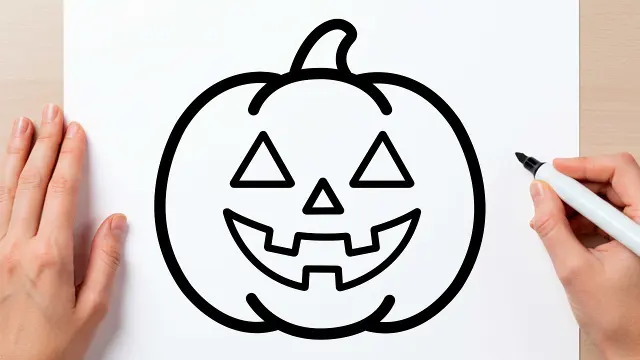
 How to Draw a Halloween Pumpkin Step by Step
#Kids Drawing
1 ideas
How to Draw a Halloween Pumpkin Step by Step
Get new #Kids Drawing ideas by email
Every Thursday: the week's best ideas, with the newest from #Kids Drawing.
Related tags
Kids Drawing: A Simple Guide to Getting Started
Drawing is one of the first ways children make their mark on the world. Long before they can write letters, most children pick up a crayon and discover that their hand can leave a line behind, and that the line can become a sun, a dog, a house, or a person with enormous hands. It is a form of play, a form of thinking, and a form of talking all at once.
Why it matters
For young children, drawing is not mainly about producing a picture. It is how they practise holding a tool, coordinating hand and eye, planning a page, and telling a story. A drawing of a family standing in a row is also a sentence about who matters to them. Adults who ask "what is happening here?" usually get far more than adults who ask "what is it?"
Drawing also builds the habit of looking closely. A child who has tried to draw a cat notices the shape of ears, the set of the eyes, the curl of a tail. That habit of attention carries into everything else.
Read more
What you need
Keep it simple. Plain paper, a soft pencil, and a few coloured pencils or wax crayons will take a child a long way. Thick crayons are easier for small hands to grip; short pencils suit children who press hard. A clipboard or a stack of paper on a table is enough. Avoid erasers at first if you can: children who can rub out every line tend to draw smaller and more cautiously, while children who cannot erase draw freely.
Styles and approaches
Children move through recognisable stages. Toddlers scribble, and the scribble is genuine exploration of movement. Around four or five, shapes appear and get named afterwards; the circle becomes a face once the eyes are added. By six or seven, children start placing things on a baseline, often a strip of ground or a line of sky, and begin to include details that matter to them rather than what a camera would record.
Older children often want to draw things "properly" and become frustrated. This is a good moment to introduce simple step-by-step drawing, where a subject is built from basic shapes: a circle for a head, a triangle for a roof, an oval for a body. Practising a single subject several times in a row is more satisfying than filling a page with unrelated sketches.
Practical tips
Draw alongside your child rather than watching over them. Sit at the same table with your own sheet of paper. Comment on effort and choices rather than on talent: "you used a lot of blue there" lands better than "that's beautiful". Let drawings be imperfect, and resist the urge to correct proportions.
Keep materials where they can be reached, so drawing does not need permission. Offer a subject when a child is stuck, and offer a new material when interest fades. Above all, let the drawing belong to the child. The value is in the doing, and it lasts long after the paper is gone.
#Kids Drawing: frequently asked questions
How do I get a young child started with drawing?
Hand them a thick crayon and a plain sheet of paper and let them scribble with no goal in mind — at the beginning, the movement itself is the point, not the result. Sit at the same table with your own sheet so that drawing feels like something you do together rather than a task you are supervising.
What supplies do we actually need to begin?
Very little is required: plain paper, a soft pencil, and either coloured pencils or chunky wax crayons. Thick crayons are easier for small hands to grip, short pencils suit children who press hard, and a clipboard keeps loose sheets steady. Elaborate art sets are not necessary and can make a child hesitant about using the good materials.
How do I know which approach suits my child's stage?
Toddlers mostly explore movement through scribble, slightly older children draw shapes first and name them afterwards, and children a little further on begin arranging things along a strip of ground or sky and adding details that matter to them. Watch what your child already does and offer the next small step rather than a full lesson.
My child gets frustrated that their drawings don't look right. What helps?
Build the subject from simple shapes in order — a circle for a head, a triangle for a roof — and practise that one subject several times rather than filling a page with unrelated sketches. Resist correcting proportions or pointing out errors; comment on choices and effort instead, and ask what is happening in the picture rather than what it is.
Do you have an easy idea for a seasonal drawing, like a pumpkin?
A pumpkin works well as a step-by-step subject because it is mostly one rounded shape with a stem and a few curved lines to suggest the ridges. Draw it alongside your child a couple of times, then let them run with it and add their own face or setting. The same shape-first method transfers easily to other holiday subjects.
How should we look after finished drawings?
Keep a folder or a shallow box for completed sheets, and pin a few up on a wall or door so the child sees their work treated as worth keeping. Photographing the larger pieces frees up space without losing them, and letting the child choose what stays reinforces that the drawing belongs to them.
Videos come from YouTube and posts from Instagram; titles and summaries are our own. All rights belong to their creators.