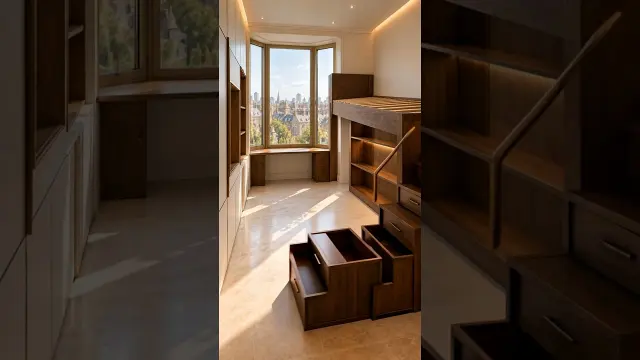
 Tiny bedroom loft bed makeover with hidden staircase storage
#Loft Bed
1 ideas
Tiny bedroom loft bed makeover with hidden staircase storage
Get new #Loft Bed ideas by email
Every Thursday: the week's best ideas, with the newest from #Loft Bed.
Related tags
Loft Bed: A Guide to Raised Beds and Small Spaces
A loft bed is a bed raised on a frame or platform so that the floor underneath stays usable. Rather than filling a room with furniture, it stacks two purposes in the same footprint: sleeping above, and storage, a desk, a reading corner or play space below. It is the piece people reach for when a room is small but the list of things it must do is long.
You will find loft beds in dormitories, studio flats, cabins, caravans and children's rooms — anywhere floor area is scarce and height is available. The idea sits close to the bunk bed and the ship's berth: raise the sleeping surface, and the space that would have been empty air becomes the most valuable part of the room.
The main kinds
The simplest is a fixed platform on four legs or two end panels, open underneath and free to be filled however you like. A second family builds the under-space in: a loft with an integrated desk, shelving, a wardrobe or a small sofa nook, so the frame does the work of several pieces at once.
Read more
Frames are usually wood, metal or a composite board, and the choice mostly comes down to how much the structure will be moved and how heavy it looks in the room. Access is either a ladder or a staircase. Ladders take almost no floor space but ask more of you at night; stairs are easier and kinder underfoot, and many designs hide drawers inside the treads, at the cost of a footprint.
Heights vary too. Full-height lofts maximise the room below; mid-height versions leave more headroom above and suit smaller rooms, lower ceilings and younger sleepers.
What to check before you buy
Measure twice, in both directions. Above the mattress you need enough room to sit up without ducking, and below you need enough to stand, sit at a desk or open a drawer. Check that the frame clears ceiling lights, fans, radiators and windows, and that the ladder or stairs do not land where a door swings.
Safety comes down to a few plain things. Guardrails should run along every open side of the upper level, and the mattress should sit low enough that the rails still do their job — a very thick mattress can quietly cancel them out. Respect the weight limit the maker gives, assemble the frame exactly as instructed, and anchor it to the wall where the design allows, since a tall bed is easier to topple than a low one. Follow any age guidance the manufacturer provides, and be wary of very high beds for small children.
Then think about daily life. Changing the sheets on a loft is a small chore that becomes a large one if access is awkward, and lighting, power sockets and ventilation all need to work on both levels. Keep bedding away from heaters and never block air vents with stored boxes.
Done thoughtfully, a loft bed gives a small room a second life. Measure the space, be honest about who will climb it and how often, and the rest follows.
#Loft Bed: frequently asked questions
What is a loft bed, and why do people use one in a small room?
A loft bed raises the sleeping surface on a frame so the floor beneath it can still be used. That makes it a practical choice for studios, dorm rooms, cabins and children's rooms, where the same footprint needs to serve more than one purpose.
Should I choose a ladder or stairs for a loft bed?
A ladder takes up very little floor space but demands more care when climbing, particularly at night. Stairs feel steadier underfoot and can include hidden storage, though they use more of the room; think about who will use the bed and how often.
What should I measure before buying a loft bed?
Check the clearance above the mattress so you can sit up comfortably, and the space below for standing, sitting at a desk or opening drawers. Also make sure the frame clears ceiling lights, fans, radiators and windows, and that the ladder or stairs will not land in a doorway.
How can I make the space under a loft bed more useful?
The area below can become a desk, reading corner, play space or storage zone, and some frames include shelving or a wardrobe built in. Keep air vents unobstructed and store boxes away from heaters so the lower level stays comfortable.
What safety points matter most with a loft bed?
Guardrails should protect every open side of the upper level, and a very thick mattress can reduce their effectiveness, so check that the mattress sits low enough. Assemble the frame as instructed, anchor it to the wall where the design allows, and follow the maker's guidance on who should use it.
How do I care for a loft bed over time?
Check the frame's fastenings, guardrails and ladder or stair connections regularly, and tighten anything that works loose. Dust the structure, keep the space underneath ventilated, and avoid overloading the bed or the storage areas beyond what the maker intends.
Videos come from YouTube and posts from Instagram; titles and summaries are our own. All rights belong to their creators.