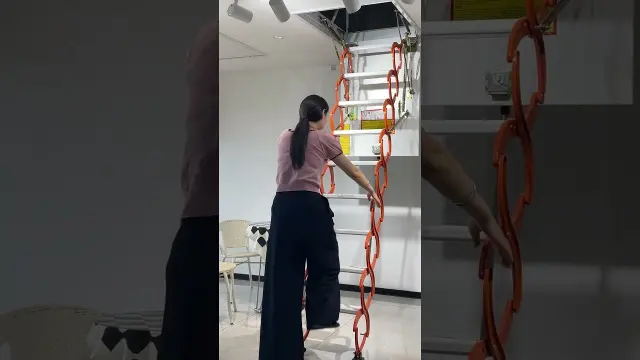
 Retractable attic staircase and loft storage space saver
#Loft Storage
1 ideas
Retractable attic staircase and loft storage space saver
Get new #Loft Storage ideas by email
Every Thursday: the week's best ideas, with the newest from #Loft Storage.
Related tags
Loft Storage: A Practical Guide to Using Your Attic Space
Almost every house with a pitched roof carries an empty volume above the ceiling that nobody really lives in: the loft. Historically that space had a job of its own — it sheltered the rooms below from rain, gave the roof its shape, and let air move freely through the timbers. Only later did people notice how much usable room was sitting there, and begin filling it with the things a household cannot quite throw away. Loft storage is the craft of making that space genuinely usable without pretending it is a room.
Know what is holding you up
Before anything goes up there, understand the structure. Many modern homes have a truss roof: a framework of prefabricated triangular frames whose lower timbers are designed to carry a ceiling, not a floor. Older houses often have a cut roof with heavier joists, but even those were rarely calculated for loads. Never assume the timbers will take the weight of boxes, water tanks or a person. If you plan to store anything substantial, have the joists assessed, and spread loads across several of them rather than concentrating everything in one corner.
Flooring and insulation
Read more
The usual solution is to board part of the loft rather than all of it, leaving the rest accessible for inspection. Boards laid directly on the joists are the simplest approach, but they compress the insulation quilt beneath, which reduces its performance — something you will feel in winter. Raised systems that stand on legs keep the boarding above the insulation depth, preserving both the floor and the thermal layer. Whichever you choose, leave a clear route to the water tank, any chimney breast, and the eaves, where ventilation must keep flowing.
Getting up there
Access matters as much as the floor. A loft hatch with a retractable ladder is fine for occasional use and takes up almost no space when folded away. If you will be up there often, a fixed timber staircase is safer and easier to carry things up, though it needs room to land. Whichever you fit, ensure the hatch is insulated and draught-sealed, and that there is a light inside — a torch balanced on a joist is how accidents happen.
Living with the space
Treat the loft as a store, not a dumping ground. Group things by category, label boxes on the side you can see, and keep heavier items close to the hatch so you never carry them far across the boards. Store in rigid containers rather than cardboard, which softens in damp air, and keep everything slightly off the floor on battens. Nothing should touch the roof felt or block the eaves, and anything flammable should stay well away from a flue. Finally, check twice a year for damp, condensation or mice — the loft is the first place a house tells you something is wrong.
#Loft Storage: frequently asked questions
How do I know whether my loft can safely take the weight of stored boxes?
It depends entirely on the roof structure above your ceiling. Many modern homes use prefabricated truss frames whose lower timbers were designed to hold a ceiling rather than a floor, while older cut roofs have heavier joists that still were rarely calculated for storage loads. Have the joists assessed before putting anything substantial up there, and spread weight across several timbers instead of piling it into one corner.
Do I have to board the entire loft to use it for storage?
No — boarding part of it is usually the better approach. Leaving sections uncovered keeps the space inspectable and preserves a clear route to the water tank, any chimney breast and the eaves, where air needs to keep moving. The boarded area does the work; the rest stays open.
Should I lay boards straight onto the joists or use a raised system?
Boards laid directly on the joists are the simplest option, but they squash the insulation beneath and you will notice the loss of warmth in cold weather. Raised systems stand on legs so the decking sits above the insulation, keeping both the walking surface and the thermal layer intact. Choose based on how much insulation depth you have and how often you will use the space.
What kind of access should I fit to the loft?
For occasional visits, a hatch with a retractable ladder is compact and perfectly adequate. If you expect to be up there regularly or to carry bulky things in and out, a fixed timber staircase is safer and easier, provided you have the room for it to land. Either way, insulate and draught-seal the hatch and put a proper light inside.
What is the best way to pack and organise things once the floor is down?
Store in rigid containers rather than cardboard, which softens in damp air, and lift everything slightly off the boards on battens. Group items by category, label the side of each box you can actually see, and keep the heavy ones near the hatch so you never lug them across the joists. Treat the loft as organised storage rather than a place to dump things you cannot decide about.
Which mistakes do people most often make with loft storage?
The common ones are assuming the timbers will hold anything, blocking the eaves or pressing items against the roof felt, and letting the space fill up unsorted. Anything flammable should be kept well away from a flue, and someone should check periodically for damp, condensation or mice, since the loft is usually the first place a house signals that something is wrong.
Videos come from YouTube and posts from Instagram; titles and summaries are our own. All rights belong to their creators.