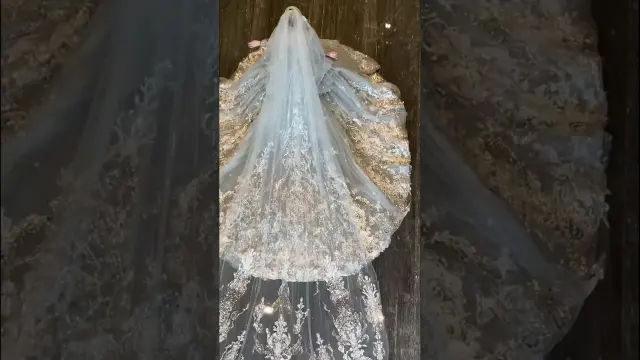
 Royal Wedding Dresses with Long Trains and Intricate Embroidery
#Long Train Gown
1 ideas
Royal Wedding Dresses with Long Trains and Intricate Embroidery
Get new #Long Train Gown ideas by email
Every Thursday: the week's best ideas, with the newest from #Long Train Gown.
Related tags
Long Train Gown: A Guide to Trailing Bridal and Formal Dresses
A long train gown is a dress with fabric that extends behind the hem and trails along the floor. The train can be a few centimetres or several metres long, and it is one of the oldest ways a garment can signal ceremony: the more fabric that follows you, the more the dress announces that this is not an ordinary day. It appears most often in wedding dresses, but also in evening gowns, court dress, christening and graduation robes, and theatrical costume.
Where the train comes from
Trailing garments go back to royal and ecclesiastical dress, where long robes marked rank and ritual. In European courts, the length of a train was once tied to status, and formal portraits from several centuries of court painting show how deliberately it was displayed. The white wedding train as it is understood today grew out of nineteenth-century bridal fashion and never really left. Its appeal is simple: a train changes how a person moves through a room, and how the room looks at them.
The main styles
Read more
- Sweep train: just brushes the floor, the shortest and most practical.
- Court train: extends a short distance beyond the hem, a classic bridal choice.
- Chapel train: roughly a metre and a half, enough to be noticed without dominating.
- Cathedral train: several metres of fabric, dramatic and heavy, usually for a large ceremony space.
- Royal or extended train: the longest form, often carried or arranged by attendants.
Trains also differ in construction. A built-in train is cut as part of the skirt; a detachable train fastens at the waist and can be removed for the reception; a train can be a separate overskirt layered over a simpler dress. Shapes vary too — a fishtail flare, a wide circular sweep or a narrow panel — and each behaves differently when you walk.
What to know before choosing one
Think about the venue first. A long train needs floor space, a smooth aisle and somewhere to move freely; gravel, grass and tight staircases are unkind to trailing fabric. Consider the weight: cathedral-length fabric pulls at the waist and shoulders over hours, so try walking, turning and sitting in the dress rather than only standing in front of a mirror.
Plan how the train will be managed. Many long trains have a wrist loop or a bustle — a hidden fastening that lifts the train for dancing — and it is worth deciding early whether you want one. Practise the walk with the shoes you will actually wear, and if the train is very long, ask someone to help arrange it.
For care, carry the train rather than dragging it over rough ground, and have the dress cleaned soon after wearing, since hems pick up everything they cross. Stored properly, a trained gown keeps its shape for decades.
#Long Train Gown: frequently asked questions
How do I know whether a long train gown is right for my wedding?
Start with the space you will actually be walking through, since a train needs a smooth floor, a clear aisle and room to turn. Then think about how much fabric you want to carry through a long day — a short sweep feels effortless, while a cathedral or royal length makes a statement and usually needs help to arrange. Trying the dress on with the shoes you plan to wear and walking, sitting and turning in it will tell you more than any mirror.
What is the difference between a built-in train and a detachable one?
A built-in train is cut as part of the skirt, so it moves as one piece with the dress and cannot be taken off. A detachable train fastens at the waist and can be removed when the formal part of the day ends, which makes it easier to dance and move around later. A third option is a separate overskirt worn over a simpler dress, giving you the look for the ceremony and a lighter gown afterwards.
How do I choose the right train length?
Match the length to the venue and to how much attention you want the dress to draw as you walk in. A sweep or court length brushes the floor and stays practical for smaller spaces, while chapel, cathedral and royal lengths need generous floor area and look best down a long aisle. Weight matters as much as length, so judge each option by how it feels to move in rather than by how it photographs standing still.
How do I walk and dance in a long train gown without trouble?
Practise the walk beforehand in your real shoes, and ask someone to help arrange the fabric behind you at the start of the aisle. A wrist loop keeps the train off the floor while you move, and a bustle — a hidden fastening that lifts the fabric — lets you dance without dragging it. Decide early whether you want either of these, because they are much easier to plan than to add at the last minute.
How should I care for a gown with a long train?
Lift and carry the train over rough ground, gravel or stairs rather than letting it drag, since the hem picks up everything it crosses. Have the dress cleaned soon after wearing, before any marks settle into the fabric, and store it properly so it keeps its shape. Handled this way, a trained gown can stay in good condition for a very long time.
What are the most common mistakes when buying a long train gown?
The biggest one is choosing the train before considering the venue — grass, gravel and tight staircases are hard on trailing fabric. Another is judging the dress only while standing still, when weight at the waist and shoulders only shows up after hours of walking and sitting. Finally, many people forget to plan how the train will be managed, so sort out the loop, bustle or helper well in advance.
Videos come from YouTube and posts from Instagram; titles and summaries are our own. All rights belong to their creators.