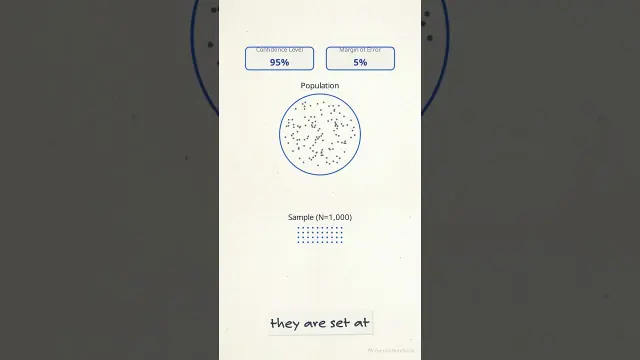
 Why 95% Became the Standard Confidence Level
#Margin of Error
2 ideas
Why 95% Became the Standard Confidence Level
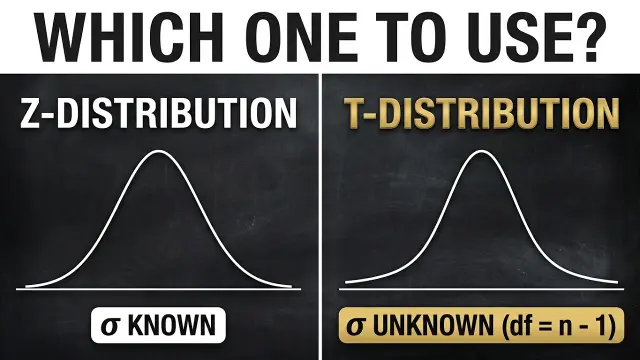 Confidence Intervals at 90%, 95% and 99% Levels
Get new #Margin of Error ideas by email
Every Thursday: the week's best ideas, with the newest from #Margin of Error.
Related tags
Margin of Error: What It Means and How to Read It
Whenever you read that a poll found one candidate ahead by four points, or that a certain share of people hold a particular view, there is usually a quiet qualifier attached: plus or minus a few points. That qualifier is the margin of error, and understanding it changes how you read almost any number drawn from a sample.
What it actually measures
A margin of error is an estimate of how far a sample result could plausibly sit from the figure you would have got by asking everyone in the population. Nobody surveys an entire country, so researchers question a smaller group and treat the answer as a stand-in for the whole. Sampling always leaves room for luck: a different group of people, chosen the same way, would have produced a slightly different number.
The margin of error puts a boundary around that wobble. If a survey reports 52 percent support with a margin of error of three points, the honest reading is that the true figure in the wider population probably falls somewhere between 49 and 55 percent. This is why the idea is so often paired with confidence levels: the margin describes the width of an interval, and the confidence level describes how often intervals built this way capture the real value.
Read more
Where the number comes from
Two things drive the margin: how many people were asked, and how confident the researchers want to be. Larger samples shrink the margin, but slowly. Quadrupling the sample only halves the margin, which is why surveys rarely grow beyond a certain size. Choosing a stricter confidence level, by contrast, widens the margin, because a wider net catches the truth more reliably.
Sample size is not the only thing that matters, though. How the sample was drawn matters at least as much. A huge sample gathered in a way that misses whole groups of people can carry a small stated margin and still be badly wrong.
What it does not cover
The margin of error only accounts for random variation from sampling. It says nothing about whether the questions were worded fairly, whether some people refused to take part, or whether those who answered differ systematically from those who did not. These sources of error can be larger than the stated margin, and they do not appear in the plus-or-minus figure.
Reading it well
- Treat small differences between two results as noise. If one figure leads another by a point or two and the margin is three, the race is effectively level.
- Look for the sample size and the population it represents. A margin without that context is hard to judge.
- Remember that a margin of error is a range, not a guarantee. Occasionally the truth falls outside it.
- Read the wording of the question alongside the number. A precise figure attached to a vague question is not precise at all.
The margin of error is not a flaw in a survey; it is the survey being honest about what a sample can and cannot tell you. Once you start noticing it, numbers in the news stop looking like verdicts and start looking like what they are: careful approximations, with limits drawn around them.
#Margin of Error: frequently asked questions
What does the margin of error actually tell me about a survey result?
It describes how far a result drawn from a sample could plausibly sit from the figure you would have found by asking the entire population. Because sampling carries an element of luck, a different group questioned the same way would have landed somewhere slightly different. The margin simply draws a boundary around that natural wobble.
What makes a margin of error wider or narrower?
Two things: how many people were questioned and how confident the researchers want to be. Adding respondents tightens the margin but with diminishing returns, while aiming for greater confidence loosens it, since a broader range catches the true value more often. The pair always move together, so one figure is meaningless without the other.
Is a survey with a small margin of error automatically more reliable?
No. A very large sample collected in a way that overlooks entire groups of people can show a tight margin and still be badly off. How the respondents were selected matters at least as much as how many of them there were, so judge both together.
How do I read it when two results are close together?
Small gaps are usually indistinguishable from noise, so a narrow lead within the stated range should be read as roughly level rather than as a winner. Always check what population the sample represents before drawing a conclusion, because a margin without that context tells you very little.
What does the margin of error leave out?
It covers only random variation from sampling. It says nothing about biased question wording, people who declined to participate, or differences between those who answered and those who did not, and those problems can distort a result more than the stated range does. A precise-looking figure attached to a vague or leading question is not precise at all.
How is the margin of error connected to a confidence level?
They describe two different parts of the same idea: the margin gives the width of an interval, while the confidence level says how often intervals built this way manage to contain the real value. Together they form the range you should picture when you read a headline number, and it is always a range, never a guarantee.
Videos come from YouTube and posts from Instagram; titles and summaries are our own. All rights belong to their creators.