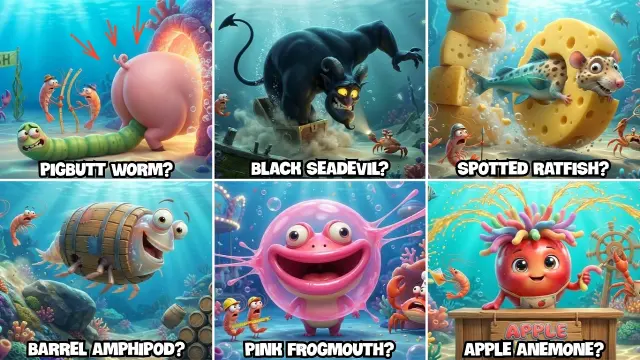
 20 Deep-Sea Creatures with Surprisingly Unusual Names
#Marine Animals
1 ideas
20 Deep-Sea Creatures with Surprisingly Unusual Names
Get new #Marine Animals ideas by email
Every Thursday: the week's best ideas, with the newest from #Marine Animals.
Related tags
Marine Animals: A Guide to Sea Life
Marine animals are the animals that live in the sea, from shallow coastal waters to the deepest parts of the ocean. They include familiar creatures such as fish, dolphins, turtles, seals, sharks, octopuses, and whales, as well as countless smaller animals that are less easy to see. Some spend their whole lives in saltwater, while others move between fresh and salt water or come ashore for part of their life cycle.
What counts as a marine animal
The term covers a very wide range of life. Some marine animals breathe air, like whales and sea turtles. Others breathe through gills, like most fish. Many are invertebrates, which means they do not have backbones. This group includes jellyfish, crabs, lobsters, starfish, sea urchins, and corals. Marine animals can live near the surface, around reefs, in kelp forests, on sandy seabeds, or far below in dark deep-sea habitats.
Main types and habitats
Read more
Marine life is often grouped by where it lives and how it moves:
- Pelagic animals live in open water, away from the seafloor. Many fish, squid, and larger animals like dolphins belong here.
- Benthic animals live on or near the ocean floor. Crabs, sea stars, and many shellfish are examples.
- Reef animals live among coral reefs, where shelter and food are abundant.
- Deep-sea animals live in cold, dark, high-pressure waters and often have special adaptations for finding food and surviving with little light.
These environments shape how animals look and behave. Some are streamlined for swimming, some are camouflaged, and some are built for clinging to rocks or hiding in sand.
How marine animals live
Marine animals have many ways of finding food and staying safe. Some are predators that hunt fish or smaller animals. Others filter tiny particles from the water, graze on algae, or scavenge dead matter. Many use camouflage, spines, shells, venom, speed, or group behavior to protect themselves. Migration is also common, especially among large fish, sea turtles, and whales, which travel long distances to feed or reproduce.
What to know if you are new to the subject
If you are just getting to know marine animals, start by thinking about the habitat as well as the species. A fish living on a reef is very different from a fish in the open ocean. It also helps to remember that not all marine animals are fish. Mammals, reptiles, birds, and many invertebrates can all be part of marine life.
A few simple tips can help you understand them better:
- Learn the basic groups first: fish, mammals, reptiles, and invertebrates.
- Look at where an animal lives: surface, reef, seafloor, or deep sea.
- Notice how it moves, feeds, and protects itself.
- Be respectful of marine habitats, which are often delicate and easily disturbed.
Marine animals are part of a complex and connected world. Once you begin to notice their differences, the ocean becomes much richer and easier to understand.
Videos come from YouTube and posts from Instagram; titles and summaries are our own. All rights belong to their creators.