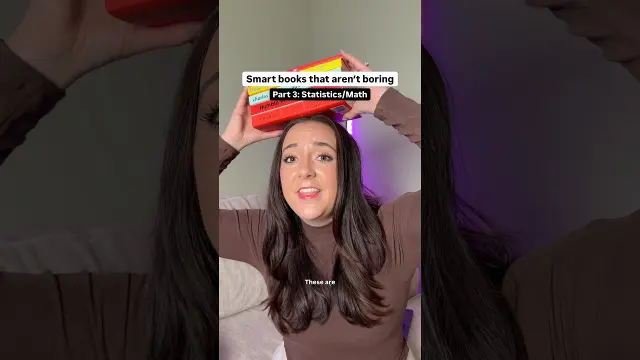
 Part Three of a Top Five Statistics and Maths Book Picks
#Math Books
1 ideas
Part Three of a Top Five Statistics and Maths Book Picks
Get new #Math Books ideas by email
Every Thursday: the week's best ideas, with the newest from #Math Books.
Related tags
A Guide to Math Books: Finding the Right One to Read
A math book is any book whose subject is mathematics — its ideas, its methods, its history, or its teaching. The category is far broader than the school textbook most people picture. It runs from slim, conversational volumes written for curious adults to dense reference works used in university courses, and from collections of puzzles to biographies of the people who shaped the field. Because the range is so wide, the single most useful thing a reader can do is work out which kind of book they are actually holding.
The main kinds
Popular math books explain ideas in plain language with few or no formulas. They aim at understanding and wonder rather than technique, and they suit readers who want to know what mathematics is about without doing exercises.
Textbooks are structured for study. They move in sequence, build on earlier chapters, and usually include worked examples and problem sets. They assume you will work, not just read.
Read more
Problem books and puzzle collections offer questions with solutions, often organised by difficulty or theme. They are the closest thing to a gym for the mind: the value comes from attempting the problems before looking anything up.
History and biography titles follow the development of ideas and the lives of the people behind them. They are a good entry point for readers who like narrative and context.
Reference works — dictionaries of terms, formula handbooks, tables — are for looking things up rather than reading through.
What beginners should know
Difficulty in mathematics is cumulative, not just a matter of style. A book that seems friendly can still assume algebra or calculus you have not met. Before committing, read the first chapter and check whether you can follow the notation; if the symbols alone are unfamiliar, the book is probably pitched above where you are right now, and that is a reason to start elsewhere, not a judgement on you.
A second point: reading mathematics is slower than reading prose. Working through a page often means re-deriving a step with pencil in hand. Expect to spend an hour on a few pages and to go back. Skimming a math book the way you skim a novel rarely leaves much behind.
Practical tips
- Read the preface and the table of contents first; authors usually state what background they assume.
- Keep paper and pencil nearby and redo at least some of the steps yourself.
- Prefer a book with answers or hints if you are studying alone, so you can check your reasoning.
- Allow yourself to skip a hard section and return to it; momentum matters more than completeness.
- Use two books on the same topic if one feels opaque — a second explanation often unlocks the first.
Choose for the pleasure of understanding, not for the prestige of finishing. A book you actually work through, however modest, will teach you more than an impressive one you abandon.
#Math Books: frequently asked questions
How do I get started with math books if I haven't studied math in years?
Start with a popular math book that explains ideas in plain language with little or no notation, since those are written for curious adults rather than students. Read the opening pages before committing and check whether the symbols feel familiar; if they don't, the book is pitched above where you are and a gentler one will serve you better. Going back a level is not a step down, it is how most people get back in.
Which kind of math book should I choose?
Decide first what you want from it: understanding and wonder, structured practice, problem-solving, or story and context. Popular books suit readers who want the big picture, textbooks suit those who plan to work through exercises in order, puzzle collections suit people who learn by attempting, and history or biography titles suit readers who need narrative to stay engaged. Reference works are for looking things up, not for reading cover to cover.
What do I actually need to work through a math book?
Paper, pencil and the willingness to be slow are the real requirements — reading mathematics means re-deriving steps yourself rather than letting your eyes pass over them. Choose a book that includes answers or hints if you are studying alone, so you can check your own reasoning instead of guessing. Beyond that, nothing special is needed.
How do I keep momentum when a section gets too hard?
Give yourself permission to skip a difficult passage and come back to it later, because finishing the book matters less than not stalling. If an explanation stays opaque, pick up another book on the same topic — a different author's phrasing often unlocks the one that wasn't landing. Reading a preface and contents page first also tells you what background the author assumes, which saves a lot of wasted effort.
What are common mistakes people make with math books?
The most common is reading a math book the way you read a novel, skimming pages without working any of the steps, which leaves almost nothing behind. Another is choosing for prestige rather than fit, then abandoning an impressive book that was never at the right level. Buying several titles at once instead of working through one properly is a close third.
Any ideas for choosing a math book as a gift?
Match the book to what the person already enjoys rather than to how good they are at math: a puzzle lover wants problems with solutions, a history reader wants narrative and context, and a curious general reader wants ideas explained without formulas. A slim, conversational title is usually the safer gift than a large reference volume. Skim the first chapter yourself first to check the tone feels welcoming.
Videos come from YouTube and posts from Instagram; titles and summaries are our own. All rights belong to their creators.