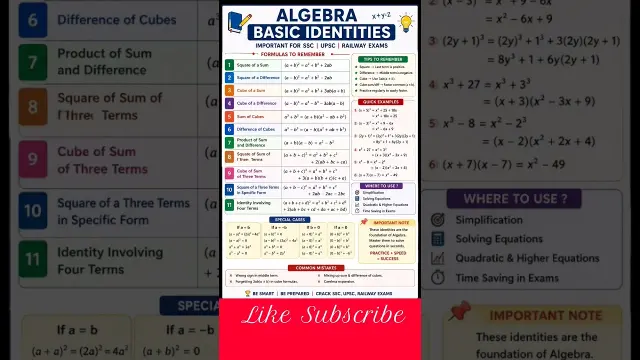
 Basic algebra identities for competitive exam revision
#Math Short Notes
1 ideas
Basic algebra identities for competitive exam revision
Get new #Math Short Notes ideas by email
Every Thursday: the week's best ideas, with the newest from #Math Short Notes.
Related tags
Math Short Notes: How to Build Study Notes That Work
Math short notes are condensed written summaries of mathematical ideas: definitions, formulas, worked patterns and the steps of a method, compressed onto a page or two so they can be read quickly and repeatedly. They are a study tool rather than a textbook. The aim is not to record everything, but to keep only what you need to recall in order to think and calculate correctly.
Where the habit comes from
Summarising is an old study practice, and mathematics has always lent itself to it. Formula tables, lists of identities and step-by-step method sheets appear in classrooms, textbooks and exam preparation material because math has a compact structure: a large number of problems often rest on a small set of results. Writing those results down in your own hand, in your own arrangement, is a way of testing whether you have actually understood them.
What belongs in a short note
Read more
- Definitions stated precisely, in the wording you would use in an answer.
- Key formulas and identities, with the conditions under which they hold.
- The skeleton of a method: the sequence of steps, and the usual first move when a problem looks unfamiliar.
- One small worked example per idea, chosen to show the typical case rather than the hardest one.
- Common mistakes and the reasons behind them, such as a sign error, a forgotten condition, or a misapplied rule.
Styles of note-taking
Some people keep a single running sheet per subject, adding to it as a course progresses. Others build topic cards, one card per idea, which makes it easy to shuffle and revisit weak areas. A third approach is a "map" note, where related results are drawn together so that connections between them are visible. None of these is inherently better; what matters is that the note stays short enough to actually be reread.
Practical tips
Write the note after you have practised, not before. A summary made while you are still learning tends to copy the textbook; one made afterwards reflects what your own errors taught you. Keep the layout stable so your eye learns where to look. Use symbols and spacing rather than long prose. Date nothing that does not need a date, and revisit the note by covering part of it and reconstructing the rest from memory.
Be careful with shortcuts. A condensed formula is only useful if you can still justify it, and a mnemonic you have forgotten the meaning of will fail you under pressure. Whenever a note feels like a magic trick, expand it until the reasoning fits in a line or two.
Finally, remember that short notes are a support, not a substitute. They work best alongside solving problems, since the act of using a formula is what fixes it in memory. Treat the note as a map you draw yourself: useful precisely because you did the drawing.
#Math Short Notes: frequently asked questions
How do I start making math short notes?
Start by working through problems first, then write down only what you actually needed to recall: definitions, formulas and the steps of the method. Writing after practice keeps the note tied to your own mistakes instead of copying the textbook.
What should a math short note actually contain?
Definitions in precise wording, key formulas with the conditions they require, the skeleton of a method, one typical worked example per idea, and the mistakes you tend to make. Leave out long derivations and anything you can already recall without help.
Which style of note is best — one long sheet, topic cards, or a connections map?
All three work, so choose by how you study: a running sheet suits a course unfolding over time, cards suit revisiting weak areas, and a map suits seeing how results relate. The deciding factor is whether the note stays short enough that you will genuinely reread it.
How do I keep a short note useful over time?
Keep the layout stable so your eye learns where to look, and revisit by covering part of the note and reconstructing the rest from memory. Revise it as your understanding changes rather than leaving the first version frozen.
What are the common mistakes people make with condensed math notes?
The usual ones are summarising before practising, cramming in too much so the note becomes unreadable, and keeping shortcuts you can no longer justify. If a line feels like a magic trick, expand it until the reasoning fits in a line or two.
Are short notes enough on their own for exam preparation?
No — they are a support, not a replacement for solving problems, since using a formula is what fixes it in memory. Treat them as a map you draw yourself, useful precisely because the drawing was your own work.
Videos come from YouTube and posts from Instagram; titles and summaries are our own. All rights belong to their creators.